Retirement · November 14, 2026
When Do I Stop HSA Contributions Before Enrolling in Medicare?
Learn how the six-month retroactive Medicare Part A rule affects HSA eligibility at 65, how to time your final contribution, and how to avoid the 6% penalty.
11 min read · 10 sections

The month an individual stops contributing to a Health Savings Account depends on whether they enroll in Medicare at age 65 or delay enrollment to keep working. Under Internal Revenue Service rules, HSA contribution eligibility ends the month Medicare coverage begins. When someone enrolls during their initial window at age 65, contributions stop right before that coverage month starts.
A different timeline applies when someone delays Medicare past age 65 to remain on an employer health plan. When they eventually apply for Medicare Part A after turning 65, the Centers for Medicare and Medicaid Services backdates Part A coverage by up to 6 months. Because HSA contributions are barred during any month of Medicare coverage, funding the account during that look-back window creates an excess contribution.
Avoiding surprise tax penalties involves halting both personal salary deferrals and employer contributions at least 6 months before applying for Medicare or claiming Social Security benefits. Weighing whether to enroll at 65 or delay involves looking closely at employer size, ongoing HSA matches, retirement timing, and how Social Security benefits interact with hospital insurance.
The Medicare and HSA Clash
Health Savings Accounts offer triple federal tax advantages: contributions reduce taxable income, account growth accumulates without annual federal tax, and withdrawals for qualified medical expenses escape federal income tax. Under rules outlined in IRS Publication 969, however, an individual cannot contribute to an HSA if they are enrolled in any part of Medicare. Eligibility ends the moment Medicare coverage takes effect, even if the person remains employed full time.
Qualifying for HSA contributions also requires enrollment in a High Deductible Health Plan, as defined by HealthCare.gov and IRS guidelines, with no other disqualifying health coverage. Medicare counts as disqualifying coverage under federal tax law. Many workers mistakenly assume they can keep funding an HSA simply because they are still on the job and covered by an employer plan, overlooking that Medicare enrollment overrides workplace plan eligibility.
This conflict catches many near-retirees off guard because Medicare Part A carries no monthly premium for most people who have worked enough quarters under Social Security. Accepting premium-free Part A at age 65 feels harmless as secondary hospital insurance, yet doing so immediately terminates the right to make or receive HSA contributions. Once Part A begins, every dollar added to the HSA becomes an ineligible deposit.
How the 6-Month Retroactive Rule Works
Medicare sets a seven-month Initial Enrollment Period around an individual's birthday, as published by the Centers for Medicare and Medicaid Services. That window opens three months before the month a person turns 65, includes the birthday month itself, and closes three months afterward. Signing up during the early months of that window ensures coverage begins on schedule without any backward reach into earlier calendar months.
Delays beyond the birthday month trigger a different rule. According to Medicare guidelines, if a person signs up for Part A after turning 65, coverage starts retroactively from the date of the application. That look-back period spans 6 months, meaning Part A is treated as active half a year before the application was submitted. For HSA holders, retroactive hospital coverage erases contribution eligibility across those six backdated months.
One important boundary limits how far back that look-back can reach. Federal Medicare rules specify that retroactive Part A coverage cannot start earlier than the month a person turned 65. A worker who applies three months after turning 65, for example, sees Part A backdated only to the birthday month rather than into age 64. Another common misconception is assuming the six-month rule applies to everyone, when it affects only those who delay past age 65.
The 6% Penalty on Excess Contributions
Contributing to an HSA during months when retroactive Medicare Part A is active creates an excess contribution under federal tax rules. According to the IRS Instructions for Form 5329, excess HSA contributions face a 6% excise tax for every year the excess amount remains in the account. That penalty is not a one-time charge; it repeats annually on the remaining excess balance until the surplus is removed or absorbed.
Annual HSA limits are calculated on a month-by-month basis when coverage changes mid-year. For a person whose Medicare Part A coverage starts mid-year, whether directly or through a six-month look-back, only the months prior to Medicare's effective date count toward the annual maximum. Both employee payroll deductions and employer deposits count toward that reduced limit, so an unexpected employer match during a backdated month can push total funding over the allowed threshold.
Correcting an excess deposit involves formal coordination with the HSA custodian before the federal tax return deadline, including extensions, for the year the mistake occurred. Leaving the money untouched triggers the 6% tax year after year, eroding the tax benefit of the account. Checking the exact effective date on the Medicare card once issued helps confirm whether any deposits overlapped with backdated coverage.
- 6%Annual excise tax on excess contributions
- 6 monthsMaximum retroactive Medicare Part A look-back
The tax impact of contributing to an HSA while covered by Medicare.
Timing Your HSA Stop Date
Calculating when to halt contributions depends on how an individual enters Medicare. Under rules administered by the Social Security Administration, anyone age 65 or older who receives Social Security retirement benefits is automatically enrolled in Medicare Part A. Filing for Social Security after age 65 triggers the same 6 months of retroactive Part A coverage automatically, because Part A cannot be declined while receiving monthly Social Security checks.
When delaying Medicare past age 65, the safe stop date is measured backward from the month a person plans to apply for Medicare or Social Security, rather than from the final day of employment. Halting payroll deductions and asking human resources to pause employer HSA deposits at least 6 months prior to the application month aligns the account with the retroactive effective date.
Two primary paths exist for people approaching age 65, and each carries distinct trade-offs depending on personal circumstances, household retirement timelines, and workplace health benefits. Neither option fits every worker, so individuals typically weigh the mechanics, advantages, and constraints of both approaches side by side before setting an enrollment calendar.
- Enroll in Medicare at 65 and stop HSA contributions: Halts HSA funding before the Initial Enrollment Period coverage begins. Pros include avoiding any risk of the six-month retroactive penalty and gaining secondary hospital coverage through Part A. Cons include losing pre-tax HSA contributions and forfeiting employer HSA matches. People often weigh this path when transitioning off an employer plan or working for an employer with fewer than 20 employees.
- Delay Medicare past 65 to keep funding an HSA: Declines all parts of Medicare and delays Social Security while staying on an employer HDHP. Pros include continuing triple-tax-advantaged savings and keeping employer HSA contributions. Cons include tracking the six-month stop date strictly before later enrollment and delaying Social Security income. People often weigh this path when planning to work additional years at an employer with 20 or more employees.
Walking Through the Decision
Take the example of David and Maria, who are both turning 65 this year. David plans to keep working until age 67 at a company with fifty employees. He currently holds a $40,000 HSA balance, contributes $5,000 a year from his own salary, and receives a $2,000 annual contribution from his employer, bringing total annual funding to $7,000. The couple is weighing whether David enrolls in premium-free Part A at 65 or delays enrollment to preserve that $7,000 annual HSA funding.
If David enrolls in Part A at age 65, his Medicare hospital coverage begins promptly as secondary insurance behind his workplace plan. In exchange, IRS rules bar him from adding his $5,000 annual contribution, and he forfeits his employer's $2,000 annual deposit immediately. That route eliminates any chance of a retroactive Part A overlap, leaving his existing $40,000 account intact to invest or spend on qualified healthcare bills.
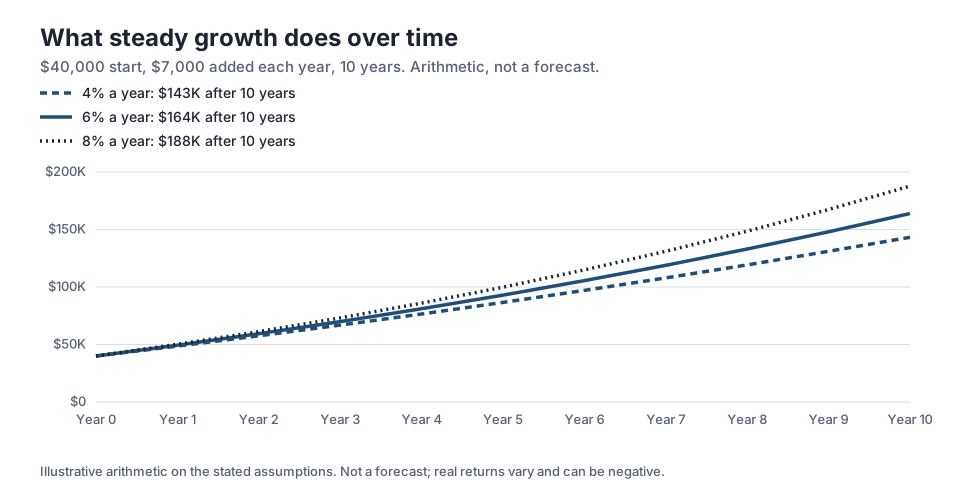
If David instead delays both Medicare and Social Security until he retires at age 67, he can continue adding $7,000 a year while covered by his employer's HDHP. To illustrate how continued funding compounds over time using arithmetic only and not a forecast, starting with $40,000 and adding $7,000 annually over 10 years produces $143,253 at an assumed 4% annual growth rate, $163,899 at 6%, or $187,763 at 8%. Although David plans to stop contributions at 67, ongoing compounding can still meaningfully expand the account over a decade.
Choosing to delay Medicare creates a strict administrative deadline in David's final year at work. When he submits his Medicare application at age 67, Part A coverage is backdated by half a year. Halting both his $5,000 salary deferrals and his employer's $2,000 contributions half a year prior to his application month avoids an overlap with retroactive coverage. The trade-offs include balancing extra years of HSA tax savings against secondary Part A protection, and key questions to ask a licensed advisor include whether the employer plan qualifies as creditable coverage to avoid Part B penalties and how delaying Social Security interacts with household retirement income.
What Happens to Your Existing HSA Balance
A common misunderstanding leads some retirees to believe they have to empty or close an HSA once Medicare begins. In reality, Medicare enrollment only ends the ability to put new money into the account. Every dollar already inside the HSA remains available indefinitely, continues to experience potential market growth or interest when invested, and retains its exemption from federal income tax when spent on qualified medical care.
Turning 65 expands how existing HSA balances can be used. According to IRS Publication 969, individuals age 65 or older can take HSA distributions free of federal income tax to cover Medicare premiums, including Part B, Part D, and Medicare Advantage plan premiums. Retirees can also use the balance for qualified out-of-pocket expenses such as dental care, vision exams, hearing aids, and prescription cost-sharing that traditional Medicare does not cover in full.
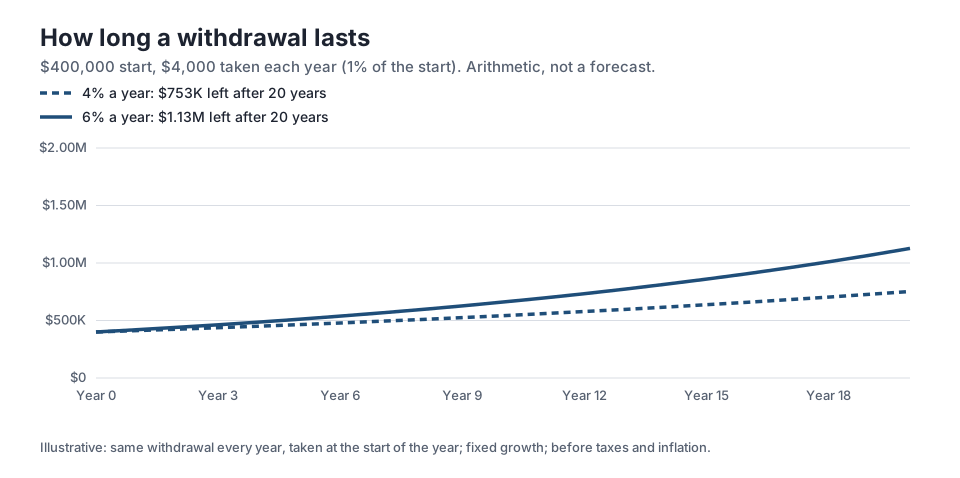
Keeping an HSA invested during retirement allows the balance to support healthcare costs over decades. As an arithmetic illustration and not a forecast, starting with a larger accumulated balance of $400,000 and withdrawing $4,000 each year, equal to 1% of the starting balance, covers every annual withdrawal and leaves $752,572 after 20 years at 4% assumed annual growth, or $1,126,883 after 20 years at 6% assumed annual growth. On a smaller balance like David's $40,000, drawing $4,000 annually represents a much higher withdrawal share and depletes the account sooner unless paired with other savings.
- Medicare Part B, Part D, and Part C (Medicare Advantage) monthly premiums once age 65 is reached
- Qualified out-of-pocket costs not covered by Medicare, including dental, vision, and hearing services
- Long-term care insurance premiums up to annual IRS age-based limits
Avoiding Part B Late Enrollment Penalties
Delaying Medicare past age 65 without facing permanent Part B late enrollment penalties depends on having creditable coverage through active employment. Under Medicare rules for working past 65, employer size determines which insurer serves as the primary coverage source. If an employer has fewer than 20 employees, Medicare generally becomes the primary insurance at age 65, while the workplace plan drops to secondary status.
That 20-employee threshold creates a critical distinction for small-company workers. When a workplace plan becomes secondary at 65, it may stop covering medical claims up to what Medicare would have covered, leaving large uncovered hospital or doctor bills if the employee declined Part B. Furthermore, working for an employer with fewer than 20 employees typically prevents delaying Part B without incurring lifetime late enrollment penalties, which is why workers at smaller firms often weigh enrolling at 65.
At employers with 20 or more workers, the group health plan remains primary, allowing an employee to delay Medicare Part A and Part B without penalty as long as coverage stems from current employment rather than COBRA or retiree insurance. Before delaying, verifying in writing with the benefits administrator that the employer's prescription drug plan is creditable under Medicare rules helps avoid separate Part D late penalties later.
Catch-Up Contributions Before You Stop
Near-retirees approaching their HSA cutoff date can use an age-based catch-up provision to maximize savings before Medicare begins. Under IRS Publication 969, individuals who are age 55 or older by the end of the tax year receive an increased annual HSA contribution limit of $1,000 above the standard self-only or family cap. That extra $1,000 allowance applies regardless of whether the worker has self-only or family HDHP coverage.
During the final calendar year of HSA eligibility, both the regular contribution limit and the $1,000 catch-up allowance are pro-rated according to the number of months the person remained eligible prior to Medicare's effective date. For instance, someone whose Part A coverage becomes effective halfway through the year, either by enrolling at 65 or through the six-month look-back, receives half of the annual limit plus half of the $1,000 catch-up amount for that year.
Married couples have an additional structural detail to keep in mind. Catch-up contributions are strictly individual, meaning a spouse age 55 or older deposits their $1,000 catch-up amount into an HSA titled in their own name rather than into the other spouse's account. Reviewing individual account ownership and pro-rated annual caps well ahead of the six-month stop window helps couples capture their full legal allowance without triggering excess contribution taxes.
- If you are under age 55You are subject to the standard annual contribution limit
- If you are age 55 or olderYou can add a $1,000 catch-up contribution to your limit
How your age affects your maximum HSA contribution limit before Medicare begins.
Key takeaways
- Employer headcount rules for the 20-employee Medicare secondary coverage threshold can include part-time and seasonal workers depending on how consecutive workweeks are tracked by human resources.
- Payroll systems sometimes continue automated employer HSA seed contributions even after an employee sets personal salary deferrals to zero, requiring separate administrative adjustments.
- Certain workplace benefits, such as a general-purpose health reimbursement arrangement or specific wellness incentive accounts, can disqualify HSA contributions independently of Medicare status.
- IRS rules place no time limit on reimbursing past out-of-pocket medical expenses from an HSA, provided the expenses occurred after the account was established and receipts are retained.
- Foregoing monthly Social Security checks solely to extend HSA funding carries an opportunity cost that individuals often weigh against total household retirement cash flow.
Sources
- IRS Publication 969 (https://www.irs.gov/publications/p969)
- IRS Instructions for Form 5329 (https://www.irs.gov/instructions/i5329)
- Medicare.gov: When can I sign up for Medicare? (https://www.medicare.gov/basics/get-started-with-medicare/sign-up/when-can-i-sign-up-for-medicare)
- SSA.gov: Sign up for Medicare (https://www.ssa.gov/medicare/sign-up)
- HealthCare.gov: Health Savings Account (HSA) (https://www.healthcare.gov/glossary/health-savings-account-hsa/)
- Medicare.gov: Working past 65 (https://www.medicare.gov/basics/get-started-with-medicare/medicare-basics/working-past-65)
11Questions
Frequently asked questions
Can I use my HSA to cover Medicare Supplement (Medigap) premiums?
No. While IRS Publication 969 permits tax-exempt HSA withdrawals for Medicare Part A, Part B, Part C, and Part D premiums once you reach age 65, Medigap policies are excluded from qualified medical expenses. Using HSA funds for Medigap premiums causes the withdrawal to be included in taxable income, though the extra early-withdrawal tax penalty does not apply at age 65 or older.
What happens if my spouse is on Medicare but I am not?
Medicare enrollment applies only to the individual, not the household. If your spouse enrolls in Medicare while you remain covered by an eligible family HDHP, you can still contribute up to the full family HSA limit into an account in your own name. Your Medicare-enrolled spouse simply cannot deposit funds or catch-up amounts into an HSA of their own.
How do I fix an excess HSA contribution if I already made one?
You can avoid the recurring 6% excise tax by contacting your HSA custodian to withdraw the excess deposit along with any net investment earnings attributed to that surplus before your federal tax filing deadline, including extensions, for that tax year. The earnings are reported as taxable income for the year of withdrawal, and the custodian issues tax reporting showing a corrective distribution.
Does enrolling in Medicare Part B only also disqualify me from HSA contributions?
Yes. IRS rules disqualify HSA contributions for any month an individual is enrolled in any part of Medicare, whether Part A alone, Part B alone, or a Medicare Advantage plan. Even if someone were to decline Part A and hold only Part B, active Part B coverage eliminates HSA contribution eligibility starting with the effective month of coverage.
Do I have to spend down my HSA balance by a certain age?
No. Unlike traditional employer retirement plans or traditional individual retirement accounts, HSAs carry no required minimum distributions at any age. Remaining funds stay invested indefinitely, pass to a surviving spouse as their own HSA, and after age 65 can even be withdrawn for non-medical expenses by reporting them as ordinary income without any extra penalty.
Can I still contribute to an FSA if I enroll in Medicare?
Yes, if your employer offers a healthcare Flexible Spending Account while you remain actively employed. FSAs do not share the HSA rule barring Medicare enrollees from contributing. However, FSAs generally follow employer plan limits and use-it-or-lose-it rules, with only modest annual carryover permitted under IRS guidelines, and access usually ends when employment stops.
12Keep reading
Related guides
 Retirement
In What Order Should I Withdraw From My Retirement Accounts?
Learn how blending withdrawals across taxable, tax-deferred, and Roth accounts can manage annual taxes, RMDs, and Social Security timing in retirement. Retirement
Should I Roll My Old 401(k) to an IRA When I Change Jobs?
Compare keeping an old 401(k), rolling to a new employer plan, or moving to an IRA, including backdoor Roth pro-rata rules and institutional fee differences. Retirement
How Do Qualified Charitable Distributions From an IRA Work?
Learn how qualified charitable distributions from an IRA work, 2026 IRS limits, RMD rules, and how lowering AGI compares with standard or itemized deductions.
13Next step
Take the next step
If you want to talk this through, an advisor at the firm can help.
14Next step
Talk it through with the firm
When you would like to talk something through, book a free call or send a message.

You will speak with Tayeb Ayat, the firm’s founder. (888) 336-8586 · info@fenul.com