Retirement · November 14, 2026
In What Order Should I Withdraw From My Retirement Accounts?
Learn how blending withdrawals across taxable, tax-deferred, and Roth accounts can manage annual taxes, RMDs, and Social Security timing in retirement.
14 min read · 10 sections

Deciding the order of retirement withdrawals means choosing how much annual spending comes from taxable brokerage accounts, tax-deferred retirement accounts, and Roth accounts each year. The conventional rule of thumb drains taxable accounts before touching tax-deferred balances and saves Roth accounts for last. While simple to follow, that rigid sequence can leave low federal income tax brackets unused in early retirement and create steep tax bills later when mandatory distributions begin.
An alternative approach blends withdrawals across multiple account types within the same calendar year. By drawing enough from a traditional IRA to occupy the standard deduction and lower ordinary income brackets, then supplementing remaining spending from taxable brokerage assets or Roth balances, retirees can smooth taxable income over decades. The approach a household selects depends on account sizes, filing status, expected Social Security benefits, and whether simplicity or lifetime tax management matters more.
No single sequence fits every household. A withdrawal plan changes as tax rules shift, portfolio values fluctuate, and health or family circumstances evolve. Understanding how the IRS taxes each account type, how deductions and capital gains thresholds interact, and how claiming Social Security alters cash flow helps retirees evaluate the trade-offs alongside a qualified tax or financial professional before settling on an annual distribution plan.
In What Order Should I Withdraw From My Retirement Accounts?
For decades, standard retirement guidance suggested emptying accounts in a strict line: spend down taxable brokerage balances initially, move to tax-deferred traditional IRAs or workplace plans only after taxable cash runs out, and leave Roth accounts untouched until the end. The logic rested on deferring ordinary income taxes as long as possible so tax-advantaged accounts could compound unhindered. Yet assuming this sequential order always minimizes lifetime taxes is a common oversight for households with substantial tax-deferred savings.
Blending withdrawals challenges that strict sequence by treating tax brackets as annual capacity that expires each December. If a married couple spends solely from a taxable brokerage account in their sixties, they may report very little ordinary income and waste their standard deduction and lower tax brackets. Meanwhile, their traditional IRA continues growing unchecked until mandatory withdrawals begin in their seventies, potentially forcing large taxable distributions at much higher marginal rates and triggering Medicare premium surcharges.
Retirees generally weigh three distinct withdrawal frameworks, each carrying clear operational and tax trade-offs. Under the sequential method, spending taxable money before tax-deferred accounts requires minimal annual math and delays income taxes, though it risks future bracket spikes. Under proportional withdrawals, taking fixed shares from every account type each year spreads tax liability evenly, yet ignores bracket thresholds. Under bracket-filling, drawing from multiple buckets to target specific tax thresholds can reduce lifetime taxes, at the cost of ongoing annual calculations.
Evaluating these three methods depends on how a household balances administrative effort against tax flexibility. Households with modest pre-tax balances often weigh the sequential approach because future mandatory distributions are unlikely to push them into higher brackets. Those seeking steady, automated cash flow sometimes weigh proportional distributions. Households holding large balances across all three buckets frequently weigh bracket-filling to moderate income swings, consulting a tax professional each autumn to calibrate exact dollar targets.
- The Sequential Method: Depletes taxable accounts, then tax-deferred accounts, and finally Roth accounts; pros include simple execution and maximum tax deferral, while cons include wasted low brackets early and potential tax spikes at age 73; people weigh it when tax-deferred balances are modest enough to avoid higher brackets later.
- Proportional Withdrawals: Draws from taxable, tax-deferred, and Roth accounts according to each account's share of total savings; pros include automated balance and smoothed annual taxes, while cons include missing specific bracket opportunities and needing periodic ratio updates; people weigh it when they want steady tax smoothing without annual projections.
- Bracket-Filling (Blending): Pulls tax-deferred funds up to a targeted low tax bracket and covers remaining spending from taxable or Roth accounts; pros include utilizing the standard deduction and limiting Medicare surcharges, while cons include complex annual projections and reliance on shifting tax rules; people weigh it when substantial savings sit across multiple tax buckets.
| Sequential Strategy | Blended Strategy | |
|---|---|---|
| Withdrawal order | Taxable, then tax-deferred, then Roth | Mix of different account types each year |
| Tax bracket usage | May waste lower brackets in early years | Aims to utilize lower brackets annually |
| RMD tax risk | Higher risk of tax spikes later in retirement | May help reduce future mandatory withdrawal taxes |
A comparison of the traditional sequential withdrawal method and a blended approach. It highlights how each strategy utilizes annual tax brackets.
Understanding Your Account Types and Their Tax Rules
Every withdrawal strategy begins with the distinct rules set by the IRS for each account category. Most retirees hold assets across three main buckets: taxable brokerage accounts funded with after-tax dollars, tax-deferred accounts such as traditional IRAs and employer retirement plans, and Roth accounts funded with after-tax contributions. Because each bucket generates a different type of taxable event—or none at all—when money leaves the account, combining them changes a household's effective tax rate.
In a taxable brokerage account, dividends and interest are taxed in the year received, while selling investments triggers capital gains or losses based on the difference between the sale price and cost basis. According to the IRS, long-term capital gains tax rates apply to assets held for more than one year. Short-term gains on assets held for one year or less are taxed as ordinary income, making holding periods a central consideration when raising cash from a brokerage account.
Tax-deferred accounts operate under a different timing rule established by the IRS. Amounts in a traditional IRA, including earnings and gains, are generally not taxed until distributed. When a retiree withdraws dollars from a traditional IRA or traditional workplace plan, the entire pre-tax distribution is counted as ordinary income on that year's return. While deferring tax during working years can lower taxes when salaries are high, every dollar eventually withdrawn carries ordinary income tax liability.
Roth IRAs reverse the timing of the tax deduction. Per IRS rules, contributions made to a Roth IRA cannot be deducted on a tax return, so money enters the account after income tax has already been settled. In exchange, qualified distributions from a Roth IRA are completely exempt from federal income tax if holding-period and age requirements are met. Drawing from a Roth account during retirement provides cash flow without adding a single dollar to adjusted gross income.
The Role of Standard Deductions and Marginal Tax Brackets
Federal income taxes apply progressively across marginal brackets rather than at one flat rate across all income. Before any income reaches even the lowest marginal bracket, the standard deduction shields a baseline amount of ordinary income from federal tax altogether. Under IRS inflation adjustments for tax year 2024, the standard deduction for married couples filing jointly is $29,200. For single filers and married individuals filing separately, the 2024 standard deduction is $14,600.
For retirees with substantial traditional IRA balances, the standard deduction acts like a zero-tax window that renews each year. If a married couple filing jointly has no other ordinary income in a given year, withdrawing up to $29,200 from a traditional IRA generates zero federal ordinary income tax under 2024 rules. Skipping that withdrawal in favor of spending solely from a taxable brokerage account forfeits that annual zero-tax allowance permanently, because unused deduction room cannot be carried forward.
Once ordinary income exceeds the standard deduction, subsequent dollars from a traditional IRA fill the lowest marginal brackets before reaching steeper tiers. By intentionally drawing enough tax-deferred money to occupy the standard deduction and the lowest ordinary brackets, retirees can extract pre-tax savings at modest rates. Monitoring how Social Security benefits, pensions, and part-time wages occupy those bottom brackets determines how much room remains for tax-deferred withdrawals or Roth conversions in any given year.
- $29,2002024 standard deduction for married couples filing jointly
- $14,6002024 standard deduction for single filers and married filing separately
Key standard deduction figures for the 2024 tax year. These amounts shield a baseline of ordinary income from federal taxes.
Capital Gains vs. Ordinary Income
Withdrawals from a taxable brokerage account differ sharply from traditional IRA distributions because only the gain portion of a sale is subject to tax, and long-term gains receive preferential federal rates. Under IRS guidelines, a 0% long-term capital gains rate applies if total taxable income is less than or equal to certain statutory thresholds. When taxable income rises above those thresholds, higher capital gains tiers apply, and the IRS notes that the maximum long-term capital gains tax rate for most individuals is 20%.
Because ordinary income from traditional IRAs sits at the bottom of the tax stack and capital gains sit on top, blending the two requires careful sequencing on paper. Taking too much ordinary income from a traditional IRA can push total taxable income above the 0% capital gains ceiling, causing brokerage gains that might have been untaxed to face federal capital gains tax instead. Failing to coordinate these two income streams can mean missing out on the 0% long-term capital gains bracket altogether.
Taxable brokerage accounts also allow retirees to select specific tax lots when raising cash. Selling shares with minimal embedded gains—or pairing realized gains with realized capital losses in down markets—keeps taxable income low even when raising substantial spending money. Meanwhile, holding appreciated shares with large unrealized gains in a taxable account until death can pass those assets to heirs with a step-up in cost basis under current law, making lot selection an important variable alongside bracket thresholds.
The Danger of the RMD Tax Spike
Deferring all withdrawals from traditional IRAs and employer retirement plans can create an unintended tax bottleneck in a retiree's seventies. According to the IRS, Required Minimum Distributions (RMDs) generally must start at age 73 for traditional IRAs and retirement plan accounts. Once those mandatory withdrawals begin, the IRS requires a specific share of the prior year-end balance to be distributed and taxed as ordinary income every year, regardless of whether the household needs the cash for living expenses.
If a retiree leaves a large pre-tax account untouched through their sixties, compounding can cause the balance to swell right before mandatory withdrawals start. That larger balance produces steep RMDs at age 73 and beyond, potentially pushing the household well past the lower tax brackets into higher marginal tiers. When large mandatory IRA distributions combine with Social Security benefits, they can also trigger what planners call the tax torpedo, where each extra IRA dollar pulls more Social Security income into taxable territory.
Higher taxable income in one's seventies carries ripple effects beyond federal income tax brackets. Medicare Part B and Part D premiums include Income-Related Monthly Adjustment Amounts, known as IRMAA, which raise monthly healthcare costs once modified adjusted gross income crosses specific tiers. Crucially, Medicare IRMAA surcharges are calculated using tax returns from two years prior. That two-year lookback means a large RMD or capital gain at age 73 affects Medicare premiums at age 75, catching many households unprepared.
Drawing down pre-tax accounts gradually during the gap years between retirement and age 73—or converting portions of a traditional IRA to a Roth IRA during low-income years—can shrink the future pool subject to mandatory distributions. The trade-off is accelerating ordinary income taxes earlier than required, which reduces the balance compounding inside the pre-tax account. Weighing today's known lower brackets against the risk of future RMD spikes and IRMAA tiers is central to multi-year withdrawal planning.
Blending Withdrawals: A Worked Example
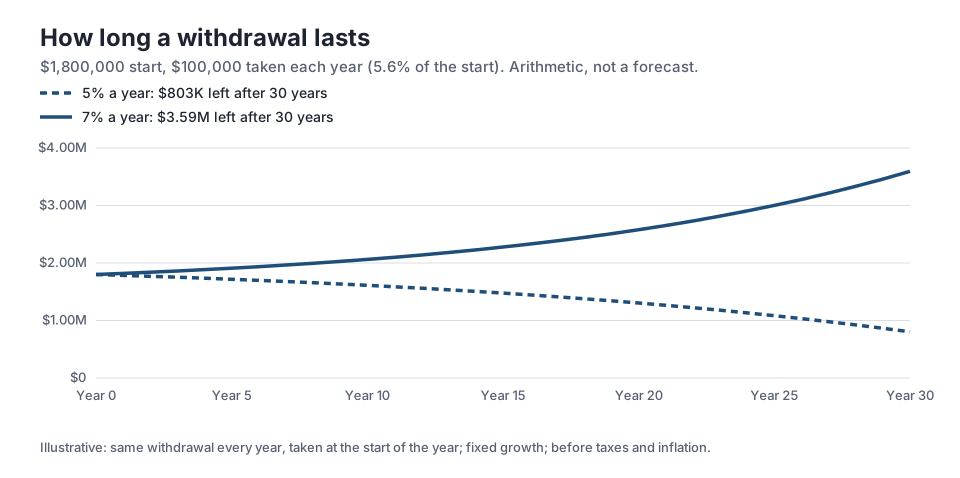
Consider David and Elena, both age 62 and retiring this year with $1,800,000 in total portfolio savings across three buckets: $1,000,000 in Traditional IRAs, $500,000 in a taxable brokerage account, and $300,000 in Roth IRAs. They plan to withdraw $100,000 annually to support their lifestyle. In an arithmetic illustration starting from $1,800,000 with $100,000 withdrawn each year—equivalent to 5.6% of the starting balance—an assumed steady 5% annual return before taxes and inflation covers every annual withdrawal and leaves $803,417 after 30 years, while an assumed steady 7% annual return covers every withdrawal and leaves $3,594,755 after 30 years.
Those growth illustrations are arithmetic exercises only, before taxes and inflation, and are not a forecast of investment results. Yet they highlight how tax drag directly affects long-term portfolio durability. If David and Elena follow the sequential method and draw their entire $100,000 annual need from their $500,000 taxable brokerage account initially, they exhaust that account within several years while leaving their $1,000,000 Traditional IRA untouched. Once Required Minimum Distributions begin, compounding inside the Traditional IRA can generate sizable mandatory withdrawals that push them into higher tax brackets and trigger Medicare IRMAA surcharges.
To examine an alternative, David and Elena weigh a bracket-filling blend during their early retirement years. They can withdraw enough from their Traditional IRA each year to occupy their standard deduction and the lower ordinary income tax brackets. To fund the remainder of their $100,000 spending target, they sell appreciated assets in their taxable brokerage account while keeping total taxable income within the lowest long-term capital gains tier, then draw a modest amount from their Roth IRAs without adding federal income tax.
Blending across all three buckets smooths taxable income, reduces future RMD pressure on the $1,000,000 Traditional IRA, and preserves Roth funds for later decades. The trade-off is the complexity of calculating and rebalancing these annual withdrawal targets as market values and tax thresholds change. David and Elena can ask their advisor how to adjust this blend during market downturns—for instance, leaning more heavily on cash or bonds inside specific accounts—and whether partial Roth conversions make sense in the years before Required Minimum Distributions begin.
Coordinating Withdrawals with Social Security
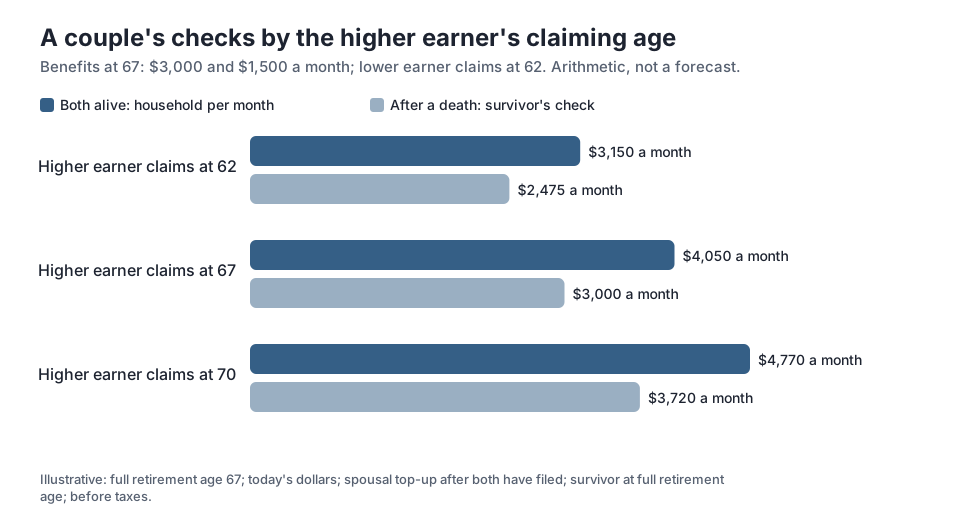
Portfolio withdrawals do not happen in isolation because Social Security benefits alter how much cash a household must pull from savings each year. For David and Elena, whose full-retirement-age benefits at age 67 are $3,000 a month for David and $1,500 a month for Elena, claiming ages shift both monthly household income and future survivor benefits. Assuming Elena claims early at age 62 for $1,050 a month, David's claiming decision dramatically changes their combined monthly checks and alters long-term pressure on their investments.
In an arithmetic illustration of Social Security timing from those age-67 benefits, if David claims at age 62 for 70% of his benefit, he receives $2,100 a month alongside Elena's $1,050, totaling $3,150 a month, with a survivor benefit of $2,475 a month. Claiming at age 67 for 100% yields $3,000 plus $1,050, totaling $4,050 a month and a $3,000 survivor check. Delaying until age 70 provides 124%, giving David $3,720 alongside Elena's $1,050 for $4,770 combined and a $3,720 survivor benefit under Social Security Administration rules.
That survivor check calculation reflects the Social Security Administration rule that a surviving spouse at full retirement age receives the larger of their own benefit or the deceased spouse's benefit, and at least 82.5% of the deceased worker's age-67 benefit when the higher earner claimed early. Waiting until age 70 raises lifetime monthly cash flow for both spouses and strengthens income protection for whichever spouse lives longer, while lowering the annual dollar amount David and Elena need to extract from their portfolio after age 70.
The trade-off of delaying Social Security until age 70 is that David and Elena rely more heavily on their $1,800,000 portfolio during their sixties to fund their $100,000 annual spending target. Those bridge years before benefits start, however, also create a prime window to draw down their $1,000,000 Traditional IRA or complete Roth conversions while ordinary income remains low. They can ask their advisor how different claiming ages interact with their tax brackets and portfolio longevity under varying return assumptions.
When to Adjust Your Strategy
Even a carefully built withdrawal sequence requires periodic review because tax statutes, portfolio balances, and household spending rarely stay static. Changes in federal deduction amounts, shifts in capital gains thresholds, or unexpected medical expenses can make last year's blend inefficient. Treating annual withdrawals as an ongoing calibration—rather than a permanent formula set once on retirement day—allows retirees to respond calmly when personal or legislative circumstances change.
Roth IRAs provide valuable flexibility during years when spending spikes above normal budgets, such as home repairs or family emergencies. Because the IRS confirms that you can leave amounts in a Roth IRA as long as you live without taking required distributions, those accounts can remain untouched during ordinary years to compound free of federal income tax. Draining Roth IRA accounts too early forfeits years of untaxed growth and removes a useful buffer against higher marginal tax brackets later in life.
Market downturns also invite adjustments to a blending plan. During years when equity prices decline sharply, selling depressed brokerage assets or pulling oversized amounts from equity-heavy accounts can lock in losses. Retirees often ask their advisors whether temporarily shifting toward fixed-income reserves, pausing Roth conversions, or adjusting discretionary spending helps preserve equity shares until markets recover, while still keeping annual taxable income within targeted marginal brackets.
Personal milestones—such as selling a home, receiving an inheritance, or experiencing a change in marital status—frequently call for a fresh tax projection before taking annual distributions. Qualified tax professionals and financial advisors can model multi-year projections that coordinate investment withdrawals, Medicare thresholds, and estate goals. When working with Fenul Wealth Management, fees are set out in the firm's written agreement before you engage.
Key takeaways
- Asset location—holding high-turnover or bond funds inside tax-deferred accounts and broad stock holdings inside taxable or Roth accounts—directly shapes which bucket holds the cash needed for a blended withdrawal.
- Keeping detailed cost-basis records for individual stock and fund purchase lots enables specific-identification selling, which manages realized capital gains more precisely than average-cost accounting.
- Using voluntary tax withholding on IRA distributions rather than quarterly estimated tax remittances can satisfy IRS safe-harbor rules evenly throughout the year, because withholding is treated as occurring pro rata across all quarters.
- Reviewing beneficiary designations alongside a withdrawal plan matters because non-spouse heirs generally face a strict window to empty inherited IRAs, making inherited Roth accounts far more tax-efficient for beneficiaries in peak earning years than large Traditional IRAs.
- Maintaining a multi-year reserve of living expenses in liquid cash or short-term fixed-income instruments allows retirees to fund spending during equity downturns without disrupting their planned tax-bracket blend.
Sources
- Retirement Plan and IRA Required Minimum Distributions FAQs (https://www.irs.gov/retirement-plans/retirement-plan-and-ira-required-minimum-distributions-faqs)
- IRS provides tax inflation adjustments for tax year 2024 (https://www.irs.gov/newsroom/irs-provides-tax-inflation-adjustments-for-tax-year-2024)
- Topic no. 409, Capital gains and losses (https://www.irs.gov/taxtopics/tc409)
- Roth IRAs (https://www.irs.gov/retirement-plans/roth-iras)
- Publication 590-B, Distributions from Individual Retirement Arrangements (IRAs) (https://www.irs.gov/publications/p590b)
11Questions
Frequently asked questions
How do state taxes impact a withdrawal sequencing strategy?
State income tax rules vary dramatically and can alter the math of blending withdrawals. Some states exempt Social Security benefits, pensions, or a portion of retirement plan distributions from state tax, while others tax traditional IRA withdrawals as ordinary income or levy their own capital gains taxes. Moving between states with different tax structures can also shift whether realizing taxable income earlier or deferring it produces a lower total tax bill for a household.
Can a retiree withdraw from a 401(k) before age 59½ without a penalty?
Federal tax law provides several exceptions to the early withdrawal penalty before age 59½. Employees who separate from service during or after the calendar year they reach age 55—or age 50 for certain public safety employees—can generally take penalty-free distributions directly from that employer's 401(k) plan, though rolling the funds into an IRA eliminates that exception. Substantially equal periodic payments spread evenly over life expectancy under IRS rules offer another structured path.
What happens to a withdrawal strategy if one spouse passes away?
When one spouse dies, the surviving spouse typically transitions from married filing jointly to single filing status in the year following the death. That shift cuts the standard deduction in half—from $29,200 to $14,600 under 2024 IRS rules—and compresses ordinary tax brackets while Social Security income drops to a single check. Filling lower joint brackets or converting pre-tax funds to Roth accounts while both spouses are alive can cushion that later bracket compression.
How does the Net Investment Income Tax affect brokerage account withdrawals?
High-earning retirees can face an additional federal surtax—the Net Investment Income Tax—on capital gains, dividends, and taxable interest once modified adjusted gross income exceeds statutory thresholds. Unlike ordinary tax brackets, those thresholds are not indexed for inflation. Because traditional IRA withdrawals raise modified adjusted gross income, large pre-tax distributions or RMDs can push brokerage capital gains across the surtax threshold, increasing the effective tax cost of raising cash.
Does eliminating a mortgage before tapping retirement accounts affect withdrawal sequencing?
Retiring without a mortgage lowers fixed monthly living expenses, which reduces the annual dollar amount a household must withdraw from its portfolio. Smaller portfolio withdrawals mean lower ordinary income from traditional IRAs or fewer realized gains from brokerage accounts, helping keep taxable income below higher marginal brackets and Medicare IRMAA thresholds. Conversely, using a single large traditional IRA distribution to eliminate a mortgage balance all at once can cause a temporary tax spike.
How do charitable contributions fit into a withdrawal strategy?
Charitably inclined retirees have specialized tools that integrate directly with tax-deferred and taxable accounts. After reaching age 70½, Qualified Charitable Distributions allow IRA owners to transfer money directly from a traditional IRA to an eligible charity, satisfying Required Minimum Distributions once they begin at age 73 without adding to adjusted gross income. Alternatively, donating appreciated shares from a taxable brokerage account directly to charity avoids capital gains tax on the appreciation.
12Keep reading
Related guides
 Retirement
When Do I Stop HSA Contributions Before Enrolling in Medicare?
Learn how the six-month retroactive Medicare Part A rule affects HSA eligibility at 65, how to time your final contribution, and how to avoid the 6% penalty. Retirement
How Do Qualified Charitable Distributions From an IRA Work?
Learn how qualified charitable distributions from an IRA work, 2026 IRS limits, RMD rules, and how lowering AGI compares with standard or itemized deductions. Retirement
Should I Roll My Old 401(k) to an IRA When I Change Jobs?
Compare keeping an old 401(k), rolling to a new employer plan, or moving to an IRA, including backdoor Roth pro-rata rules and institutional fee differences.
13Next step
Take the next step
If you want to talk this through, an advisor at the firm can help.
14Next step
Talk it through with the firm
When you would like to talk something through, book a free call or send a message.

You will speak with Tayeb Ayat, the firm’s founder. (888) 336-8586 · info@fenul.com