Retirement · November 14, 2026
Should I Roll My Old 401(k) to an IRA When I Change Jobs?
Compare keeping an old 401(k), rolling to a new employer plan, or moving to an IRA, including backdoor Roth pro-rata rules and institutional fee differences.
13 min read · 10 sections

Deciding whether to roll a former employer's 401(k) into an individual retirement account depends on three practical factors: whether you use the backdoor Roth IRA strategy, how investment fees compare across accounts, and what your new employer's retirement plan allows. For high-earning technology workers, moving pre-tax workplace savings into a traditional IRA is rarely a simple default step. Understanding how each destination interacts with IRS tax rules helps clarify the trade-offs before any transfer request is submitted.
A generic rollover guide often frames an IRA as an obvious upgrade over an employer plan because retail brokerages offer thousands of investments. In practice, leaving money in a former employer's 401(k) or moving it into a new employer's plan can preserve institutional pricing and keep traditional IRA balances at zero. Keeping pre-tax money inside employer plans matters directly if your household income exceeds direct Roth IRA eligibility limits.
Each of the three main paths—leaving the account behind, transferring to a new workplace 401(k), or rolling into a traditional IRA—carries distinct administrative, tax, and fee consequences. Employer plans often provide federal creditor protection and institutional share classes, while retail IRAs provide broad investment choice at the cost of creating a pre-tax IRA balance. Weighing those differences alongside your ongoing retirement savings plans keeps a job change from creating unintended tax bills.
Should I roll my old 401(k) to an IRA when I change jobs?
Whether an IRA rollover fits a job change hinges on how you plan to save for retirement in the years ahead. Under limits set by the IRS, the 2026 contribution limit for an IRA is $7,500. High-income engineers who earn above the IRS income phase-out for direct Roth IRA contributions often rely on indirect conversions to put that $7,500 into a Roth account, a method that breaks down if a large pre-tax rollover sits in a traditional IRA.
A common pitfall is assuming a rollover IRA is always cheaper than a workplace 401(k). Retail brokerages often advertise account openings with no annual maintenance charge, yet the underlying retail mutual funds, advisory wrap fees, or exchange-traded fund expenses inside an IRA can still exceed the institutional pricing negotiated by a large technology employer. Checking both the fund expense ratios and any plan recordkeeping charges reveals the actual cost difference.
Departing employees generally weigh three distinct destinations for an old pre-tax balance: leaving the funds in the former employer's 401(k), rolling the balance into the new employer's 401(k), or rolling the balance into a traditional IRA. Each route preserves the tax-deferred status of pre-tax contributions and earnings when executed as a direct transfer, yet each route affects investment flexibility, account consolidation, ERISA creditor protection, and future Roth conversions differently.
- Leave in Old 401(k): Funds remain tax-deferred without new contributions; preserves a zero balance in traditional IRAs for backdoor Roth conversions, keeps institutional fund access, and maintains federal ERISA creditor protection, though it leaves an extra account to monitor under the former employer's rules.
- Roll Over to New Employer's 401(k): Transfers the balance directly into the new workplace plan; consolidates accounts, keeps traditional IRA balances at zero for backdoor Roth purposes, and retains ERISA creditor protection, though it depends on the new plan accepting rollovers and offering competitive fees.
- Roll Over to a Traditional IRA: Moves pre-tax funds to a retail brokerage account; provides wide investment selection and direct provider control, though it creates a pre-tax IRA balance that triggers the pro-rata rule on backdoor Roth conversions and may carry higher retail fund fees.
| Workplace 401(k) | Rollover IRA | |
|---|---|---|
| Investment Pricing | Institutional share classes | Retail mutual funds or ETFs |
| Account Fees | Plan recordkeeping charges | Often no annual maintenance charge |
| Backdoor Roth Impact | Keeps traditional IRA balances at zero | Pre-tax funds disrupt backdoor conversions |
A comparison of typical costs and pricing structures between a workplace retirement plan and a retail IRA.
The Pro-Rata Rule and Backdoor Roth Disruption
Many technology workers earn salaries and equity compensation that place them above the income ceiling for contributing directly to a Roth IRA. To continue building Roth balances, they use a backdoor Roth strategy, which under IRS rules involves making a non-deductible contribution to a traditional IRA and then converting that contribution to a Roth IRA. When no pre-tax dollars exist in any traditional IRA, only investment earnings between the contribution and conversion dates are taxed.
Rolling a former employer's pre-tax 401(k) into a traditional IRA disrupts that mechanism because of the IRS pro-rata rule. Under rules administered by the IRS, the pro-rata rule requires that any withdrawal or Roth conversion from an IRA containing both pre-tax and after-tax funds must include a proportional mix of both. You cannot isolate a new non-deductible contribution and convert only those after-tax dollars while leaving pre-tax rollover funds untouched.
The IRS aggregation rule widens this restriction across every non-Roth IRA you own. For the pro-rata rule, the IRS treats all of your traditional, SEP, and SIMPLE IRAs as a single combined account. Even if you open a brand-new traditional IRA solely to hold a non-deductible contribution while keeping your old 401(k) rollover in a separate brokerage's traditional IRA, the IRS combines both balances when calculating the taxable share of a conversion.
Triggering the pro-rata rule by forgetting about existing pre-tax IRA balances when executing a backdoor Roth is a frequent and costly oversight. Because a large rollover dwarfs a single year's non-deductible contribution, almost the entire conversion becomes ordinary taxable income in that calendar year, while the remaining after-tax basis stays trapped inside the combined IRA balance and creates ongoing IRS tax reporting work for future years.
Leaving the 401(k) at Your Former Employer
Leaving retirement savings in a former employer's 401(k) is often available whenever the vested balance exceeds the plan's small-balance cash-out threshold. The account keeps its tax-deferred status and continues participating in whatever market movements its chosen funds experience, even though you can no longer direct new salary deferrals into it. Because the funds stay inside a workplace plan rather than an IRA, traditional IRA balances remain at zero for backdoor Roth conversions.
Keeping funds in a former plan does not reduce your capacity to save at a new company. The IRS sets the 2026 employee contribution limit for 401(k) plans at $24,500 across all workplace plans combined in a calendar year, regardless of how many legacy 401(k) accounts remain open from prior jobs. People weigh leaving money behind when the former plan offers low-cost institutional funds and solid administration, though doing so leaves another login and beneficiary form to track.
Workplace accounts also carry statutory legal protections that differ from individual accounts. Funds held inside an employer-sponsored 401(k) remain shielded from most civil judgments and creditors under federal ERISA law. Leaving money behind does mean accepting the former employer's investment menu, administrative rules, and potential changes in plan recordkeepers over time, including fees that some plans start charging directly to separated participants once they leave the company.
Comparing Investment Fees: Tech 401(k) vs. Retail IRA
Large technology employers frequently sponsor multi-billion-dollar retirement plans that qualify for institutional share classes or collective investment trusts unavailable to individual retail investors. A common pitfall is assuming a rollover IRA is always cheaper than a workplace 401(k), when the opposite is frequently true for index funds and target-date portfolios. Over multi-decade careers, small annual expense ratio differences compound into substantial gaps in terminal retirement wealth.
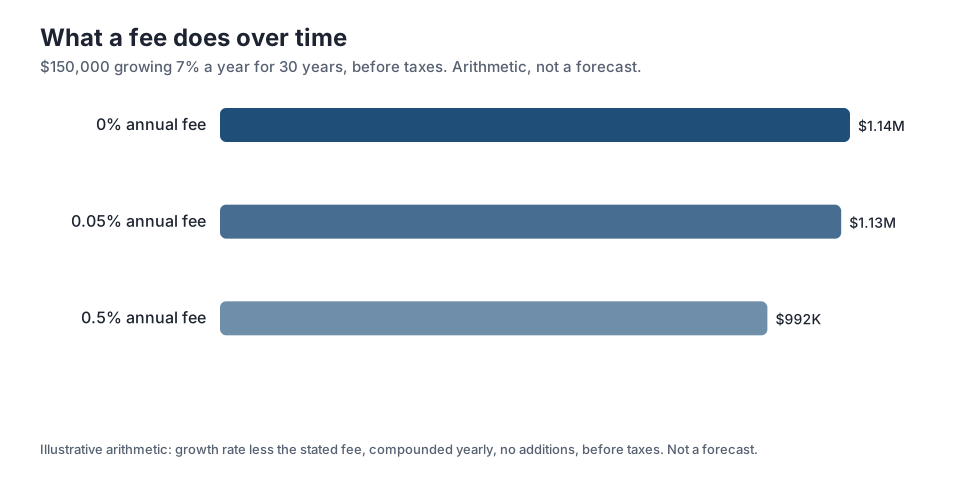
An arithmetic illustration using a $150,000 starting balance and an assumed 7% annual return before fees over 30 years shows how fee drag compounds; this is arithmetic only and not a forecast of market performance. With a 0% annual fee, the balance after 30 years is $1,141,838, or $1.14M. With a 0.05% annual fee typical of institutional plans, the balance after 30 years is $1,125,939, or $1.13M, which is $15,899 ($16K) less than the 0% fee case.
Raising the annual fee to 0.50% (0.5%)—a level seen when retail IRAs hold higher-cost active funds or carry an ongoing advisory fee—changes the long-term outcome dramatically under the same $150,000 starting balance, 7% gross annual return assumption, and 30-year horizon. At a 0.5% annual fee, the ending balance drops to $992,155 ($992K), which is $149,683 ($150K) less than the 0% fee case, illustrating how seemingly modest ongoing costs erode compounding.
Fee comparisons extend beyond mutual fund expense ratios alone. Some workplace 401(k) plans pass flat quarterly recordkeeping fees to former employees, while retail IRAs may avoid annual custody charges yet levy trading commissions, fund loads, or percentage-based management fees. Reviewing the old plan's annual fee disclosure alongside the specific expense ratios of the funds you intend to hold in an IRA clarifies whether a rollover lowers or raises total annual costs.
Moving the Money to Your New Employer's 401(k)
Many employer-sponsored 401(k) plans accept incoming direct rollovers from a previous employer's qualified plan, often referred to as a roll-in. Moving an old balance into the new employer's 401(k) consolidates retirement savings onto one dashboard while keeping traditional IRA balances at zero. For high earners planning annual backdoor Roth conversions, a roll-in delivers account simplification without triggering the pro-rata rule, while keeping federal ERISA creditor protection intact.
Incoming rollovers do not reduce your annual contribution headroom at the new company. Under IRS rules, the 2026 total combined contribution limit for a 401(k), including employer matches and any after-tax contributions, is $72,000, and rolled-in balances from a prior employer are excluded from that $72,000 ceiling. That distinction matters to engineers who max out employee deferrals, receive sizable employer matching contributions, or use mega backdoor Roth plan features.
- $72,000Total combined 401(k) contribution limit
- $24,500Employee 401(k) contribution limit
- $7,500IRA contribution limit
These are the maximum contribution limits set by the IRS for 2026. Rolled-in balances from a prior employer do not count toward these annual ceilings.
Consolidation into a new workplace plan involves practical trade-offs worth verifying before initiating a transfer. Not every employer plan accepts incoming rollovers, and some restrict roll-ins during an initial waiting period or reject after-tax basis. In addition, if a smaller new employer sponsors a plan with higher expense ratios or a limited fund lineup compared with your former company's 401(k), convenience alone could come with higher ongoing fees.
How After-Tax 401(k) Contributions Complicate Rollovers
High-saving technology workers frequently contribute after-tax dollars—distinct from designated Roth contributions—into their 401(k) to take advantage of total plan limits. When leaving a job, an old 401(k) can contain both pre-tax dollars and non-Roth after-tax contributions plus their pre-tax earnings. Under IRS rollover guidance, separating these components during a direct rollover requires careful coordination with the plan administrator so each dollar lands in the appropriate tax bucket.
IRS rules permit an account holder to split a workplace plan rollover so that the after-tax principal moves directly into a Roth IRA while the pre-tax contributions and associated earnings move into a traditional IRA or a new employer's 401(k). Routing the pre-tax portion into the new employer's 401(k) rather than a traditional IRA keeps traditional IRA balances at zero, avoiding future pro-rata complications while getting the after-tax basis into a Roth account.
A frequent pitfall is thinking you can isolate and convert only the after-tax portion of a traditional IRA to a Roth IRA to avoid taxes. While a 401(k) administrator can separate pre-tax and after-tax basis at the moment funds leave the workplace plan, rolling the entire mixed balance into a traditional IRA traps both buckets together. Once combined inside a traditional IRA, any subsequent Roth conversion triggers the IRS pro-rata calculation.
Direct vs. Indirect Rollovers: Avoiding the 60-Day Trap
How money physically moves between retirement custodians changes the tax outcome dramatically. In a direct trustee-to-trustee transfer, the old 401(k) administrator sends funds straight to the receiving 401(k) or IRA custodian, or issues a check made out to the new custodian for your benefit. Under IRS rollover rules, a direct trustee-to-trustee transfer avoids the mandatory 20% tax withholding and removes the risk of missing tight deposit deadlines.
By contrast, an indirect rollover paid directly to you is subject to a mandatory 20% federal income tax withholding under IRS rules, even if you intend to deposit the money into another retirement account. Under those same IRS rules, you have 60 days from the date you receive a retirement plan distribution to roll it over to another plan or IRA to avoid taxes on the distribution.
- If you choose a direct trustee-to-trustee transferThe administrator sends funds straight to the new custodian, avoiding the mandatory 20% tax withholding.
- If you choose an indirect rollover paid directly to youThe distribution is subject to a mandatory 20% federal income tax withholding.
- If you receive an indirect rollover distributionYou have 60 days to deposit the funds into another retirement account to avoid taxes on the distribution.
This flow shows how the method of transferring retirement funds dictates tax withholding and deposit deadlines. It outlines the consequences of direct and indirect rollovers.
Doing an indirect rollover and failing to replace the 20% withheld for taxes within the 60-day window is an expensive administrative trap. Because the old plan withholds 20% and sends it to the IRS, depositing only the remaining check into an IRA leaves a shortfall. Unless you make up that missing 20% out of pocket within 60 days, the IRS treats the unreplaced amount as a taxable distribution, and if you withdraw funds before age 59½, you may owe an additional 10% early distribution tax.
A related pitfall is cashing out a 401(k) during a job transition and severely stunting long-term compound growth. Taking cash out triggers ordinary income tax plus the potential 10% early distribution tax before age 59½, permanently removing capital from tax-advantaged compounding. Even when a job transition involves temporary expenses, cashing out retirement assets locks in immediate tax drag that cannot be reversed once the 60-day rollover window closes.
Walkthrough: A Tech Engineer's Rollover Decision
Consider Alex, a 35-year-old tech engineer earning $200,000 who holds a $150,000 pre-tax balance in a former employer's 401(k). Because Alex's $200,000 income exceeds direct Roth IRA eligibility limits, Alex plans to make a $7,500 backdoor Roth IRA contribution this year. Alex is comparing the former 401(k)'s 0.05% institutional fee against a retail traditional IRA's 0.50% fee, assuming an average 7% annual return before fees over 30 years for illustration only.
Rolling the $150,000 pre-tax balance into a traditional IRA would cause the pro-rata rule to treat the vast majority of Alex's $7,500 backdoor Roth conversion as taxable income, undermining the purpose of making a non-deductible IRA contribution. In addition, the fee difference compounds over a 30-year horizon under the 7% gross return assumption: a 0.05% fee leaves $1,125,939 versus $992,155 at a 0.50% fee, compared with $1,141,838 at a 0% fee.
Each path leaves Alex with clear trade-offs rather than a single universal answer. Leaving the $150,000 in the former 401(k) or transferring it via a direct rollover into the new employer's 401(k) preserves a zero balance in traditional IRAs for the $7,500 backdoor Roth contribution and can keep fees near institutional levels if the new plan is competitive. Rolling to a traditional IRA offers broader investment choices only at the cost of disrupting backdoor Roth conversions and potentially facing higher ongoing fees.
Useful questions include whether the new employer's 401(k) accepts incoming direct rollovers, what total fund and administrative fees apply in both workplace plans, and whether the old account contains any after-tax basis that needs to be split directly to a Roth IRA rather than rolled into a pre-tax account.
An illustration of how different annual fee rates affect a starting balance over 30 years, assuming a 7% annual return.
Key takeaways
- The IRS evaluates traditional, SEP, and SIMPLE IRA balances for the pro-rata rule on December 31 of the conversion year, meaning an outgoing roll-in from a traditional IRA into a workplace 401(k) before year-end can clear a pre-tax balance even if a backdoor Roth conversion happened earlier that year.
- While federal ERISA rules shield 401(k) balances from most non-bankruptcy creditors, creditor protections for rollover IRAs in civil lawsuits depend on individual state statutes, which vary substantially across states.
- Leaving funds in a former employer's 401(k) preserves penalty-free withdrawals at age 55 only if separation from that employer occurred in or after the calendar year you reached age 55, whereas rolling into an IRA moves penalty-free access to age 59½.
- Unlike pre-tax 401(k) balances and traditional IRAs, Roth IRAs carry no required minimum distributions during the original owner's lifetime, giving Roth assets more flexibility later in retirement.
- Former employers can force out very small 401(k) balances below statutory thresholds into a safe-harbor IRA or cash distribution after separation, so checking the plan's minimum balance rule prevents unexpected automatic transfers.
Sources
- COLA Increases for Dollar Limitations on Benefits and Contributions (https://www.irs.gov/retirement-plans/cola-increases-for-dollar-limitations-on-benefits-and-contributions)
- Rollovers of Retirement Plan and IRA Distributions (https://www.irs.gov/retirement-plans/plan-participant-employee/rollovers-of-retirement-plan-and-ira-distributions)
- Publication 590-B, Distributions from Individual Retirement Arrangements (IRAs) (https://www.irs.gov/publications/p590b)
- Publication 590-A, Contributions to Individual Retirement Arrangements (IRAs) (https://www.irs.gov/publications/p590a)
11Questions
Frequently asked questions
Can I roll over my 401(k) directly into a Roth IRA?
Yes, a direct rollover from a pre-tax 401(k) to a Roth IRA is permitted under IRS rules, though it is treated as a taxable Roth conversion in the year of transfer rather than a non-taxable rollover. Because the full pre-tax amount adds to ordinary taxable income, high earners often review their marginal federal and state tax brackets before converting a large balance all at once, or look at partial conversions spread across multiple tax years.
What happens to my unvested employer match when I leave my job?
Only the vested portion of an employer's matching or profit-sharing contributions belongs to a departing employee and is eligible for rollover. Unvested dollars are typically forfeited after employment ends, though some plans hold them temporarily in case an employee is rehired within a specific window outlined in the plan's Summary Plan Description. Reviewing the plan's vesting schedule before resigning clarifies how much of the account is portable.
Do I owe taxes if I move my 401(k) to a new employer's plan?
Moving pre-tax dollars from an old 401(k) to a new employer's 401(k) through a direct rollover creates no federal income tax liability, and the receiving plan records the incoming funds separately from current-year salary deferrals. If the former account holds designated Roth 401(k) money, the new plan needs to offer a Roth 401(k) feature to accept those funds; otherwise, Roth 401(k) balances are typically directed to a Roth IRA.
Can I cash out my old 401(k) to settle student loans or a mortgage?
Plan rules generally permit a full cash distribution after separation from service regardless of whether the money goes toward debt reduction. However, cashing out pre-tax dollars adds the entire distribution to ordinary income for that year—potentially pushing a high earner into a higher marginal tax bracket—and triggers the 10% early distribution tax before age 59½, with no special IRS exception for student loan or mortgage repayment from a 401(k).
How long do I have to decide what to do with my old 401(k)?
For balances above a former employer's automatic force-out threshold, federal rules impose no deadline on leaving funds in the old plan, allowing months or years to evaluate a new employer's investment lineup. The 60-day rollover clock only begins when a distribution check is actually issued to you in an indirect rollover, not merely when your employment ends.
Will a rollover affect my current year 401(k) contribution limit?
No, an incoming rollover into a workplace 401(k) or an IRA does not count toward the $24,500 employee deferral limit, the $72,000 total 401(k) limit, or the $7,500 IRA limit for 2026. When switching employers mid-year, however, the $24,500 employee deferral cap tracks total elective deferrals across both the old and new employers' plans combined, so reviewing year-to-date wage statements helps prevent excess deferrals.
12Keep reading
Related guides
 Retirement
How Does a Backdoor Roth IRA Work and What Is the Pro-Rata Rule?
Learn how the backdoor Roth IRA works for high earners, how the IRS pro-rata rule calculates taxable conversions, and how Form 8606 tracks basis. Retirement
How Do Qualified Charitable Distributions From an IRA Work?
Learn how qualified charitable distributions from an IRA work, 2026 IRS limits, RMD rules, and how lowering AGI compares with standard or itemized deductions. Retirement
In What Order Should I Withdraw From My Retirement Accounts?
Learn how blending withdrawals across taxable, tax-deferred, and Roth accounts can manage annual taxes, RMDs, and Social Security timing in retirement.
13Next step
Take the next step
If you want to talk this through, an advisor at the firm can help.
14Next step
Talk it through with the firm
When you would like to talk something through, book a free call or send a message.

You will speak with Tayeb Ayat, the firm’s founder. (888) 336-8586 · info@fenul.com