Retirement · November 14, 2026
How Do Qualified Charitable Distributions From an IRA Work?
Learn how qualified charitable distributions from an IRA work, 2026 IRS limits, RMD rules, and how lowering AGI compares with standard or itemized deductions.
11 min read · 10 sections

A qualified charitable distribution moves money directly from an individual retirement account to an eligible charity without adding that withdrawal to adjusted gross income. Established under rules administered by the IRS, this mechanism lets IRA owners who have reached age 70½ transfer funds straight from their retirement custodian to a qualifying public charity. Unlike taking a cash withdrawal and writing a personal check, the direct transfer keeps the gifted amount off the taxable income line entirely.
Once an account owner reaches age 73, federal rules generally require annual withdrawals called required minimum distributions from traditional IRAs. Normally, every dollar withdrawn counts as ordinary income, which can push a retiree into a higher tax bracket or increase income-based Medicare surcharges. By directing part or all of a required distribution straight to a charity, a retiree satisfies the annual withdrawal mandate while keeping the transferred sum out of adjusted gross income.
Many retirees claim the standard deduction rather than itemizing expenses on their tax return. Under typical charitable giving rules, a cash gift from a checking account offers little or no tax reduction for non-itemizers, aside from a modest allowance introduced for 2026. Weighing a direct IRA transfer against giving cash from a bank account depends on age, total giving, and how adjusted gross income interacts with taxes and health premiums.
What is a qualified charitable distribution?
Under IRS rules, a qualified charitable distribution is a direct transfer of funds from an IRA made out to a qualified charity. Because the retirement custodian sends the money straight to the organization rather than to the account holder, the Internal Revenue Service allows the distribution to bypass federal income taxation. The transferred dollars still leave the tax-deferred retirement account permanently, reducing the remaining balance without generating an ordinary income entry on the return.
The IRS limits the amount of a QCD to the portion of the distribution that would otherwise be included in taxable income. Traditional IRAs funded solely with deductible contributions or pre-tax employer rollovers contain only taxable dollars, so distributions from those accounts qualify in full. If an IRA also holds after-tax nondeductible contributions, only the pre-tax earnings and deductible principal can be excluded through a charitable transfer, preventing duplicate tax benefits on after-tax basis.
Normally, taking money out of a traditional IRA creates taxable income regardless of how the recipient uses the cash afterward. Even if a retiree immediately donates that withdrawal to a local food bank or house of worship, the original withdrawal still raises adjusted gross income. A QCD bypasses that sequence by routing the funds directly from the custodian to the charitable recipient, separating charitable giving from personal cash flow.
- If a distribution is a direct transfer from an IRA to a qualified charityThe distribution can bypass federal income taxation
- If a traditional IRA is funded solely with deductible contributionsDistributions from the account qualify in full
- If an IRA holds after-tax nondeductible contributionsOnly the pre-tax earnings and deductible contributions qualify
A decision flow explaining how the source of funds determines if a charitable transfer is tax-free.
Who is eligible to make a QCD?
The IRS stipulates that an IRA owner is required to be at least age 70½ on the exact date the distribution is made. Reaching age 70 earlier in the calendar year does not satisfy this eligibility rule. Initiating a charitable transfer prior to the half-year mark after a seventieth birthday is a common misstep that disqualifies the transaction, turning the withdrawal into ordinary taxable income even if the account holder turns 70½ later that same year.
Eligibility also depends on the structure of the retirement account holding the funds. Traditional IRAs serve as the primary vehicle for these transfers. Inactive SEP IRAs and inactive SIMPLE IRAs, meaning accounts that are no longer receiving ongoing employer contributions, are likewise eligible under IRS guidelines. Employer-sponsored workplace plans do not offer direct charitable transfers, so account holders with assets in workplace accounts face different steps if they want to give directly.
Not every charitable entity qualifies to receive a direct IRA transfer. The recipient organization is required to be an eligible public charity recognized under federal tax law. Attempting to send a QCD to a donor-advised fund or a private foundation disqualifies the exclusion, because the IRS bars intermediary grant-making vehicles and private foundations from receiving these transfers.
How a QCD counts toward your required minimum distribution
IRS regulations generally require minimum distributions to begin for the year an account owner reaches age 73, based on the prior year-end account balance and life expectancy tables. A qualified charitable distribution counts directly toward satisfying that annual RMD obligation. Because QCD eligibility begins at age 70½ while required withdrawals begin at age 73, account owners have a window of a couple of years where they can make charitable transfers before mandatory withdrawals begin.
Satisfying a required withdrawal through a charitable transfer requires attention to ordering within the calendar year. IRS ordering rules treat the earliest distributions taken from an IRA during the year as counting toward the annual RMD until the full requirement is met. If a retiree withdraws the full required amount for personal spending early in the year, a charitable transfer made later in the same year still counts as a QCD, though it cannot retroactively offset the earlier taxable withdrawal.
A frequent mistake occurs when an account owner takes an RMD into a personal checking account beforehand, intending to forward the money to a charity right away. Once the custodian sends funds made out to the individual or deposits them into a personal bank account, the transaction becomes a standard taxable distribution. That withdrawal cannot be undone or converted into a QCD after the fact, leaving the retiree with higher adjusted gross income for the year.
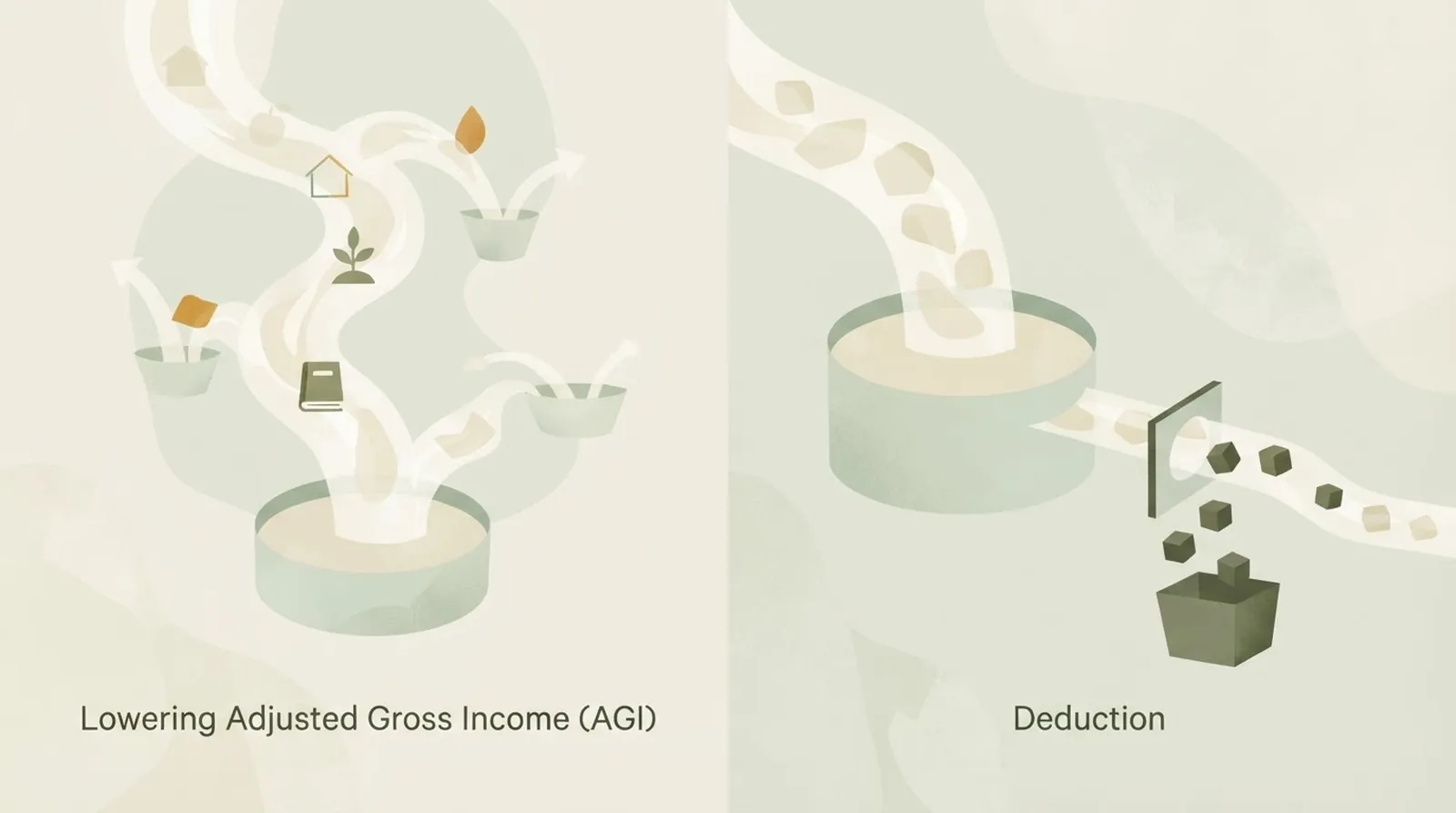
How lowering Adjusted Gross Income differs from a deduction
Assuming a charitable deduction produces the exact same tax savings as a QCD overlooks how federal tax returns calculate income. A standard or itemized charitable deduction lowers taxable income near the bottom of the return, after adjusted gross income has already been calculated. By contrast, a QCD excludes the IRA transfer at the top of the return, keeping adjusted gross income lower from the outset. That structural difference triggers distinct downstream effects across several federal benefit and tax formulas.
Many retirement-age calculations depend directly on adjusted gross income rather than final taxable income. The Social Security Administration uses a combined income formula rooted in adjusted gross income to determine what share of Social Security benefits becomes taxable. Likewise, Medicare uses modified adjusted gross income from an earlier lookback tax year to assess income-related monthly adjustment amounts on Part B and Part D premiums. Lowering adjusted gross income can help keep a retiree below those Medicare premium surcharge brackets.
Beyond Medicare premiums and Social Security benefit taxation, several states tie their state income tax calculations directly to federal adjusted gross income rather than federal itemized deductions. In states that offer no charitable deduction for non-itemizers, or that disallow itemized deductions altogether, a standard cash donation yields no state tax reduction. Excluding the transfer from federal adjusted gross income through a QCD often lowers state taxable income in states that follow federal AGI definitions.
The 2026 dollar limits for making a QCD
Each year, the IRS indexes the maximum amount an individual can exclude from income through qualified charitable distributions to keep pace with inflation. For tax year 2026, the maximum annual exclusion for QCDs is $111,000 per eligible IRA owner. Any direct transfers made to qualified charities within that calendar year count toward this ceiling, whether the money goes to a single organization or is split among multiple eligible charities across several separate transactions.
Under rules administered by the IRS, individuals also have access to a once-in-a-lifetime provision allowing a QCD to fund a split-interest entity, such as a charitable remainder unitrust, charitable remainder annuity trust, or charitable gift annuity. For 2026, this one-time election permits a transfer of up to $55,000. That split-interest amount counts toward the overall $111,000 annual limit for the year in which it is executed, rather than stacking on top of it.
Split-interest arrangements carry stricter conditions than direct gifts to a public charity. The entity receiving the funds is required to be funded solely with the qualified charitable distribution, with no commingling of other personal assets. Income distributions generated from the split-interest entity to the donor or spouse are taxed as ordinary income when received, and the entity cannot hold assets transferred in prior years. Because administrative fees and legal setup costs apply, donors examine whether the gift size justifies creating the arrangement.
- $111,000Maximum annual exclusion per eligible IRA owner
- $55,000One-time election limit for a split-interest entity
Key maximum dollar amounts for qualified charitable distributions in the 2026 tax year.
How the new standard deduction rules compare
Beginning with tax year 2026, federal law updates from the IRS allow filers who take the standard deduction to claim an above-the-line deduction for cash donations to qualified charities. Individuals who do not itemize may deduct up to $1,000 of cash contributions, while married couples filing jointly who do not itemize may deduct up to $2,000. While this provision restores a modest tax benefit for bank-account donations, those caps sit far below the $111,000 annual QCD exclusion.
Retirees funding charitable gifts from retirement savings generally weigh three main approaches: executing a qualified charitable distribution, taking a taxable withdrawal and claiming the standard deduction alongside the 2026 cash allowance, or taking a taxable withdrawal and itemizing deductions on Schedule A. Each approach carries distinct trade-offs depending on age, total giving, and other household deductions.
Because none of these routes serves every household equally, the choice hinges on personal tax circumstances rather than a universal rule. A donor younger than 70½ cannot use a QCD, whereas a donor giving well above the $1,000 or $2,000 non-itemizer limits who takes the standard deduction would receive no federal tax benefit beyond that cap from a personal check.
- Qualified charitable distribution: The IRA custodian sends funds directly to an eligible charity, satisfying the RMD while excluding the transfer from adjusted gross income. Pros include lowering AGI, meeting annual RMD rules, and working alongside the standard deduction. Cons include the age 70½ minimum, ineligibility for donor-advised funds or private foundations, and irrevocability once sent. People weigh it when retirees over 70½ want to support a charity while limiting the tax impact of required IRA withdrawals.
- Cash donation with the standard deduction: The retiree takes a taxable IRA withdrawal into a bank account, writes a check to charity, and claims the standard deduction. Pros include simplicity from a checking account, a 2026 deduction of up to $1,000 for single filers or $2,000 for joint filers without itemizing, and eligibility for donor-advised funds. Cons include higher AGI from the full withdrawal, potential increases in Medicare premiums or Social Security taxation, and the low dollar cap. People weigh it when donors are under 70½ or give modest amounts and prefer writing a personal check.
- Cash donation with itemized deductions: The retiree takes a taxable IRA withdrawal, donates cash, and itemizes deductions on Schedule A instead of taking the standard deduction. Pros include deducting large gifts against taxable income, funding donor-advised funds, and having no age restriction. Cons include raising AGI before deductions apply, needing total itemized expenses to exceed the standard deduction, and facing adjusted gross income limits on charitable deductions. People weigh it when individuals carry substantial mortgage interest, state taxes, or other deductible costs that make itemizing worthwhile.
Walk-through: Choosing the QCD route
A 76-year-old single retiree holds a $900,000 traditional IRA, faces a $36,000 required minimum distribution for the year, and plans to give $10,000 to her church. She typically claims the standard deduction because her home carries no mortgage and her state taxes remain modest. She compares taking the full $36,000 withdrawal into her checking account and writing a personal check to the church against routing the $10,000 gift directly from her IRA.
Under the personal-check route, her IRA custodian sends the entire $36,000 to her bank account, adding the full withdrawal to her adjusted gross income. Even with the non-itemizer allowance permitting a deduction for cash gifts, most of her $10,000 contribution yields no federal deduction because she does not itemize, and her higher adjusted gross income affects her Medicare premium bracket calculations. Under the QCD route, her custodian sends $10,000 straight to her church and distributes the remaining portion of her required withdrawal to her checking account.
Choosing the direct transfer keeps her adjusted gross income lower and satisfies the full $36,000 RMD requirement, though she loses the ability to claim the $10,000 gift as a standard charitable deduction on her return. Taking the check-writing route preserves flexibility to direct funds anywhere without custodian paperwork, at the cost of higher adjusted gross income. Before acting, she prepares to ask her advisor how the custodian handles direct transfer paperwork and whether her church meets specific IRS eligibility rules.
| Personal Check Route | QCD Route | |
|---|---|---|
| Destination of funds | Sent to bank account | Sent directly to charity |
| Impact on adjusted gross income | Adds full withdrawal to income | Excludes transfer from income |
| Effect on Medicare premiums | Higher income affects bracket | Keeps income lower |
A comparison of taking a personal withdrawal versus using a direct charitable transfer for a donation.
How to move the money and report it
Executing a qualified charitable distribution requires working directly through the IRA custodian rather than withdrawing cash personally. Most custodians provide a dedicated distribution form where the account owner specifies the dollar amount, the charity's legal name, and the mailing address or electronic routing details. Some custodians issue a check made out directly to the charity and mail it to the account owner to forward, while others send the check directly; either method works as long as the check is never made out to the individual.
Documentation standards for charitable transfers mirror standard tax-deduction rules. The IRS requires the donor to obtain the same type of contemporaneous written acknowledgment from the charity that is required to claim an itemized deduction, prior to filing the annual tax return. That letter or receipt states the amount contributed, the date of the transfer, and confirmation that the donor received no goods or services in exchange for the gift. Failing to secure this written confirmation puts the tax exclusion at risk during an examination.
Key takeaways
- Inherited traditional IRAs qualify for QCDs as long as the beneficiary has personally reached age 70½, regardless of the original owner's age at death.
- When an account owner holds multiple traditional IRAs, IRS aggregation rules combine their balances for RMD calculations, yet a QCD can be drawn entirely from a single IRA to satisfy the combined requirement.
- For retirees who hold a self-directed IRA with check-writing privileges, a charitable check counts in the year it clears the account rather than the date it is written, unlike checks issued directly by a traditional custodian.
- Retirees who continue earning wages and making deductible traditional IRA contributions after age 70½ face an offset rule that reduces the tax-excluded portion of later QCDs by the amount of those post-70½ deductible contributions.
- Federal tax withholding is not required on a qualified charitable distribution, and electing no withholding prevents funds from being diverted to the IRS instead of reaching the charity.
Sources
- irs.gov (https://www.irs.gov/publications/p590b)
- irs.gov (https://www.irs.gov/pub/irs-drop/n-25-67.pdf)
- irs.gov (https://www.irs.gov/retirement-plans/retirement-plan-and-ira-required-minimum-distributions-faqs)
- irs.gov (https://www.irs.gov/taxtopics/tc506)
11Questions
Frequently asked questions
Can I make a QCD to a donor-advised fund?
No. Under IRS guidelines, donor-advised funds, private grant-making foundations, and supporting organizations are not eligible recipients for qualified charitable distributions. The IRS restricts eligible recipients to active public charities because the funds are meant to go immediately toward charitable operations rather than sitting in an advisory or endowment vehicle where the donor retains ongoing distribution input. Donors who wish to fund a donor-advised fund from retirement savings would take a standard taxable distribution into a bank account and contribute cash separately.
Does a QCD work with a Roth IRA?
While IRS rules technically allow qualified charitable distributions from a Roth IRA once the owner reaches age 70½, doing so rarely provides a tax benefit. Qualified distributions from a Roth IRA are already excluded from federal taxable income, and original Roth IRA owners face no lifetime required minimum distributions. Because a QCD only excludes amounts that would otherwise be taxed as income, directing a charitable gift from a traditional pre-tax IRA is the structure designed for pre-tax accounts, whereas a Roth withdrawal carries no taxable income exclusion advantage.
Can I make a QCD from an employer-sponsored 401(k) plan?
No. Qualified charitable distributions are permitted only from IRAs, not from employer-sponsored 401(k) or similar workplace retirement plans. An individual with retirement assets inside a workplace plan who wants to use a QCD would move funds into a traditional IRA through a direct rollover beforehand. Under IRS rollover rules, however, any required minimum distribution owed by the workplace plan for that calendar year cannot be rolled into an IRA and is required to be withdrawn as taxable income prior to transferring the remaining balance.
What happens if my QCD exceeds my required minimum distribution for the year?
Any qualified charitable distribution amount above the current year's required minimum distribution remains excluded from adjusted gross income, provided the total charitable transfers stay within the $111,000 annual IRS ceiling for 2026. That excess charitable transfer does not carry forward to satisfy required minimum distributions in future tax years. Each calendar year's required withdrawal is calculated independently based on the prior year-end IRA balance, and only charitable transfers completed within that same calendar year count toward that year's requirement.
Can my spouse and I both make QCDs from the same IRA?
No. Individual retirement accounts belong to one individual, so a spouse cannot execute a qualified charitable distribution from an IRA titled solely in the other spouse's name. Each spouse who has reached age 70½ may transfer up to the $111,000 annual limit for 2026 only from traditional, inherited, or inactive SEP or SIMPLE IRAs held in that spouse's own name. Married couples filing jointly who each hold separate IRAs can therefore combine two separate exclusions in a single tax year.
How do I report a qualified charitable distribution on my tax return?
IRA custodians report total annual withdrawals, including charitable transfers, on the standard year-end retirement distribution form without separating out the QCD portion. When preparing the federal income tax return, the filer reports the full gross distribution on the line for total IRA distributions, subtracts the qualified charitable transfer when entering the taxable amount on the adjacent line, and writes the letters QCD next to that entry to notify the IRS why the full distribution is not taxable.
12Keep reading
Related guides
 Retirement
How Does a Backdoor Roth IRA Work and What Is the Pro-Rata Rule?
Learn how the backdoor Roth IRA works for high earners, how the IRS pro-rata rule calculates taxable conversions, and how Form 8606 tracks basis. Retirement
In What Order Should I Withdraw From My Retirement Accounts?
Learn how blending withdrawals across taxable, tax-deferred, and Roth accounts can manage annual taxes, RMDs, and Social Security timing in retirement. Retirement
Should I Roll My Old 401(k) to an IRA When I Change Jobs?
Compare keeping an old 401(k), rolling to a new employer plan, or moving to an IRA, including backdoor Roth pro-rata rules and institutional fee differences.
13Next step
Take the next step
If you want to talk this through, an advisor at the firm can help.
14Next step
Talk it through with the firm
When you would like to talk something through, book a free call or send a message.

You will speak with Tayeb Ayat, the firm’s founder. (888) 336-8586 · info@fenul.com