Retirement · November 14, 2026
How Does a Backdoor Roth IRA Work and What Is the Pro-Rata Rule?
Learn how the backdoor Roth IRA works for high earners, how the IRS pro-rata rule calculates taxable conversions, and how Form 8606 tracks basis.
13 min read · 10 sections

High-earning physicians and technology engineers often discover that their household income bars them from contributing directly to a Roth IRA. A backdoor Roth IRA is a two-step method built around existing IRS rules to move dollars into a Roth account despite those income caps. Instead of contributing to a Roth IRA directly, an individual makes a nondeductible contribution to a traditional IRA and then converts that balance into a Roth IRA.
While the two-step conversion itself has no upper income ceiling, complications arise when the individual already holds pre-tax money inside traditional, SEP, or SIMPLE IRAs. Many professionals accumulate those pre-tax balances by rolling over a hospital residency retirement plan or an old employer account when switching jobs. In those situations, the IRS pro-rata rule prevents converting only the newly deposited after-tax dollars.
Under the pro-rata rule, the IRS treats all traditional, SEP, and SIMPLE IRAs owned by an individual as one combined pool. Every dollar converted to a Roth IRA is then taxed in proportion to the pre-tax and after-tax shares of that combined pool. Understanding the arithmetic behind that ratio, alongside proper basis tracking on IRS Form 8606, helps high earners weigh their account options before converting.
What Is the Backdoor Roth IRA and the Pro-Rata Rule?
A traditional IRA and a Roth IRA share the same annual contribution cap set by the IRS. For 2026, the IRS sets the annual IRA contribution limit at $7,500 across all traditional and Roth IRAs combined, with a higher catch-up limit available for individuals age 50 or older. Unlike direct Roth IRA contributions, however, the ability to contribute to a traditional IRA without claiming a tax deduction is open to earners at every income level.
Because nondeductible traditional IRA contributions have no income cap and Roth conversions also have no income cap, high earners use those two separate IRS provisions in sequence. An individual deposits up to the $7,500 annual limit into a traditional IRA without taking a tax deduction, then converts the account balance into a Roth IRA. Once inside the Roth IRA, qualified future withdrawals are exempt from federal income tax.
The pro-rata rule enters the picture because the IRS views traditional-style IRAs through a unified lens. According to IRS rules on IRA distributions, when calculating the tax on a Roth conversion, an individual has to aggregate the balances of all traditional, SEP, and SIMPLE IRAs. Any pre-tax money sitting in those accounts gets blended together with the new nondeductible contribution in the tax calculation.
That blending means a conversion is rarely free of tax when pre-tax IRA dollars exist anywhere under the account owner's name. Rather than letting someone isolate and convert only the nondeductible contribution, the IRS treats each converted dollar as containing a proportional slice of pre-tax funds and after-tax basis. Only the after-tax share passes into the Roth IRA without triggering ordinary income tax.
- $7,500Annual IRA contribution limit for 2026
- 0%Federal income tax on qualified Roth IRA withdrawals
Key figures for funding a backdoor Roth IRA strategy in 2026.
Income Limits for Direct Roth IRA Contributions
Each year, the IRS publishes modified adjusted gross income phase-out ranges that determine who can contribute directly to a Roth IRA. For single tax filers, the phase-out begins at a lower income threshold and closes completely once modified adjusted gross income climbs past the upper cap. Married couples filing joint returns face a higher phase-out range, yet dual-income medical or engineering households routinely cross even the joint ceiling.
Several common compensation structures push high earners beyond the 2026 direct Roth IRA limits. Attending physicians transitioning out of residency experience a sharp jump in base salary, often supplemented by call stipends or productivity bonuses. Senior software engineers and product managers frequently receive restricted stock units or performance cash awards that count toward modified adjusted gross income in the year shares vest.
Filing status also alters how quickly direct eligibility disappears. Married filers who submit separate returns while living together face an especially narrow phase-out window that drops their allowed direct contribution to zero at modest income levels. Because modified adjusted gross income includes capital gains, dividends, and taxable interest alongside wages, a profitable investment sale can unexpectedly disqualify someone mid-year.
When income rises above the applicable 2026 IRS threshold, direct contributions to a Roth IRA are prohibited and trigger excess contribution penalties if left uncorrected. Those caps apply strictly to direct contributions, leaving the door open for nondeductible traditional IRA funding followed by a conversion. Evaluating projected annual income before contributing helps prevent excess contribution headaches when tax returns are prepared.
How to Execute a Backdoor Roth IRA Contribution
Executing a backdoor Roth IRA involves two distinct administrative transactions that rely on specific IRS deduction and distribution rules. Per the IRS, if an individual is covered by a workplace retirement plan and married filing jointly, the traditional IRA tax deduction is completely phased out in 2026 if modified adjusted gross income is $149,000 or more. For a single filer covered by a workplace plan in 2026, the IRS deduction phase-out range begins at a modified adjusted gross income of $81,000.
Because high earners above those thresholds cannot deduct traditional IRA deposits, the initial contribution creates after-tax basis rather than a current-year tax break. The individual opens or uses a traditional IRA, deposits up to the $7,500 limit, and holds the cash briefly in a settlement fund. Promptly converting the account to a Roth IRA minimizes the chance of interest or dividends accumulating before the transfer, since any earnings accrued before conversion become taxable upon moving to the Roth IRA.
- If you are a single filer covered by a workplace planthe deduction phase-out begins at a modified adjusted gross income of $81,000
- If you are married filing jointly and covered by a workplace planthe deduction is completely phased out at a modified adjusted gross income of $149,000
This flow outlines the income thresholds where traditional IRA deductions phase out. It details the conditions for single and joint filers covered by workplace plans.
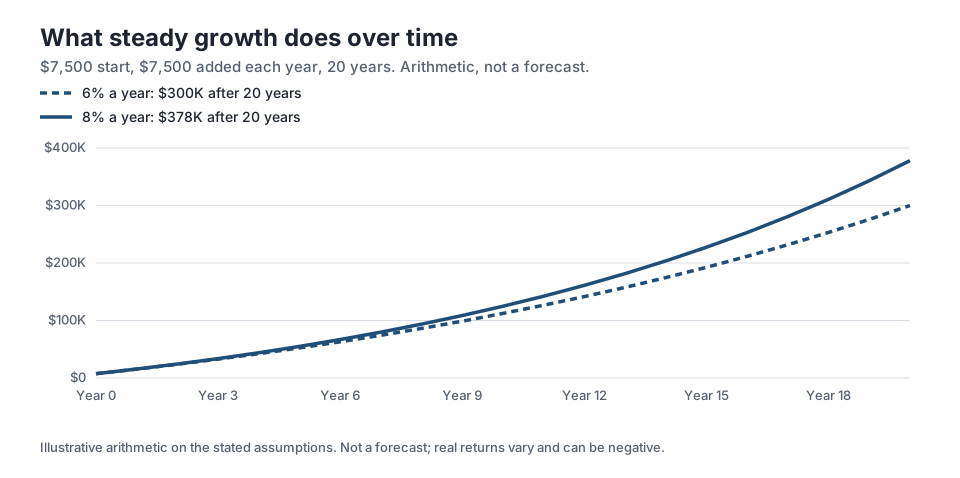
Per IRS rules on IRA contributions, contributions to a Roth IRA are not tax-deductible, but qualified distributions are exempt from federal income tax. To see how repeated annual contributions might compound inside a Roth account, consider a purely illustrative arithmetic calculation that assumes a $7,500 initial deposit followed by $7,500 added each year for 20 years. Under an assumed 6% annual return, the illustrative balance after 20 years reaches $299,945; under an assumed 8% annual return, the illustrative balance reaches $378,172.
Those figures represent arithmetic only under fixed assumptions, not a prediction or forecast of future investment performance. Real-world outcomes depend on market volatility, asset allocation, contribution timing, and whether Congress adjusts IRA rules or contribution limits over two decades. Waiting too long between the traditional deposit and the Roth conversion can also create small taxable earnings if the cash sits uninvested in an interest-bearing money market sweep for months.
Understanding the Pro-Rata Rule
When an individual holds both pre-tax dollars and nondeductible dollars across traditional-style IRAs, the IRS pro-rata rule governs how much of a Roth conversion is taxable. Under IRS rules for Form 8606, the basis in a traditional IRA equals the total of all nondeductible contributions minus any prior nontaxable distributions. That cumulative basis represents money on which the account owner has already settled federal income tax.
To determine the nontaxable portion of a conversion, the IRS divides the individual's total after-tax basis by the combined value of all traditional, SEP, and SIMPLE IRAs. That denominator includes the ending balance on the final day of the calendar year in which the conversion occurs, plus the converted amount itself and any other distributions taken during the year. Every converted dollar is split according to that single ratio.
A frequent pitfall is assuming someone can isolate and convert only the after-tax dollars while leaving pre-tax money behind in another traditional IRA. Another common mistake is thinking the pro-rata formula applies solely to the specific IRA account from which the conversion originates. Even if someone opens a brand-new traditional IRA at a separate brokerage for the nondeductible deposit, the IRS aggregates every non-Roth IRA owned by that individual into one combined calculation.
Because the IRS measures balances on the final day of the conversion year rather than on the date of the transaction, timing matters deeply. Rolling pre-tax IRA dollars into an employer plan in the spring still clears the year-end calculation as long as the pre-tax IRA balance stands at zero when the calendar year ends. Conversely, rolling an old employer 401(k) into a rollover IRA in December after a spring conversion pulls that new balance into the year-end pro-rata denominator.
The Role of Existing Traditional IRAs
High-earning physicians and engineers frequently carry pre-tax IRA balances without realizing how those legacy accounts affect a backdoor Roth strategy. Upon finishing medical residency or leaving a technology employer, workers often transfer an old 403(b) or 401(k) into a rollover traditional IRA for easier management. That rollover preserves pre-tax status, yet it simultaneously introduces pre-tax funds into the IRS pro-rata pool.
Another widespread pitfall is failing to realize that SEP and SIMPLE IRAs are included in the pro-rata calculation alongside traditional and rollover IRAs. Physicians who earn independent contractor income from moonlighting or expert witness work sometimes open a SEP IRA to shelter earnings. Engineers who previously worked at a smaller firm or startup may still hold a SIMPLE IRA from earlier in their career.
Under IRS aggregation rules, balances held inside SEP and SIMPLE IRAs carry the exact same weight as a standard rollover IRA when calculating conversion taxes. Leaving an older SEP or SIMPLE account open creates a hidden tax drag on every future backdoor Roth conversion, even if no new contributions have entered those older accounts for years.
Knowing which accounts fall outside the pro-rata formula is equally important for planning. Employer-sponsored retirement plans such as active 401(k)s, 403(b)s, and governmental 457(b) plans are excluded from the IRA aggregation rule, as are existing Roth IRAs. Only the account owner's own non-Roth IRAs enter the denominator, which explains why clearing or relocating pre-tax IRA balances changes the tax math.
Reporting the Conversion on Form 8606
Proper tax reporting keeps a backdoor Roth IRA from turning into an expensive recordkeeping mistake. Per IRS instructions, filers are required to submit IRS Form 8606 for any year they make a nondeductible contribution to a traditional IRA. In addition, IRS Form 8606 is also used to report conversions from traditional, SEP, or SIMPLE IRAs to a Roth IRA.
Forgetting to file IRS Form 8606 is one of the most consequential errors high earners make, because it can lead to double taxation on the nondeductible contributions. Without Form 8606 on file, the IRS lacks documentation proving that the traditional IRA deposit used already-taxed dollars. When those funds are later converted or withdrawn, the IRS may treat the entire distribution as taxable pre-tax income.
Form 8606 separates the two sides of the transaction into distinct reporting sections. One section tracks cumulative nondeductible contributions, subtracts any prior nontaxable distributions, and applies the year-end pro-rata fraction when pre-tax IRA balances exist. A separate section reports the total amount converted to a Roth IRA during that calendar year and carries any taxable conversion amount onto the filer's main federal income tax return.
Timing differences can complicate tax software entries if an individual makes a prior-year traditional IRA contribution between January and the April tax deadline and converts it shortly afterward. In that scenario, Form 8606 for the prior tax year records the nondeductible basis alone, while the following year's Form 8606 reports the actual conversion. Retaining copies of every filed Form 8606 preserves an accurate paper trail of remaining basis across decades.
A Backdoor Roth IRA Example in Practice
Examining a worked example illustrates how the pro-rata arithmetic affects a high-earning household. Suppose Dr. Aris and Dr. Elena, a married couple filing jointly, earn $400,000 in combined income. Because their joint income exceeds the IRS limit for direct Roth IRA contributions, Aris cannot contribute directly to a Roth IRA. However, Aris already holds a $92,500 pre-tax rollover IRA from his medical residency years.
Wanting to fund a Roth account, Aris deposits a $7,500 nondeductible contribution into a traditional IRA and converts $7,500 to a Roth IRA in the same calendar year. When the IRS aggregates his accounts at year-end, his $92,500 pre-tax rollover balance and his $7,500 after-tax contribution form a combined traditional IRA pool. His after-tax basis represents only a small fraction of that total balance.
Because of the pro-rata rule, only that small fraction of the $7,500 conversion escapes federal income tax. Almost the entire $7,500 conversion is treated as a taxable transfer of pre-tax dollars and added to their $400,000 taxable income for the year. Meanwhile, the unused portion of his $7,500 after-tax basis remains inside the traditional IRA and gets tracked forward on future tax filings.
This outcome leaves the couple weighing distinct trade-offs: rolling the $92,500 pre-tax IRA into Aris's current workplace retirement plan to clear the pre-tax balance, converting the entire combined IRA balance and absorbing the upfront tax bill, or accepting the ongoing pro-rata calculation each year. Before acting, they can ask a licensed tax advisor whether Aris's employer retirement plan accepts incoming IRA rollovers, what fees that plan charges, and how extra taxable income affects their current tax bracket.
Options for Handling Existing Pre-Tax IRAs
When existing pre-tax IRA balances stand in the way of a clean backdoor conversion, high earners generally evaluate three distinct structural approaches. Each path carries specific tax, administrative, and fee consequences depending on employer plan rules, current marginal tax brackets, and long-term retirement goals. Understanding those trade-offs clarifies why two households with identical incomes may handle legacy IRAs differently.
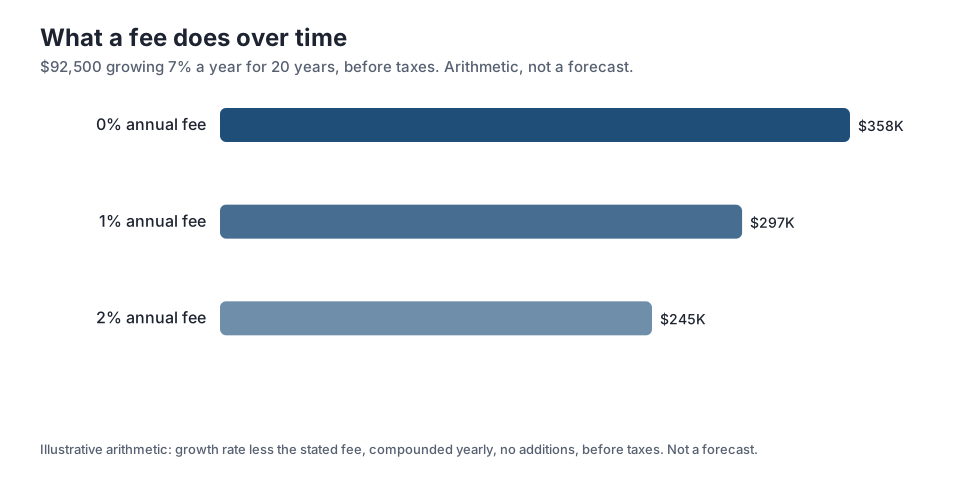
This chart illustrates how different annual fee percentages affect a starting balance over 20 years. Higher fees significantly reduce the final accumulated amount.
Rolling pre-tax IRA dollars into an employer 401(k) avoids immediate taxes, yet plan expenses inside workplace accounts vary widely. To see how ongoing fees affect compounding over time, consider a purely illustrative arithmetic calculation on a $92,500 balance growing at an assumed 7% annual return over 20 years. With a 0% annual fee, the balance reaches $357,946; with a 1% annual fee, it reaches $296,660, or $61,286 less than the lowest-fee case; and with a 2% annual fee, it reaches $245,430, or $112,516 less.
Those figures are arithmetic only under constant assumed returns and fee rates, rather than a forecast of any specific 401(k) plan. The numbers also cannot reflect differences in investment menus, creditor protections, or distribution flexibility between an IRA and an employer plan. Reviewing a workplace plan's summary plan description and fee disclosures alongside a tax professional helps establish the full picture before transferring pre-tax assets.
- Convert the Entire Balance to a Roth IRA: With this option, an individual converts both the new nondeductible contribution and all existing pre-tax traditional IRA balances to a Roth IRA in the same calendar year. Pros: Eliminates all traditional IRA balances, making future backdoor Roth conversions free from pro-rata taxes, and allows all future qualified growth inside the Roth IRA to remain exempt from federal income tax. Cons: Triggers a potentially large immediate income tax bill on the pre-tax balances and could push household income into a higher marginal tax bracket for the year. People weigh this option when the existing pre-tax IRA balance is relatively small or when cash outside the retirement account is available to cover the resulting taxes.
- Roll Pre-Tax IRAs into a Workplace 401(k): With this option, an individual transfers existing pre-tax traditional IRA balances into a current employer's 401(k) plan, leaving a zero balance in traditional IRAs by year-end. Pros: Clears the traditional IRA balance to avoid the pro-rata rule entirely while continuing to defer income taxes on the pre-tax money until retirement. Cons: Requires the employer's 401(k) plan to accept incoming IRA rollovers, and workplace plans may carry higher administrative fees or fewer investment choices than an IRA. People weigh this option when an employer's 401(k) accepts rollovers, offers competitive investment options, and the earner wants to execute backdoor Roth contributions annually without pro-rata taxes.
- Proceed with the Pro-Rata Tax: With this option, an individual makes the nondeductible contribution and converts only that amount, settling the pro-rata income tax on the portion deemed pre-tax. Pros: Moves some assets into a Roth IRA without requiring account transfers to an employer 401(k). Cons: Triggers ordinary income taxes on a share of the conversion every year and requires consistent, accurate tracking of remaining after-tax basis on IRS Form 8606 year after year. People weigh this option when rolling money into a 401(k) is unavailable and the pre-tax balance is too large to convert all at once, yet building Roth assets remains a priority.
Key takeaways
- Workplace retirement plans that allow after-tax 401(k) contributions paired with in-plan Roth conversions operate under separate IRS limits and bypass the IRA pro-rata calculation altogether.
- Temporary income dips during a medical fellowship, parental leave, sabbatical, or career transition can lower the marginal tax cost of converting existing pre-tax IRA balances.
- State income tax treatment of Roth conversions varies across jurisdictions, so state brackets and residency plans factor into the total cost alongside federal tax brackets.
- Retaining digital copies of every filed IRS Form 8606 helps surviving spouses or estate executors verify existing after-tax basis many years after the original contributions.
- Charitable giving tools available later in retirement, such as qualified charitable distributions directly from a traditional IRA, interact differently with pre-tax balances than Roth conversions do.
Sources
- IRS: Retirement Topics - IRA Contribution Limits (https://www.irs.gov/retirement-plans/plan-participant-employee/retirement-topics-ira-contribution-limits)
- IRS: Instructions for Form 8606 (https://www.irs.gov/instructions/i8606)
- IRS: Publication 590-B, Distributions from Individual Retirement Arrangements (IRAs) (https://www.irs.gov/publications/p590b)
- IRS: IRA Deduction Limits (https://www.irs.gov/retirement-plans/ira-deduction-limits)
- IRS: Publication 590-A, Contributions to Individual Retirement Arrangements (IRAs) (https://www.irs.gov/publications/p590a)
11Questions
Frequently asked questions
Can I do a backdoor Roth IRA if I already have a Roth 401(k) at work?
Yes, because IRS contribution limits for employer-sponsored 401(k) plans and individual IRAs are completely separate. Funding a Roth 401(k) at work does not reduce how much an individual can contribute to a traditional IRA for a backdoor conversion, and Roth 401(k) balances are excluded from the IRA pro-rata aggregation formula. Unlike Roth IRAs, however, Roth 401(k) accounts follow workplace plan distribution restrictions while the employee still works for that employer.
Does the pro-rata rule apply to my spouse's traditional IRA balances?
No, because IRAs are strictly individual accounts even when a married couple files a joint federal tax return. The IRS pro-rata calculation looks solely at the traditional, SEP, and SIMPLE IRAs owned by the specific person making the conversion. Consequently, one spouse with no pre-tax IRA balances can complete a clean backdoor Roth conversion while the other spouse leaves pre-tax IRAs untouched, with each spouse reporting activity on a separate Form 8606.
Is there a deadline for converting a nondeductible traditional IRA contribution to a Roth IRA?
The IRS imposes no waiting period or deadline for converting funds already inside a traditional IRA to a Roth IRA. However, the contribution deadline differs from conversion timing: an individual can make a prior-year traditional IRA contribution up to the April tax-filing deadline without extensions, while any Roth conversion is always taxed and reported in the actual calendar year the transfer settles, creating a split-year reporting sequence on Form 8606.
Do inherited IRAs count toward the pro-rata rule calculation?
An inherited traditional IRA held as a non-spouse beneficiary is maintained separately and does not count toward the beneficiary's personal pro-rata rule calculation. By contrast, a surviving spouse who chooses to roll or retitle an inherited traditional IRA into their own name merges that balance into their personal IRA pool, which then brings those inherited pre-tax funds into any future pro-rata calculation.
What happens if my traditional IRA earns interest before I convert it?
Any interest, dividends, or investment gains earned inside a traditional IRA prior to conversion represent pre-tax growth that becomes taxable ordinary income when moved to a Roth IRA. Converting the entire account balance including those small earnings clears the traditional IRA back to a zero balance for year-end pro-rata tracking, though trailing monthly interest dividends posted afterward can leave tiny residual balances unless swept over as well.
Can I undo a Roth IRA conversion if I get hit with a surprise pro-rata tax bill?
No, because federal tax law enacted under the Tax Cuts and Jobs Act eliminated the ability to recharacterize or undo a completed Roth IRA conversion back into a traditional IRA. While a conversion is permanent once processed, an ordinary traditional or Roth IRA contribution made for the current or prior year can still be recharacterized or removed before the tax-filing deadline, including extensions, if caught before conversion.
12Keep reading
Related guides
 Retirement
Should I Roll My Old 401(k) to an IRA When I Change Jobs?
Compare keeping an old 401(k), rolling to a new employer plan, or moving to an IRA, including backdoor Roth pro-rata rules and institutional fee differences. Retirement
How Do Qualified Charitable Distributions From an IRA Work?
Learn how qualified charitable distributions from an IRA work, 2026 IRS limits, RMD rules, and how lowering AGI compares with standard or itemized deductions. Retirement
In What Order Should I Withdraw From My Retirement Accounts?
Learn how blending withdrawals across taxable, tax-deferred, and Roth accounts can manage annual taxes, RMDs, and Social Security timing in retirement.
13Next step
Take the next step
If you want to talk this through, an advisor at the firm can help.
14Next step
Talk it through with the firm
When you would like to talk something through, book a free call or send a message.

You will speak with Tayeb Ayat, the firm’s founder. (888) 336-8586 · info@fenul.com