Retirement · November 16, 2026
Should I Take My Airline Pilot Pension as a Lump Sum or Annuity?
This article compares an airline pilot pension lump sum rollover to a monthly annuity at age 65, covering breakeven math, taxes, inflation, and spousal rules.
12 min read · 10 sections

Deciding between a pension lump sum and a monthly annuity at age 65 involves trading predictable lifetime income for personal investment control. Neither structure suits every cockpit career or household balance sheet. An annuity distributes steady monthly checks for life without portfolio oversight, whereas a lump sum rolled into an individual retirement account preserves access to principal and remaining assets for heirs while shifting market and longevity exposure onto the retiree.
Airline pilots face a distinct retirement timeline because federal aviation rules enforce a hard stop at age 65, leaving no option to extend airline flying years to recover from early portfolio losses. Evaluating the choice involves comparing the monthly payout rate against the lump sum value, testing how inflation erodes fixed checks over two or three decades, and weighing survivor protection for a spouse.
Tax rules, required minimum distributions, and pension insurance limits also shape the outcome. Moving a lump sum directly into an IRA defers federal income taxes until withdrawals begin, whereas cash distributions trigger immediate withholding. Understanding how each mechanism operates allows retiring airline pilots to frame concrete questions with a financial professional before an irrevocable election deadline arrives.
Lump Sum or Monthly Annuity: The Pilot's Pension Decision
Choosing how to receive an accrued defined-benefit airline pension balances lifetime income stability against asset flexibility. Under a monthly annuity, the pension plan converts a pilot's accrued benefit into regular checks that continue for life, transferring investment risk to the plan sponsor. Under a lump sum election, the plan calculates the actuarial present value of those future payments and distributes a single capital amount eligible for an IRA rollover.
Timing makes this choice especially consequential for commercial aviators. Under 14 CFR 121.383, enforced by the Federal Aviation Administration, airline pilots operating under Part 121 are required to retire upon reaching their 65th birthday. Because career airline earnings end abruptly on that birthday, pilots often rely on their pension election to anchor household cash flow immediately after leaving the flight deck.
| Monthly Annuity | Lump Sum | |
|---|---|---|
| Income stability | Regular checks that continue for life | Anchors cash flow but depends on withdrawals |
| Investment risk | Transferred to the plan sponsor | Assumed by the pilot |
| Flexibility | Fixed monthly payments | Eligible for an IRA rollover |
This table compares a monthly annuity against a lump sum payout. It highlights differences in income stability, investment risk, and flexibility.
Plan solvency also enters the evaluation when assessing long-term annuity promises. If a distressed single-employer pension plan terminates without sufficient funding, the Pension Benefit Guaranty Corporation assumes responsibility up to statutory limits. For a 65-year-old retiree in 2026, the PBGC maximum insured pension benefit is $93,477.24 per year, or $7,789.77 per month, meaning larger airline pensions face potential benefit reductions if a carrier fails.
- Single-Life Monthly Annuity: The pension plan distributes a fixed monthly amount for the rest of the pilot's life and stops upon death. Pros include lifetime income regardless of market swings, zero investment management duties, and a predictable baseline for fixed living expenses. Cons include flat payments that lose ground to inflation, zero remaining pension asset for heirs, and no liquidity for large unexpected expenses. Pilots weigh this option when prioritizing steady income, expecting longer-than-average longevity, and holding other assets for legacy goals.
- Joint and Survivor Monthly Annuity: The pension plan distributes a reduced monthly amount during the pilot's lifetime and continues a percentage to a surviving spouse after death. Pros include protecting a spouse from outliving the income stream, shifting dual-life longevity risk to the pension plan, and creating a steady household financial floor. Cons include a lower initial payout than the single-life option, complete termination of benefits after both spouses pass away, and inflation erosion across two lifetimes. Pilots weigh this option when a spouse relies heavily on pension income and neither partner wants portfolio management duties.
- Lump Sum Rollover to an IRA: The retiree declines lifetime monthly checks and transfers the pension's entire present value directly into a traditional IRA. Pros include total control over investment choices, the ability to pass remaining balances to heirs, and flexible withdrawal amounts as tax or spending needs change. Cons include absorbing all market and longevity risk personally, maintaining ongoing portfolio discipline, and risking depletion if market declines hit early in retirement. Pilots weigh this option when leaving an inheritance, managing investments personally, and adjusting withdrawals for inflation are priorities.
How the Mandatory Age 65 Retirement Impacts Your Choice
The federal mandate in 14 CFR 121.383 removes a common financial buffer available to workers in many other professions. Unlike corporate executives or independent business owners who can postpone retirement for several years if financial markets decline near their target exit date, Part 121 airline pilots are required to step out of the cockpit at age 65 regardless of market valuations or interest rate levels.
That fixed exit date magnifies sequence of returns risk for anyone electing a lump sum rollover. A frequent pitfall is assuming a retiree can easily surpass a pension's implied payout rate through market investing without accounting for the order in which returns arrive. When an IRA experiences sharp losses during the early years of retirement while simultaneously funding fixed monthly withdrawals, fewer shares remain invested to capture any subsequent market recovery.
Returning to major airline captain wages to rebuild a depleted portfolio is not permitted under Part 121 rules after age 65, although some retired aviators transition into simulator instruction, corporate aviation, or consulting work. By contrast, electing a monthly annuity insulates that portion of retirement income from early market downturns, because the pension plan continues distributing the scheduled monthly benefit regardless of equity or bond market volatility.
Interest rate movements prior to retirement also affect the lump sum side of the ledger. Because pension actuaries calculate lump sum payouts by discounting future monthly checks using statutory corporate bond interest rates, higher interest rates shrink the lump sum offered for the same monthly annuity, while lower rates expand it. Pilots approaching age 65 track their plan's rate lock dates so sudden rate shifts do not catch them off guard.
Calculating the Breakeven Point
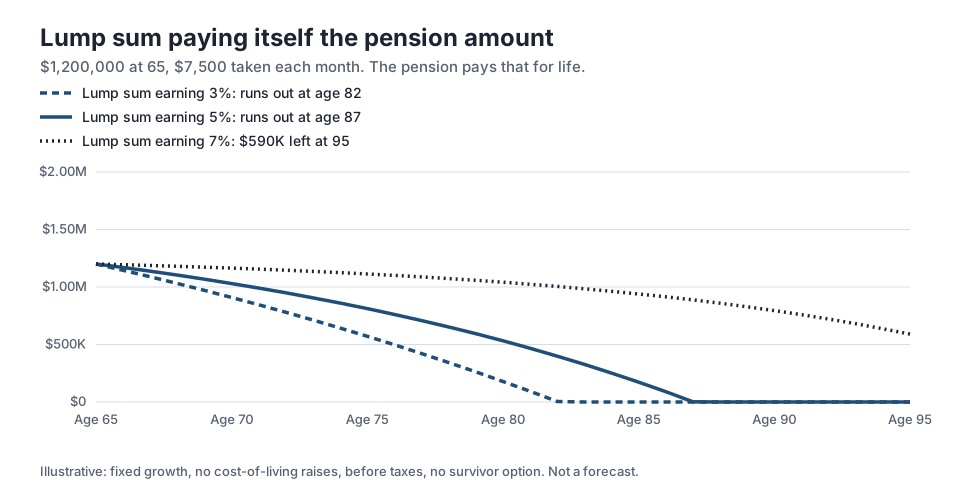
Comparing a lump sum against a lifetime annuity begins with breakeven math, illustrated through Captain David. Retiring from a major airline at age 65, David chooses between a $1,200,000 lump sum or a single-life annuity of $7,500 per month, equal to $90,000 per year. Dividing the $90,000 annual benefit by the $1,200,000 lump sum shows the pension distributes 7.5% of the lump sum value each year.
Without factoring in investment growth, cumulative $90,000 annual annuity checks surpass the initial $1,200,000 lump sum after more than a decade. If David lives into his eighties and nineties, cumulative single-life annuity payments reach $1,800,000 by age 85 and $2,700,000 by age 95. Those cumulative totals underscore how longevity shapes the comparison between lifetime checks and a finite capital pool.
Rolling the $1,200,000 lump sum into an IRA changes the math once assumed investment returns enter the calculation alongside $7,500 monthly withdrawals. Under a steady 3% assumed annual return, the IRA balance runs out at age 82. Under a conservative 5% assumed annual return, the balance lasts past age 85 and runs out at age 87. Under an assumed 7% annual return, the account funds every $7,500 monthly withdrawal and leaves $590,015 at age 95.
These illustrative calculations assume constant annual returns rather than uneven market swings, highlighting the pitfall of underestimating life expectancy and outliving a lump sum drawn down too quickly. David weighs the predictability of monthly airline checks that continue for life against the flexibility and legacy potential of an IRA, and the questions to ask an advisor about how inflation and his spouse's needs alter the math.
Tax Implications of Your Pension Payout
Tax outcomes diverge sharply depending on how pension funds leave the employer plan. Monthly annuity checks are generally taxed as ordinary federal income in the year received, assuming all benefits accrued through pre-tax employer contributions. By contrast, executing a direct rollover moves the lump sum straight from the pension plan trustee to an IRA custodian, preserving tax deferral until future withdrawals occur.
Internal Revenue Service Publication 575 explains how to report distributions from pensions and annuities on a federal income tax return, including the procedures governing tax-deferred rollovers. Under IRS rules detailed in Publication 575, a direct rollover of an eligible pension lump sum to a traditional IRA avoids the mandatory 20% federal income tax withholding applied to payouts sent directly to the participant.
- If a lump sum is sent directly to the participantthe payout is subject to a mandatory 20% federal income tax withholding.
- If a lump sum is moved as a direct rollover to a traditional IRAthe mandatory 20% federal income tax withholding is avoided.
This flow chart explains how the payout method affects federal income tax withholding. A direct rollover avoids mandatory withholding, while a direct payment triggers it.
A costly pitfall occurs when a retiring pilot requests the lump sum as a personal cash check rather than a direct rollover. Receiving cash directly triggers the mandatory 20% federal tax withholding, leaving the pilot with less cash than the gross pension distribution. To avoid owing ordinary income taxes on that withheld sum, the retiree has to replace the missing 20% using outside cash within the IRS rollover window to finish an indirect rollover.
State income taxes and ongoing withholding elections add another layer to the comparison. While federal rules govern the 20% withholding on non-direct cash payouts and tax-deferred IRA rollovers, state taxation of monthly airline pensions versus traditional IRA withdrawals varies widely across jurisdictions. Reviewing state residency plans and filing IRS withholding forms helps retirees avoid unexpected tax balances or underpayment penalties during their initial retirement years.
Inflation and the Purchasing Power of a Fixed Pension
Over a 20- to 30-year retirement, rising consumer prices steadily reduce the real purchasing power of fixed monthly checks. Most private-sector airline defined-benefit pensions do not include an automatic cost of living adjustment, unlike Social Security benefits. A frequent pitfall is forgetting that a fixed monthly pension loses significant purchasing power over a 20-year retirement, leaving retirees either to trim living standards or pull larger amounts from outside savings.
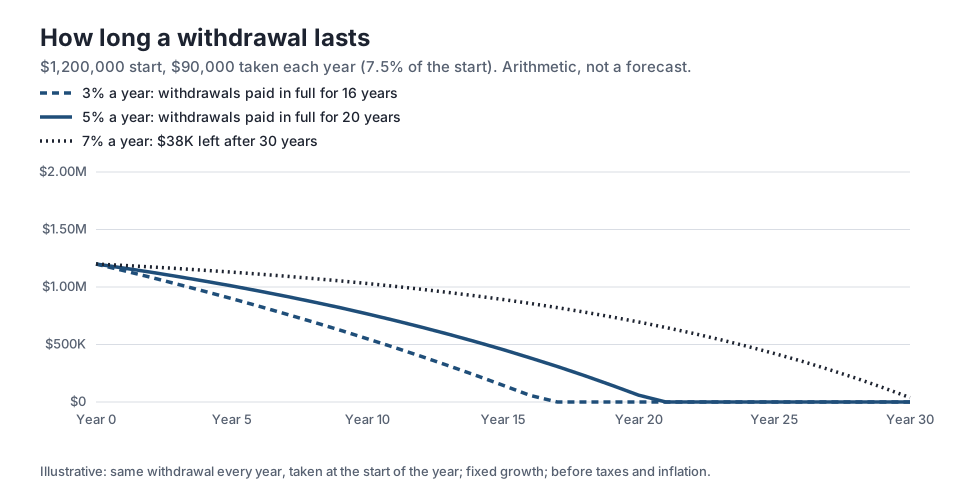
Rolling a lump sum into an IRA offers flexibility to adjust annual withdrawals as living costs rise, though higher withdrawals accelerate depletion when market returns lag. Using an illustrative $1,200,000 starting balance with $90,000 withdrawn each year, equal to 7.5% of the start balance, portfolio longevity depends heavily on assumed annual returns. At an assumed 3% annual growth rate, the $90,000 annual withdrawal is paid in full for 16 years before the money runs out.
At an assumed 5% annual growth rate, the $90,000 withdrawal is paid in full for 20 years before the money runs out, whereas an assumed 7% annual growth rate funds every withdrawal across 30 years and leaves $38,132 remaining. Because these arithmetic illustrations hold annual withdrawals flat rather than increasing them for inflation, retirees evaluate whether separate growth investments or delayed Social Security claiming can help counter fixed pension erosion.
Survivor Benefits and Protecting Your Spouse
Married pilots weigh how each pension election protects a surviving spouse if the pilot dies earlier in retirement. A single-life annuity delivers the largest monthly benefit while the pilot is alive, yet payments cease completely at death, potentially leaving a spouse without that cash flow. Selecting a joint-and-survivor annuity reduces the initial monthly payout in exchange for continuing a percentage of that benefit to the surviving spouse for life.
Federal pension insurance caps also reflect survivor elections. Under Pension Benefit Guaranty Corporation rules, the PBGC insured benefit limit is reduced if a benefit will be paid to a survivor upon the participant's death, creating a lower dollar cap than the single-life limit. Conversely, rolling a lump sum into an IRA allows a spouse named as beneficiary to inherit the remaining account balance, though that balance fluctuates with market returns and prior withdrawals.
Federal retirement statutes enforce strict procedural safeguards for married plan participants. A common pitfall is overlooking the spousal consent requirement before submitting pension election paperwork. Under federal pension rules, a married pilot cannot select a single-life annuity or a lump sum payout over the default joint-and-survivor annuity unless the spouse executes a written waiver, typically notarized or witnessed by a plan representative, within the plan's election window.
Required Minimum Distributions (RMDs) from an IRA
Although a direct rollover to a traditional IRA shields a lump sum from immediate taxation, Internal Revenue Service rules do not let pre-tax retirement accounts compound indefinitely without taxation. Once an account owner reaches the applicable statutory starting age, federal rules mandate annual withdrawals called required minimum distributions, calculated by dividing the prior year-end IRA balance by an IRS life expectancy divisor.
Internal Revenue Service Publication 590-B outlines the timelines and calculation rules governing individual retirement arrangements. Under current IRS rules in Publication 590-B, traditional IRA owners born between 1951 and 1959 are required to begin taking required minimum distributions at age 73. Traditional IRA owners born in 1960 or later are required to begin taking required minimum distributions at age 75.
Required distributions count as ordinary taxable income and can lift household income into higher marginal tax brackets or higher Medicare premium tiers later in retirement. By contrast, a monthly pension annuity already distributes taxable income each year, avoiding separate RMD calculations on that benefit. Pilots evaluating an IRA rollover examine how future RMDs interact with Social Security, defined-contribution retirement accounts, and potential Roth conversions between age 65 and age 73 or age 75.
Making the Final Decision
Finalizing a pension election brings together breakeven math, tax timing, health outlook, and family goals before the airline's administrative deadline locks in the choice. Pilots retiring earlier than age 65 through voluntary programs also review early distribution rules: IRS Publication 590-B states that withdrawals from a traditional IRA before age 59 1/2 are generally subject to a 10% additional early withdrawal tax unless a statutory exception applies.
Weighing these pension mechanics alongside defined-contribution retirement accounts, taxable brokerage savings, and projected Social Security benefits clarifies whether the pension is intended to serve as a fixed income floor or a flexible capital pool. At Fenul Wealth Management, fees are set out in the firm's written agreement before you engage, and licensed professionals can model side-by-side cash flows across varying lifespans, tax brackets, and inflation scenarios.
Before signing irrevocable election documents, retiring pilots frequently compile their pension benefit statements, spousal age details, and outside account balances to review with a financial advisor and a qualified tax preparer. Raising targeted questions helps ensure every long-term trade-off is examined clearly prior to benefit commencement.
- How does the pension's implied annual payout rate compare against a sustainable IRA withdrawal strategy once inflation and uneven market returns are modeled?
- How would a surviving spouse's annual cash flow and tax brackets differ between a joint-and-survivor annuity and an inherited IRA balance?
- How will required minimum distributions starting at age 73 or age 75 interact with Social Security benefits, defined-contribution savings, and Medicare premium thresholds?
- Do early retirement age penalties, spousal waiver deadlines, or Pension Benefit Guaranty Corporation coverage caps affect the specific airline plan terms?
Key takeaways
- Actuarial interest rate windows inside an airline pension plan can change a lump sum quote significantly from one quarter or plan year to the next, making it important to verify the exact calculation date before submitting election paperwork.
- Beneficiary designations on a traditional IRA override provisions written in a last will and testament, so couples selecting a lump sum rollover separately review primary and contingent beneficiary forms with their IRA custodian.
- Retiree medical bridge benefits or flight pass privileges offered by an airline sometimes depend on whether a pilot retires directly into monthly pension status, warranting a check of human resources benefit rules alongside financial math.
- Income spikes caused by large IRA withdrawals can trigger higher income-related monthly adjustment amounts on Medicare Part B and Part D premiums two years later, an indirect cost that steady monthly pension checks often avoid.
- Once benefit commencement occurs or an annuity election passes the plan's revocation window, the choice between a lump sum and a lifetime monthly payout is typically permanent and cannot be reversed.
Sources
- eCFR :: 14 CFR 121.383 -- Airman: Limitations on use of services (https://www.ecfr.gov/current/title-14/part-121/section-121.383)
- Maximum Monthly Guarantee Tables | Pension Benefit Guaranty Corporation (https://www.pbgc.gov/wr/benefits/guaranteed-benefits/maximum-guarantee)
- Publication 575 - Internal Revenue Service (https://www.irs.gov/publications/p575)
- Publication 590-B - Internal Revenue Service (https://www.irs.gov/publications/p590b)
11Questions
Frequently asked questions
Can I roll my airline pension lump sum directly into a Roth IRA?
Yes, federal rules permit a direct rollover from a qualified pension plan into a Roth IRA, though the transaction counts as a taxable Roth conversion in the year completed. Pre-tax pension dollars transferred into a Roth IRA are added to ordinary taxable income for that calendar year, while avoiding the 10% additional early withdrawal tax if executed as a direct transfer.
What happens to my pension if the airline goes bankrupt?
If a carrier enters bankruptcy and terminates an underfunded single-employer pension plan, the Pension Benefit Guaranty Corporation steps in as trustee and distributes monthly benefits up to statutory age-adjusted limits. By contrast, a lump sum already transferred into an individual retirement account belongs personally to the retiree and remains outside the airline's bankruptcy proceedings, though plans sometimes restrict lump sum payouts during severe underfunding before termination.
Do I owe taxes immediately if I take the lump sum in cash?
Requesting the lump sum as a direct cash distribution triggers mandatory 20% federal income tax withholding by the plan administrator, and the entire taxable distribution is reported on your return for that year. Unless you deposit the full gross distribution, using outside personal savings to replace the 20% withheld, into an eligible IRA within the IRS indirect rollover window, the unrolled portion becomes permanently taxable and may incur early withdrawal taxes if under age 59 1/2.
How does the PBGC maximum benefit limit affect my highly compensated pilot pension?
Long-tenured captains whose earned airline benefit exceeds the PBGC 2026 maximum of $93,477.24 per year ($7,789.77 per month) at age 65 face benefit reductions down to that statutory cap if the qualified plan fails. In addition, non-qualified excess benefit plans created for highly compensated pilots above IRS qualified plan limits receive no PBGC coverage and rank as unsecured claims in an airline bankruptcy.
Can I take a partial lump sum and a reduced monthly annuity?
Availability of a split distribution depends strictly on the written provisions of the employer's pension plan document. While many legacy airline defined-benefit plans offer an all-or-nothing choice between a full lump sum and a full annuity, other plans permit electing a partial lump sum alongside a reduced monthly annuity, making the Summary Plan Description the primary source to verify.
Will my monthly pension payments increase with inflation?
Most private-sector airline defined-benefit pensions distribute flat nominal dollar amounts for life without automatic cost of living adjustments, unlike Social Security or certain government pensions. Pilots review their individual Summary Plan Description or union contract benefit summary to confirm whether any scheduled escalators or ad hoc increases exist, because fixed payments otherwise lose real purchasing power as consumer prices rise.
12Keep reading
Related guides
 Retirement
In What Order Should I Withdraw From My Retirement Accounts?
Learn how blending withdrawals across taxable, tax-deferred, and Roth accounts can manage annual taxes, RMDs, and Social Security timing in retirement. Retirement
When Do I Stop HSA Contributions Before Enrolling in Medicare?
Learn how the six-month retroactive Medicare Part A rule affects HSA eligibility at 65, how to time your final contribution, and how to avoid the 6% penalty. Social Security
Should I Claim Social Security at 65 or Wait Until 70?
Airline pilots face mandatory retirement at 65, but claiming Social Security is a separate choice. Compare claiming at 65 against bridging to 67 or 70.
13Next step
Take the next step
If you want to talk this through, an advisor at the firm can help.
14Next step
Talk it through with the firm
When you would like to talk something through, book a free call or send a message.

You will speak with Tayeb Ayat, the firm’s founder. (888) 336-8586 · info@fenul.com