Social Security · November 14, 2026
Should I Claim Social Security at 65 or Wait Until 70?
Airline pilots face mandatory retirement at 65, but claiming Social Security is a separate choice. Compare claiming at 65 against bridging to 67 or 70.
12 min read · 9 sections

Airline pilots face an abrupt career deadline at age 65, when federal rules require an immediate stop to commercial line flying. Because airline wages end on that birthday, many pilots assume Social Security benefits have to begin at the same time. In reality, leaving the cockpit and filing for Social Security are two independent decisions. A pilot can leave an airline at 65 and delay Social Security until full retirement age at 67 or as late as age 70.
Generic retirement articles often advise workers to delay Social Security by staying on the job a few extra years. That path is closed to Part 121 captains and officers, which changes the financial math. Instead of relying on continued airline employment, pilots who delay benefits bridge the income gap using retirement accounts, taxable savings, or post-airline earnings. Claiming at 65 provides immediate monthly cash flow and reduces early portfolio withdrawals, while bridging trades upfront savings for a higher benefit later.
Deciding between claiming at 65 and waiting involves weighing longevity expectations, spousal protection, investment risk, and multi-year tax brackets. Neither timing choice fits every household. Understanding the exact reduction formulas, delayed retirement credits, survivor rules, and withdrawal mechanics allows pilots and their spouses to evaluate each path with clear assumptions before filing a claim with the Social Security Administration.
The Age 65 Mandate: Forced Retirement vs. Claiming Age
Under federal aviation regulation 14 CFR § 121.383, set by the Federal Aviation Administration, no pilot may serve in Part 121 commercial airline operations after reaching age 65. That statutory birthday triggers an automatic halt to flying for major carriers, regardless of a pilot's health, seniority, or desire to keep working. While some pilots transition into simulator instruction or corporate aviation, most experience a complete stop in their primary career earnings right at age 65.
A common pitfall is assuming that mandatory retirement at 65 requires filing for Social Security at 65. The Social Security Administration ties benefit timing to birth year rather than employer or aviation rules. Retirement benefits can begin as early as age 62, reach their baseline unreduced level at full retirement age, or grow through age 70. Separating the date airline flying stops from the date Social Security checks start opens up several ways to structure early retirement income.
When airline compensation stops at 65, household spending continues, which creates an income gap until Social Security begins. Bridging that gap means funding living expenses from existing assets, such as a 401(k), traditional IRA, or brokerage account, for two to five years. Whether drawing down savings early is preferable to claiming a smaller Social Security check immediately depends on portfolio size, tax brackets, health outlook, and how long a surviving spouse might rely on the benefit.
The Math of Delaying Social Security
For anyone born in 1960 or later, the Social Security Administration sets full retirement age at 67. Filing before age 67 results in a permanent reduction to the Primary Insurance Amount, which is the baseline monthly check earned at full retirement age. According to Social Security Administration rules, claiming at age 65 instead of 67 permanently reduces the monthly benefit by 13.3%. On an illustrative age-67 benefit of $3,500 a month in today's dollars, claiming at 65 produces $3,033 a month, or 86.7% of the full amount.
Waiting past full retirement age works in the opposite direction through delayed retirement credits. Under Social Security Administration rules, each full year a worker waits past age 67 increases the monthly benefit by 8% per year, stopping at age 70. Waiting all three years raises the illustrative $3,500 monthly benefit to $4,340 a month, or 124% of the age-67 amount. No additional credits accrue after age 70, so there is no financial reason to delay claiming past that birthday.
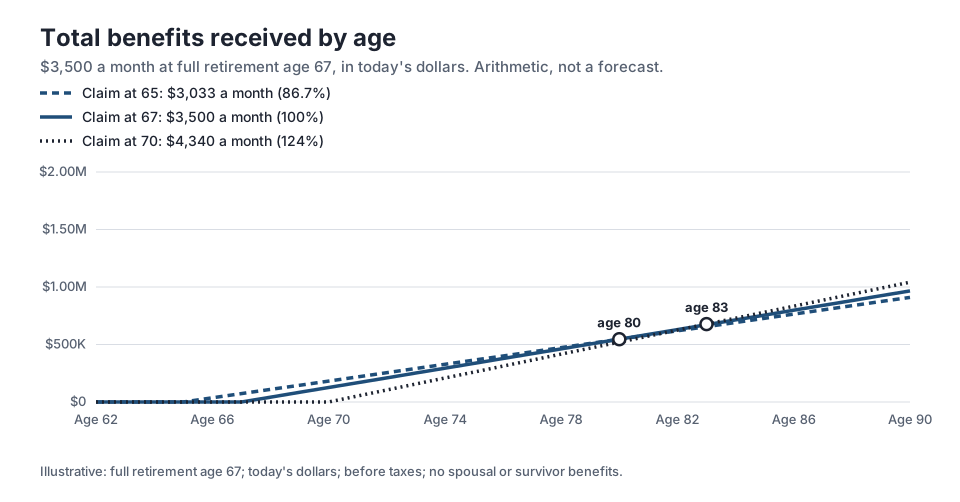
Cumulative lifetime totals illustrate the break-even math in pure arithmetic, holding benefits in today's dollars before taxes. Claiming $3,033 a month at 65 delivers $545,940 by age 80 and $909,900 by age 90. Waiting until 67 for $3,500 a month reaches $546,000 by age 80 and $966,000 by age 90, catching up to the age-65 total around age 80. Delaying to 70 for $4,340 a month yields $520,800 by age 80 and $1,041,600 by age 90, catching up to the age-67 total around age 83.
One frequently overlooked factor in that break-even comparison is how annual cost-of-living adjustments interact with claiming age. The Social Security Administration applies cost-of-living adjustments as a percentage increase to whatever monthly benefit a person is receiving or has earned. Because compounding applies to the higher base, every future inflation adjustment adds more dollars to an age-70 benefit than to an age-65 benefit. That compounding effect can modestly pull the real-world break-even age earlier than simple constant-dollar arithmetic indicates.
Protecting Your Spouse: The Survivor Benefit
Married pilots face a claiming decision that affects two lifetimes rather than one. Under Social Security Administration rules, a surviving spouse who has reached full retirement age can receive up to 100% of the deceased worker's benefit, including any delayed retirement credits the worker earned by waiting to claim. Because many pilot households have one higher earner and one lower-earning spouse, the timing of the higher earner's claim sets the permanent floor for whichever spouse lives longer.
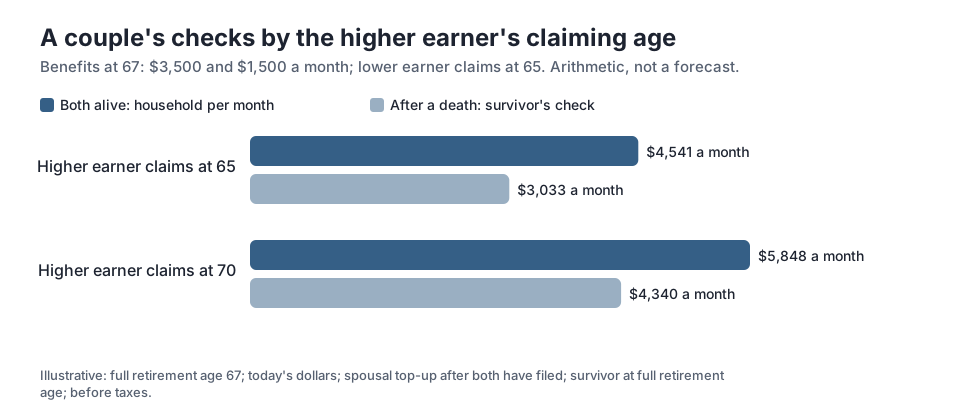
A common oversight is forgetting that a surviving spouse inherits delayed retirement credits earned by the higher earner. Consider an illustrative couple whose full-retirement-age benefits at 67 are $3,500 a month for the higher earner and $1,500 a month for the lower earner, where the lower earner claims at 65 and receives $1,508. If the higher earner claims at 65 for $3,033, combined checks equal $4,541 a month, and after the higher earner's death the survivor receives $3,033 a month.
By contrast, when that higher earner delays to age 70 for $4,340 a month, the couple's combined income rises to $5,848 a month while both spouses are living. When the higher earner dies, the lower-earning spouse's smaller check ends and the survivor steps up to $4,340 a month. Under Social Security Administration survivor rules, the survivor receives the larger of their own check or the deceased spouse's benefit, at least 82.5% of the deceased's age-67 amount if the deceased claimed early, provided the survivor is at full retirement age.
Bridging the Gap with Portfolio Withdrawals
To delay Social Security past mandatory retirement at 65, pilots usually replace missing airline income with distributions from a 401(k), IRA, or brokerage account. Many retirees hesitate to touch retirement accounts at 65 out of concern over early withdrawal penalties. According to the Internal Revenue Service, distributions from a qualified retirement plan or IRA before age 59 1/2 are generally subject to a 10% additional tax. Because mandatory pilot retirement occurs at 65, that age-based penalty no longer applies.
Pilots who leave an airline even earlier through early retirement packages or medical transitions have another provision to understand. Under the Internal Revenue Service Rule of 55, an employee who separates from service during or after the year they reach age 55 can take distributions from that employer's 401(k) plan without the 10% additional tax. That exception applies specifically to the separating employer's qualified plan, whereas funds rolled over into a traditional IRA generally remain subject to the age 59 1/2 threshold.
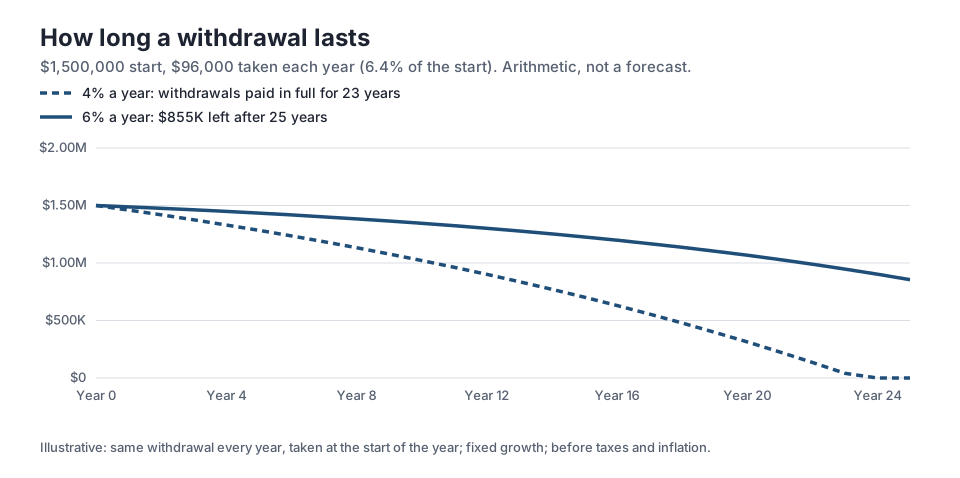
Whether a portfolio can support five years of bridge spending depends on withdrawal size, asset growth, and investment volatility. Pure arithmetic illustrates the sensitivity to market returns, though it is not a forecast of future performance. Starting from $1,500,000 and withdrawing $96,000 a year, or 6.4% of the starting balance, an assumed annual return of 4% covers the $96,000 withdrawal in full for 23 years before the account reaches zero. At an assumed annual return of 6%, every $96,000 withdrawal is covered for 25 years, leaving $854,793 remaining.
Real-world portfolios do not earn steady returns like 4% or 6% every year. Pulling large annual sums from investments during the bridge window introduces sequence-of-returns risk, meaning a sharp stock market drop right after age 65 forces sales at depressed prices. Even if long-term average returns turn out higher later, early losses paired with heavy withdrawals can permanently impair portfolio longevity. Evaluating cash buffers and asset mix before retiring helps clarify how much market risk a bridge strategy carries.
Tax Implications of the Bridge Strategy
Funding five years of living expenses entirely from pre-tax 401(k) or traditional IRA accounts can significantly alter a household's tax picture. Another frequent pitfall is ignoring the immediate tax cost of pulling large sums out of tax-deferred accounts to bridge to age 70. Every dollar withdrawn from a traditional pre-tax retirement account is taxed as ordinary income in the year of distribution, which can push taxable income into higher federal brackets during the bridge period compared with claiming Social Security at 65.
At the same time, those early withdrawals reduce the pre-tax balance that remains subject to future mandatory distributions. Under Internal Revenue Service rules, required minimum distributions from traditional IRAs and 401(k) plans generally are required to begin for the year a person reaches age 73. If a pilot leaves a large pre-tax balance untouched until age 73 while also collecting a larger age-70 Social Security benefit, the combination of mandatory withdrawals and taxable Social Security income can create a steep tax spike later in retirement.
Social Security benefits themselves follow distinct federal tax rules that differ from 401(k) distributions. Depending on a couple's combined income, a substantial portion of Social Security benefits can avoid federal income tax altogether, whereas every dollar taken from a traditional 401(k) is fully taxable. Shifting income toward pre-tax withdrawals between ages 65 and 70 and toward Social Security after age 70 changes which dollars appear on future tax returns, making multi-year tax projections valuable for pilots weighing a bridge.
Evaluating Your Claiming Options
At age 65, pilots generally evaluate three claiming timelines: filing for Social Security immediately upon leaving the cockpit, bridging two years to full retirement age at 67, or bridging five years to age 70. Each path balances early portfolio preservation against lifetime monthly income and spousal security. Weighing these choices involves looking at health and family longevity, total retirement savings, tax brackets during the bridge years, and whether a spouse relies on the higher earner's benefit.
Claiming Social Security at 65 means filing immediately upon mandatory retirement and accepting a permanently reduced monthly benefit. Pros include preserving retirement savings by lowering early withdrawals, providing immediate monthly income to replace airline wages, and avoiding the risk of dying before reaching the break-even age. Cons include locking in a 13.3% lifetime reduction compared with age 67, permanently lowering the survivor check for a widow or widower, and receiving smaller cost-of-living dollar increases. Some pilots weigh this option when savings are modest, health limits longevity, or a spouse has a higher benefit.
Bridging to full retirement age at 67 uses two years of 401(k) or IRA withdrawals to cover living expenses before claiming an unreduced benefit. Pros include securing 100% of the Primary Insurance Amount with no early reduction, limiting heavy portfolio withdrawals to two years, and providing a larger survivor benefit than claiming at 65. Cons include drawing down savings during the initial two years of retirement, forfeiting the higher 124% benefit available at age 70, and increasing taxable income during the bridge. Some pilots weigh this option when seeking their full baseline benefit without a five-year portfolio drain.
Bridging to age 70 relies on portfolio withdrawals or outside income for five years while Social Security earns delayed retirement credits up to 124% of the age-67 amount. Pros include maximizing monthly lifetime income, securing the highest possible survivor benefit for a spouse, and reducing future pre-tax balances before age-73 required minimum distributions begin. Cons include heavy early withdrawals that heighten market downturn risk, a multi-year wait past age 80 to break even on cumulative checks, and potentially higher bridge-year tax brackets. Some pilots weigh this option when savings are substantial and longevity or spousal protection is a priority.
- Official Primary Insurance Amount estimates for both spouses from the Social Security Administration
- Pre-tax versus taxable account balances available to fund spending between ages 65 and 70
- Plan-specific 401(k) withdrawal rules from the airline's retirement administrator
- Projected marginal federal and state tax brackets across the bridge years and past age 73
Walk-through: Captain John's Decision
To see how the numbers interact in practice, consider Captain John, age 65, and his wife Mary, age 63. Federal rules require John to retire from commercial flying this year. His Primary Insurance Amount at age 67 is $3,500 a month, and he holds $1,500,000 in his 401(k). Claiming Social Security immediately at 65 gives him $3,033 a month, while waiting until age 70 raises his monthly check to $4,340. John and Mary need $8,000 a month to cover retirement living expenses.
If John claims at 65, his $3,033 Social Security check covers part of their $8,000 monthly budget, leaving $4,967 a month to withdraw from his 401(k). That path keeps annual withdrawals smaller from the start and leaves more money invested in the 401(k) early on, while locking in the permanent benefit reduction. Because John is 65, distributions from his 401(k) avoid the early withdrawal penalty. Mary's own claiming decision at 65 or later will also adjust how much the household draws from savings.
If John instead bridges to age 70, he takes no Social Security and withdraws the full $96,000 a year from his $1,500,000 balance to meet their $8,000 monthly need. At 6.4% of his starting balance, that $96,000 annual draw tests portfolio durability: under illustrative arithmetic, a steady 4% return sustains the full withdrawal for 23 years, whereas a 6% return sustains it for 25 years with $854,793 left. In exchange for the portfolio drain, John's cumulative Social Security total passes his age-67 baseline around age 83.
Beyond break-even math, delaying to 70 alters Mary's financial security if John dies before her. Under survivor rules, Mary could step up to John's $4,340 monthly benefit rather than $3,033, substantially reducing the income drop she would face alone. John and Mary face a clear trade-off between preserving upfront 401(k) liquidity and building larger lifetime and survivor income. Key questions for an advisor include how $96,000 in annual bridge withdrawals affects their tax bracket, whether market downturns threaten the portfolio draw, and how Mary's claiming age fits the household plan.
- Social Security benefit$3,033
- 401(k) withdrawal$4,967
- Total monthly need$8,000
A breakdown of how Captain John meets his monthly retirement budget by combining Social Security and portfolio withdrawals.
Key takeaways
- Missing early-career credits or recent high-earning years on a Social Security Administration statement can shift the baseline Primary Insurance Amount.
- Some employer 401(k) plans restrict distribution frequency compared with an IRA, which affects flexible monthly or annual partial withdrawals after age 65.
- Spending pre-tax 401(k) dollars for living expenses may already fill lower federal tax brackets, affecting Roth conversion room.
- Fixed-income or cash reserves inside a retirement plan can fund near-term withdrawals so an equity downturn does not force stock sales during the bridge years.
- Medicare eligibility begins at 65 even when retirement benefits wait until 70, meaning health coverage and Medicare enrollment timelines are separate from Social Security claiming.
Sources
- 14 CFR § 121.383 - Airman: Limitations on use of services. (https://www.ecfr.gov/current/title-14/chapter-I/subchapter-G/part-121/subpart-M/section-121.383)
- Starting Your Retirement Benefits Early | SSA (https://www.ssa.gov/benefits/retirement/planner/agereduction.html)
- Delayed Retirement Credits | SSA (https://www.ssa.gov/benefits/retirement/planner/delayret.html)
- Survivors Benefits | SSA (https://www.ssa.gov/benefits/survivors/ifyou.html)
- Topic No. 558, Additional Tax on Early Distributions from Retirement Plans Other Than IRAs | Internal Revenue Service (https://www.irs.gov/taxtopics/tc558)
- Retirement Topics - Exceptions to Tax on Early Distributions | Internal Revenue Service (https://www.irs.gov/retirement-plans/plan-participant-employee/retirement-topics-exceptions-to-tax-on-early-distributions)
- Retirement Topics — Required Minimum Distributions (RMDs) | Internal Revenue Service (https://www.irs.gov/retirement-plans/plan-participant-employee/retirement-topics-required-minimum-distributions-rmds)
- Benefit Reduction for Early Retirement | SSA (https://www.ssa.gov/oact/quickcalc/earlyretire.html)
10Questions
Frequently asked questions
Can I fly for a foreign airline after age 65 to bridge the gap?
Foreign carriers operate under aviation authorities outside the United States, and several international jurisdictions allow commercial flying past age 65. Earning wages abroad can replace portfolio withdrawals during a bridge period, though pilots who claim Social Security before full retirement age while working outside the country remain subject to Social Security Administration foreign work rules and earnings tests. Cross-border income also introduces tax treaty, foreign tax credit, and Social Security totalization agreement questions that warrant review with an international tax specialist.
Does my pilot pension affect my Social Security benefit?
Traditional defined benefit pensions from commercial airlines do not reduce Social Security retirement or survivor benefits because airline wages were subject to Social Security employment taxes throughout your career. By contrast, pensions earned from employment where Social Security taxes were not withheld, such as certain state, municipal, or foreign government roles, have historically involved separate coordination rules. Checking your Social Security earnings record confirms that all airline service years were properly credited and identifies any non-covered employment.
Can I claim a spousal benefit at 65 and switch to my own at 70?
Under the Social Security Administration's deemed filing rule for anyone born on or after January 2, 1954, filing for either a retirement benefit or a spousal benefit automatically counts as filing for both. The agency distributes the higher of the two amounts rather than allowing a worker to collect a spousal check while their own retirement benefit grows to age 70. Survivor benefits are an exception to deemed filing, meaning a widow or widower can sometimes claim one benefit earlier and switch later.
What happens to my Social Security if I take a corporate flying job under Part 91?
The age-65 limit in 14 CFR § 121.383 applies specifically to Part 121 scheduled airline operations, not to corporate or private flying under Part 91. Wages earned as a Part 91 pilot are subject to Social Security employment taxes and can replace earlier lower-earning years in your top earnings history. However, if you claim Social Security before full retirement age while flying under Part 91, the Social Security Administration applies an annual earnings test that temporarily withholds benefits above a statutory threshold.
How do Medicare premiums factor into the bridge strategy?
Medicare eligibility starts at age 65 regardless of whether you have filed for Social Security. When Social Security benefits are delayed to 67 or 70, Medicare Part B and Part D premiums cannot be deducted from a monthly check, so retirees arrange direct billing with the Centers for Medicare & Medicaid Services. In addition, large pre-tax 401(k) bridge withdrawals raise modified adjusted gross income, which can trigger Income-Related Monthly Adjustment Amount surcharges on Medicare premiums two years later.
Will drawing down my 401(k) early affect my future Required Minimum Distributions?
Yes. Required minimum distributions starting at age 73 are calculated each year by dividing your prior year-end pre-tax account balance by an Internal Revenue Service life-expectancy factor. Withdrawing money from a traditional 401(k) or IRA between ages 65 and 70 shrinks the remaining balance, which lowers future mandatory annual withdrawals. The trade-off is giving up tax-deferred compounding on the dollars withdrawn earlier, so modeling lifetime tax projections helps clarify the net impact.
11Keep reading
Related guides
 Social Security
How Are My Social Security Benefits Taxed?
Learn how combined income and traditional IRA withdrawals affect Social Security taxes, and see how different retirement accounts interact. Social Security
How Does My Social Security Claiming Age Affect My Spouse?
Learn how a primary earner's Social Security claiming age shapes joint retirement income and sets the surviving spouse's permanent monthly benefit. Retirement
In What Order Should I Withdraw From My Retirement Accounts?
Learn how blending withdrawals across taxable, tax-deferred, and Roth accounts can manage annual taxes, RMDs, and Social Security timing in retirement.
12Next step
Take the next step
If you want to talk this through, an advisor at the firm can help.
13Next step
Talk it through with the firm
When you would like to talk something through, book a free call or send a message.

You will speak with Tayeb Ayat, the firm’s founder. (888) 336-8586 · info@fenul.com