Social Security · November 14, 2026
How Are My Social Security Benefits Taxed?
Learn how combined income and traditional IRA withdrawals affect Social Security taxes, and see how different retirement accounts interact.
12 min read · 10 sections

Whether Social Security retirement benefits face federal income tax depends on a household's broader cash flow rather than on the benefit check in isolation. Retirees who rely solely on Social Security rarely owe federal tax on those benefits. Once additional income enters the picture—such as retirement account distributions, part-time wages, or investment earnings—a meaningful portion of those monthly checks can become taxable, turning an ordinary spending decision into a tax planning question.
To determine how much of a benefit is subject to tax, the IRS relies on a specific calculation rather than standard taxable income. Because of how that calculation works, drawing even a modest extra sum from a pre-tax retirement account can push a retiree across a statutory income boundary and increase the taxable share of their Social Security benefits for the entire calendar year.
For people nearing or living in retirement who draw money from multiple accounts, understanding how each withdrawal source interacts with Social Security helps clarify the true tax cost of spending choices. Mapping out which accounts supply each dollar of cash flow allows households to weigh trade-offs before requesting distributions rather than confronting an unexpected tax bill at filing time.
How Social Security Benefits Are Taxed
According to the Social Security Administration, up to 85% of Social Security benefits can be taxable depending on a household's combined income. That upper limit also establishes an important boundary: regardless of how much other income a retiree receives from investments, pensions, or retirement accounts, a portion of every Social Security benefit check always remains free from federal income tax.
Many people assume that reaching a certain milestone birthday exempts retirement checks from federal taxation, yet age plays no role in the IRS formula. Whether a beneficiary claims early in their sixties or continues receiving checks well into their eighties, the exact same statutory rules apply whenever total income crosses the federal benchmarks.
Another common surprise involves inflation. Congress set the dollar thresholds used to test Social Security benefits decades ago and never tied them to annual cost-of-living increases. Because wages, retirement account balances, and annual Social Security adjustments have climbed steadily over time while those fixed thresholds remained unchanged, a larger share of retirees cross into taxable territory every year.
The starting benefit figure for the calculation is the gross annual amount reported on the annual Social Security benefit statement, before deductions for Medicare premiums or voluntary federal tax withholding. Using the gross benefit rather than the net deposit arriving in a bank account prevents understating how much income enters the test, while only the federally calculated taxable share is added to adjusted gross income.
- 85%Maximum taxable portion of benefits for higher incomes
- 50%Maximum taxable portion of benefits for moderate incomes
A quick look at the key percentages used to determine taxes on Social Security benefits.
What Is Provisional (Combined) Income?
To decide whether benefits are taxable, the Social Security Administration and the IRS measure a figure known as combined income, often called provisional income in retirement planning. Combined income is calculated as adjusted gross income, plus nontaxable interest, plus half of annual Social Security benefits. Adjusted gross income captures ordinary items such as wages, pensions, taxable investment earnings, and pre-tax retirement account withdrawals before subtracting standard or itemized deductions.
Counting half of annual Social Security benefits rather than the full amount—or excluding them completely—creates a direct link between benefit size and tax exposure. For married couples filing a joint return, both spouses' gross benefits are added together before taking half, meaning higher combined Social Security checks start the household closer to the statutory thresholds before any account withdrawals occur.
Nontaxable interest represents a frequent stumbling block for retirees holding municipal bonds. Even though interest from municipal bonds generally avoids regular federal income tax, the IRS requires adding that nontaxable interest back into combined income. Investors who purchase municipal bonds assuming the income stays invisible to every part of the tax return sometimes discover that those interest checks still push their Social Security benefits into taxable ranges.
Combined income also differs from final taxable income in how deductions apply. Neither the standard deduction—nor the additional standard deduction available to older adults—reduces combined income. Those deductions lower taxable income only at the end of the return after the IRS worksheet has already determined how much Social Security is subject to tax.
The Tax Thresholds for Single Filers
The Social Security Administration applies two distinct brackets to unmarried individuals filing federal tax returns. For an individual filer whose combined income stays below $25,000, Social Security benefits remain completely untaxed. When combined income falls between $25,000 and $34,000, up to 50% of benefits may be taxable. Once combined income rises above $34,000, up to 85% of benefits may be taxable.
Crossing one of those boundaries does not immediately apply the 50% or 85% rate to the entire annual benefit. Instead, the IRS uses a graduated worksheet that phases in the taxable share bit by bit as combined income rises above $25,000, and phases it in more steeply above $34,000, until hitting the statutory ceiling.
- If combined income is below $25,000benefits remain completely untaxed
- If combined income is between $25,000 and $34,000up to 50% of benefits may be taxable
- If combined income is above $34,000up to 85% of benefits may be taxable
A decision flow showing how combined income levels determine the taxable portion of Social Security benefits for single filers.
That gradual phase-in creates an unusual marginal effect for single retirees. Whenever an additional dollar of ordinary income inside the phase-in band pulls another slice of Social Security onto the tax return, the effective tax increase on that extra income exceeds the retiree's stated marginal federal tax bracket alone.
Other unmarried filing statuses follow these same limits rather than the married joint brackets. Individuals filing as head of household or as a qualifying surviving spouse test their Social Security benefits against the $25,000 and $34,000 thresholds, making filing status an important factor when projecting retirement taxes.
The Tax Thresholds for Married Couples
For married couples filing jointly, the Social Security Administration sets slightly wider brackets. When joint combined income sits between $32,000 and $44,000, up to 50% of benefits may be taxable, and when combined income exceeds $44,000, up to 85% may be taxable. By contrast, IRS rules assign a $0 base amount to married individuals filing separately who lived with their spouse at any time during the year, leaving benefits exposed immediately.
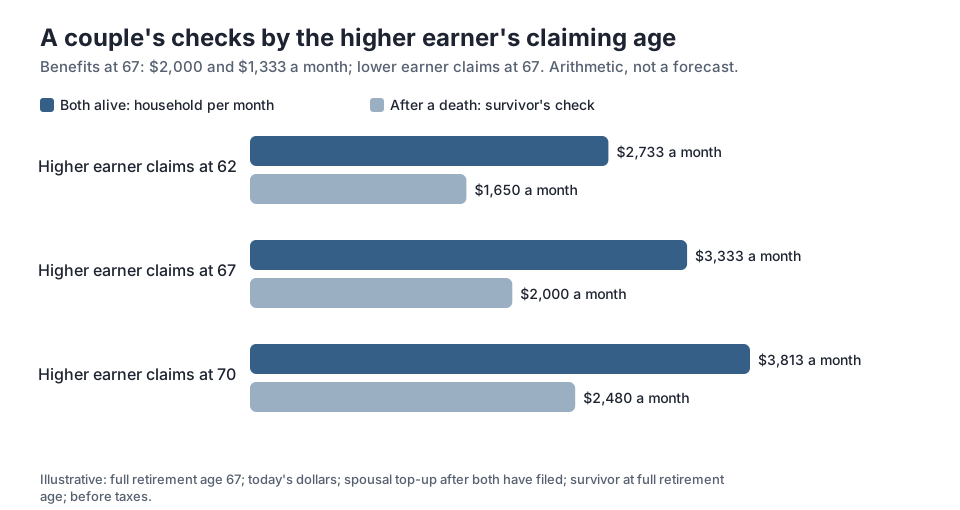
Claiming ages shape the Social Security portion of a couple's combined income. Assuming a higher earner eligible for $2,000 a month at age 67 and a lower earner claiming $1,333 a month at age 67, claiming by the higher earner at age 62 sets their check at 70%, or $1,400, for $2,733 together. Claiming at age 67 yields 100%, or $2,000, totaling $3,333 together, while waiting until age 70 raises it to 124%, or $2,480, for $3,813 together.
Delaying benefits increases both lifetime household cash flow and the surviving spouse's income. Under the illustrative survivor rule—where the survivor keeps the larger of their own check or the deceased's benefit, and at least 82.5% of the deceased's age-67 benefit when the deceased claimed early, assuming the survivor has reached full retirement age—the survivor check rises from $1,650 after an age 62 claim to $2,000 at age 67 and $2,480 at age 70. Meanwhile, joint thresholds are less than double the single thresholds, narrowing the untaxed zone for couples.
An exception exists for married couples who live apart for the entire tax year. Under IRS rules, a married person filing a separate return who did not live with their spouse at any point during the calendar year uses the $25,000 and $34,000 brackets instead of the $0 base amount.
How Traditional IRA Withdrawals Affect Your Taxes
As the IRS notes in its guidance on retirement arrangements, distributions from a traditional IRA are generally included in gross income, raising adjusted gross income and feeding directly into combined income. Taking an unexpected lump-sum withdrawal from a pre-tax account—for instance, to settle a major expense or replace a vehicle—without checking the math can push up to 85% of Social Security benefits into taxable territory for that entire year.
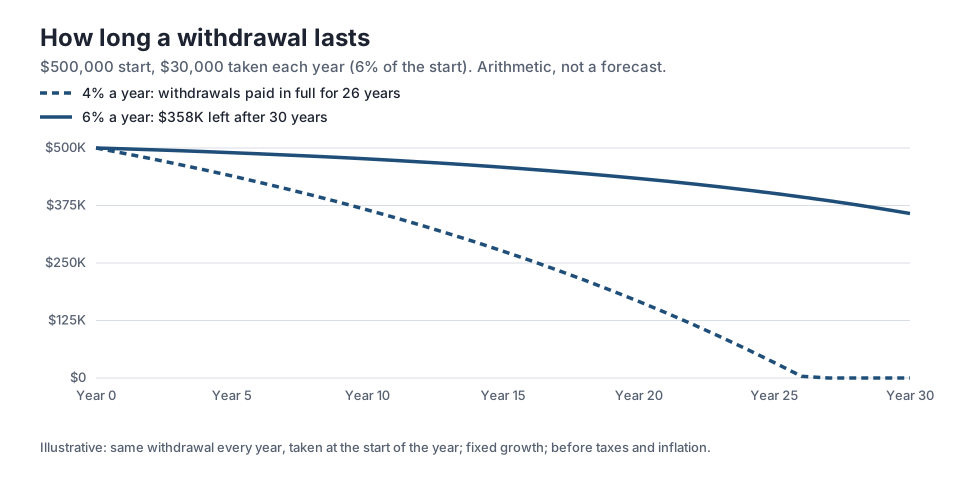
Consistent withdrawals also reshape retirement tax exposure over decades. Assuming a $500,000 starting balance and $30,000 withdrawn each year—or 6% of the initial balance—an assumed 4% annual growth rate covers the $30,000 withdrawal in full for 26 years before the account runs out. Under an assumed 6% annual growth rate, every annual withdrawal is covered and $357,695 remains after 30 years.
Those contrasting outcomes demonstrate how modest shifts in long-term growth determine whether steady withdrawals deplete a pre-tax account early or leave a sizable sum remaining after 30 years. When balances persist late into retirement, ongoing annual distributions continue adding ordinary income every year, sustaining upward pressure on combined income and Social Security taxation.
Distributions from employer-sponsored pre-tax retirement plans follow the same gross income rules as traditional IRA withdrawals. Moving funds from a workplace plan into a traditional IRA through a direct trustee-to-trustee rollover avoids triggering gross income, whereas taking a taxable cash payout adds immediately to combined income.
- Traditional IRA pros: provides reliable cash flow in retirement while allowing remaining pre-tax assets to grow tax-deferred until withdrawn.
- Traditional IRA cons: raises adjusted gross income with each dollar distributed and can push combined income over the 50% or 85% Social Security tax thresholds.
- When people weigh traditional IRA withdrawals: retirees often draw from pre-tax accounts when they have not yet reached higher combined income brackets or when satisfying mandatory annual distribution rules.
The Roth IRA Advantage
Roth accounts operate under the opposite tax treatment. Under IRS rules governing individual retirement arrangements, qualified distributions from a Roth IRA are completely exempt from federal income tax and are excluded from gross income. Because those distributions never enter adjusted gross income or nontaxable interest, drawing from a Roth account adds nothing to combined income and leaves Social Security tax calculations untouched.
To preserve that exclusion, a Roth withdrawal has to satisfy federal qualification standards. Generally, the account owner meets IRS age requirements and completes the required multi-year holding period measured from the initial Roth contribution. Taking earnings before satisfying both conditions can turn a withdrawal into taxable income, pulling it straight into the combined income test.
Because Roth accounts and traditional IRAs affect combined income differently, retirees holding both account types face clear trade-offs. Sourcing baseline living expenses from a pre-tax account while tapping a Roth IRA for irregular spending lets a household control how much ordinary income hits its tax return, though spending Roth dollars shrinks a pool of assets that otherwise grows free of future income taxes.
Designated Roth accounts inside employer-sponsored workplace plans share this combined income exclusion once distributions qualify under IRS rules. Maintaining Roth balances alongside pre-tax accounts preserves tax diversification, giving households a source of liquidity for unexpected medical or home expenses without disturbing Social Security brackets.
- Roth IRA pros: delivers cash exempt from federal income tax, leaves combined income unchanged, and shields Social Security benefits from higher taxation.
- Roth IRA cons: relies on dollars already taxed in earlier years and reduces an account balance capable of ongoing growth free of future income tax.
- When people weigh Roth IRA withdrawals: retirees often turn to Roth accounts when sitting near a combined income threshold and needing extra cash without triggering higher taxes on Social Security.
Example: The Impact of an Extra Withdrawal
Consider Robert and Susan, both 67 and married filing jointly. They collect $40,000 a year in Social Security benefits and withdraw $20,000 a year from their traditional IRA. Following the IRS formula, they add $20,000—half of their $40,000 Social Security total—to their $20,000 traditional IRA distribution, resulting in a combined income of $40,000 for the year.
At $40,000 of combined income, Robert and Susan stand above the $32,000 mark but below the $44,000 threshold, meaning up to 50% of their benefits may be taxable. If they withdraw an extra sum from their traditional IRA for a home repair that pushes their combined income past $44,000, up to 85% of their benefits may be taxable. That additional pre-tax distribution incurs regular income tax on itself while simultaneously pulling a larger portion of their Social Security onto the tax return.
- Traditional IRA withdrawal$20,000
- Social Security portion$20,000
- Combined income$40,000
A breakdown of how Robert and Susan calculate their combined income using their traditional IRA withdrawal and their Social Security benefits.
Robert and Susan face a clear withdrawal trade-off: taking the repair funds from their traditional IRA raises combined income past the upper threshold, whereas pulling the cash from a Roth IRA keeps their combined income steady at $40,000 while depleting after-tax savings. Questions they might raise with a licensed financial advisor or tax professional include how close their baseline sits to $44,000, what effective marginal tax rate applies to the extra withdrawal, and how multi-year withdrawal sequencing affects future required distributions.
Other Income Sources and Exceptions
Not every government benefit receives the same tax treatment. As the IRS clarifies in its official guidance on Social Security benefits, Supplemental Security Income (SSI) checks are not taxable and do not count toward combined income. While retirement, survivor, and disability benefits all enter the formula, SSI benefits remain completely outside the federal tax calculation.
Beyond retirement account withdrawals, most other common income streams count toward combined income. Workplace pensions, taxable annuity payouts, realized capital gains from brokerage sales, ordinary dividends, and wages from part-time employment all raise adjusted gross income. On the other hand, certain above-the-line tax adjustments—such as eligible health savings account contributions—can lower adjusted gross income and reduce the figure tested against the thresholds.
Several cash inflows remain outside the combined income test entirely. Life insurance death benefits, cash gifts received, and the return of original cost basis when selling an asset in a regular taxable brokerage account do not enter adjusted gross income, meaning only the capital gain portion of a brokerage sale affects Social Security taxation.
Because multiple income streams interact differently across filing statuses and tax years, rules of thumb only go so far. To verify how specific figures work together, individuals can use the IRS Interactive Tax Assistant tool, which walks through benefit totals, filing status, and other income items to determine whether Social Security benefits are taxable.
Key takeaways
- Splitting a major one-time expense across two calendar years—such as December and January—allows retirees to spread pre-tax withdrawals across separate tax returns rather than concentrating an income spike in a single year.
- Evaluating Roth conversions during lower-income years before claiming Social Security shifts pre-tax savings into Roth accounts without inflating combined income once benefits start, though conversions increase taxable income in the conversion year.
- Because Medicare income-related premium surcharges also rely on modified adjusted gross income, an unplanned pre-tax withdrawal can trigger higher healthcare premiums alongside increased Social Security taxation.
- Realizing capital losses in a taxable brokerage account to offset capital gains can lower adjusted gross income, creating extra room below Social Security thresholds during years with large investment sales.
- Confirming the full combined income impact with a licensed tax professional before finalizing a large retirement distribution helps households compare the after-tax cost across available accounts.
Sources
- Must I pay taxes on Social Security benefits? (https://faq.ssa.gov/en-us/Topic/article/KA-02471)
- Income Taxes and Your Social Security Benefit (https://www.ssa.gov/benefits/retirement/planner/taxes.html)
- Publication 590-B (2023), Distributions from Individual Retirement Arrangements (IRAs) (https://www.irs.gov/publications/p590b)
- Tax Topic 423 - Social Security and Equivalent Railroad Retirement Benefits (https://www.irs.gov/taxtopics/tc423)
- Publication 915 (2023), Social Security and Equivalent Railroad Retirement Benefits (https://www.irs.gov/publications/p915)
- Are My Social Security or Railroad Retirement Tier I Benefits Taxable? (https://www.irs.gov/help/ita/are-my-social-security-or-railroad-retirement-tier-i-benefits-taxable)
11Questions
Frequently asked questions
Do required minimum distributions (RMDs) count toward my provisional income?
Yes. Under IRS rules, required minimum distributions from traditional IRAs and pre-tax workplace retirement plans count as ordinary gross income in the year distributed, which raises adjusted gross income and combined income. Because mandatory withdrawal percentages climb with age, retirees who kept combined income low earlier in retirement frequently cross higher Social Security thresholds once RMDs begin—unless eligible donors use qualified charitable distributions to send IRA funds straight to charity, which satisfies the RMD without entering adjusted gross income.
Does tax-exempt municipal bond interest affect my Social Security taxes?
Yes. Both individual municipal bond interest and exempt-interest dividends from municipal bond mutual funds are reported on the nontaxable interest line of the federal return and added straight into combined income. Holding municipal bonds inside a traditional IRA removes even the regular federal exemption, because every dollar distributed from a traditional IRA is taxed as ordinary income regardless of the underlying investment.
Are my Social Security benefits taxed at the state level?
State taxation rules differ significantly from federal law. Most states exempt Social Security benefits from state income tax altogether, while a smaller group taxes a portion of benefits under state-specific age exemptions, residency rules, or income thresholds that do not match the federal combined income brackets. Reviewing the revenue rules in a retiree's current or planned state of residence helps clarify whether any state-level liability applies alongside federal taxes.
Can I have taxes withheld directly from my Social Security checks?
Yes. Beneficiaries can submit a voluntary withholding request to the Social Security Administration to have federal income tax deducted from monthly checks at one of the fixed percentage choices listed on the IRS form. Arranging withholding from Social Security benefits—or electing tax withholding directly on IRA distributions—helps households cover ongoing tax liabilities steadily across the year instead of filing quarterly estimated payments.
If my spouse dies, how does the change to single filer status affect my provisional income thresholds?
After the year of a spouse's death—unless a survivor qualifies for surviving spouse status by maintaining a home for a dependent child—the surviving spouse generally moves from married filing jointly to single filer status, lowering the combined income brackets from $32,000 and $44,000 to $25,000 and $34,000. Although total Social Security income drops when one check ends, the survivor keeps the higher benefit and typically retains the couple's combined retirement accounts, often increasing the taxable share of the remaining check.
12Keep reading
Related guides
 Social Security
Should I Claim Social Security at 65 or Wait Until 70?
Airline pilots face mandatory retirement at 65, but claiming Social Security is a separate choice. Compare claiming at 65 against bridging to 67 or 70. Social Security
How Does My Social Security Claiming Age Affect My Spouse?
Learn how a primary earner's Social Security claiming age shapes joint retirement income and sets the surviving spouse's permanent monthly benefit. Taxes
How do I use a donor-advised fund to bunch charitable contributions?
Learn how charitable bunching with a donor-advised fund compares to annual giving, including standard deduction math, appreciated assets, and IRS rules.
13Next step
Take the next step
If you want to talk this through, an advisor at the firm can help.
14Next step
Talk it through with the firm
When you would like to talk something through, book a free call or send a message.

You will speak with Tayeb Ayat, the firm’s founder. (888) 336-8586 · info@fenul.com