Social Security · November 14, 2026
How Does My Social Security Claiming Age Affect My Spouse?
Learn how a primary earner's Social Security claiming age shapes joint retirement income and sets the surviving spouse's permanent monthly benefit.
11 min read · 10 sections

When the higher-earning partner in a marriage chooses when to start Social Security, that decision establishes two separate financial baselines for the household. It shapes the combined monthly income the couple relies on while both partners are alive, and it sets the ceiling for the survivor benefit that the remaining partner will collect after one spouse passes away.
Standard claiming calculators often evaluate a single worker's life expectancy to estimate an individual break-even age. For a married couple, that individual lens leaves out half of the household equation because rules administered by the Social Security Administration tie a lower-earning partner's long-term financial footing directly to the primary earner's filing record.
Because spousal benefits while both partners are living follow different rules than survivor benefits after a death, timing choices affect each stage differently. Understanding how those two calculations interact helps couples weigh immediate cash flow needs against permanent income protection for whichever partner lives longer.
How the Primary Earner's Claiming Age Affects the Spouse
In many married households, one partner earned significantly more over a career than the other. When that primary earner files for Social Security retirement benefits, the chosen claiming age creates lasting consequences for the entire household budget. Filing early locks in a reduced monthly baseline on the primary record, while waiting past full retirement age builds a larger benefit that carries forward to a widow or widower.
The financial impact unfolds across two distinct chapters of retirement. While both spouses are alive, a lower-earning partner may qualify for a spousal benefit totaling up to 50% of the primary earner's full retirement age amount, provided the lower earner waits until their own full retirement age to file. During this joint phase, the lower earner's maximum spousal check depends on the primary worker's baseline record rather than any delayed credits.
- If the primary earner files earlyThis locks in a reduced monthly baseline on the primary record.
- If the primary earner waits past full retirement ageThis builds a larger benefit that carries forward to a surviving spouse.
When the higher earner files for benefits creates lasting consequences for the household.
When one spouse dies, the household loses the smaller of the two monthly checks and transitions to a single Social Security income stream. At that point, the surviving spouse becomes eligible for up to 100% of the benefit the deceased partner was receiving, or had earned the right to receive, at death. Because only one check remains to cover ongoing living costs, the primary earner's claiming age sets the permanent floor for the survivor's retirement income.
Spousal Benefits vs. Survivor Benefits: Understanding the Difference
Married couples frequently mix up spousal benefits and survivor benefits, yet the Social Security Administration operates them under separate formulas and eligibility rules. A spousal benefit exists to supplement household cash flow while both partners are living. A survivor benefit exists to replace the lost primary earner's income after a death occurs in the household.
Under spousal rules, a husband or wife can receive a combined benefit equal to as much as 50% of the higher earner's primary insurance amount, which is the monthly sum earned at full retirement age. If the lower-earning spouse has a work history of their own, Social Security issues their own earned retirement benefit and adds a spousal supplement only if their own check falls short of that half-benefit limit.
Survivor rules operate on a much larger scale. After the higher earner passes away, the surviving spouse stops collecting any spousal supplement and steps into the deceased worker's benefit level, up to 100% of what that worker claimed or accrued. Confusing the 50% spousal cap with the survivor benefit can lead couples to underestimate how much longevity protection depends on the primary earner's filing age.
The Limits of Spousal Benefits While Both Are Alive
A widespread misconception among near-retirees is that delaying benefits past full retirement age increases the partner's spousal check at the same annual rate it increases the primary worker's check. According to the Social Security Administration, spousal benefits are strictly capped at 50% of the primary earner's full retirement age benefit. Spousal benefits do not increase if the higher-earning spouse delays claiming past their full retirement age.
For workers born in 1960 or later, the Social Security Administration establishes full retirement age at 67. Even if the primary earner waits until age 70 to start collecting, the lower-earning partner's maximum spousal benefit stays anchored to half of the higher earner's age 67 amount. Waiting past age 67 expands the primary earner's own monthly check rather than the spousal calculation.
Timing rules also link when a married spouse can access that spousal benefit. Under current guidelines from the Social Security Administration, a married partner cannot collect a spousal benefit until the higher earner actually files for their own retirement benefit. If the primary earner waits until age 70, the lower-earning partner can only draw on their own work record in the interim before becoming eligible for a spousal supplement.
| Primary Benefit | Spousal Benefit | |
|---|---|---|
| At age 67 | 100% | 50% |
| Delayed to age 70 | 124% | 50% |
Waiting past full retirement age increases the primary worker's check but does not increase the spousal benefit.
How Delayed Retirement Credits Boost the Survivor's Check
Although waiting past full retirement age adds nothing to a spousal benefit while both spouses are alive, delaying transforms the math for a surviving partner. The Social Security Administration increases a worker's retirement benefit by 8% per year for each full year they defer claiming past full retirement age, with those increases continuing up to age 70. Delayed retirement credits stop growing once the worker reaches age 70.
Unlike spousal benefits, survivor benefits inherit every dollar of those delayed retirement credits. When a primary earner with a full retirement age of 67 waits until age 70 to file, their benefit expands through three years of 8% annual credits. After the primary earner passes away, a surviving spouse who has reached full retirement age can collect that full, enhanced monthly check rather than reverting to the age 67 baseline or a 50% spousal amount.
This inheritance rule turns the primary earner's delay into durable longevity protection for the lower-earning spouse. Even if the primary earner collects benefits for only a brief period after age 70, the elevated benefit does not vanish when they die. Instead, that higher monthly income continues for the rest of the surviving spouse's life, helping offset the loss of the household's smaller Social Security check.
The Cost of Claiming Early: Reductions for Spouses and Survivors
Filing before full retirement age imposes permanent reductions for both workers and spouses, though the exact percentage varies by benefit type and claiming age. According to the Social Security Administration, a husband or wife can begin collecting a reduced spousal benefit as early as age 62, provided the higher-earning partner has already filed for their own retirement benefits.
When a spouse whose full retirement age is 67 claims a spousal benefit at age 62, the Social Security Administration permanently lowers that spousal check to 32.5% of the higher earner's full benefit. That reduced percentage stays in place for as long as both partners remain alive, and it does not step back up once the claiming spouse reaches age 67.
- 32.5%Spousal benefit if claimed at age 62
- 71.5%Survivor benefit if claimed at 60
- 82.5%Survivor minimum if primary claimed early
Claiming before full retirement age permanently reduces spousal and survivor benefits.
Early filing by the primary earner creates an equally permanent constraint on survivor income. If the higher earner claims at age 62, their own retirement benefit is permanently reduced, which permanently caps the survivor benefit available to their widow or widower. Because of that cap, a surviving spouse cannot collect the deceased worker's full age 67 benefit if the primary earner chose to start at age 62.
Widows and widowers face their own early-claiming reductions if they take survivor benefits prior to full retirement age. The Social Security Administration permits a surviving spouse to start survivor benefits as early as age 60. However, claiming survivor benefits at age 60 permanently reduces the monthly check to 71.5% of the deceased worker's full amount, rather than the full 100% available by waiting until full retirement age.
Walking Through the Decision: A Couple's Claiming Strategy
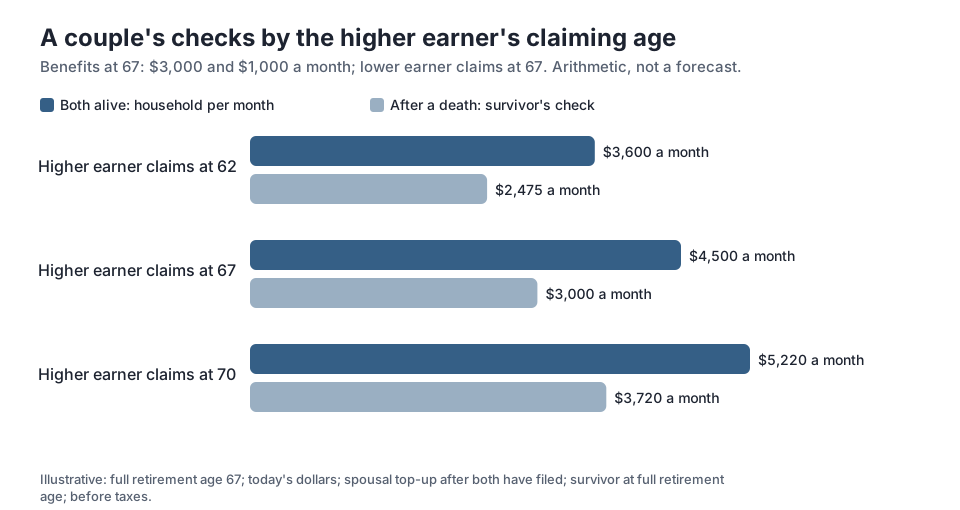
In an illustrative example, John and Mary are a married couple who are both age 62 and born in 1960 or later, giving both a full retirement age of 67. Under these assumptions, John's primary insurance amount at age 67 is $3,000 a month, and Mary's own earned benefit at age 67 is $1,000 a month. Mary plans to wait until age 67 to claim, and the couple is evaluating John filing at age 62, waiting until age 67, or delaying until age 70.
If John claims at age 62, he collects 70% of his full benefit, or $2,100 a month, while Mary receives $1,500 at age 67—equal to 50% of his age 67 benefit—providing $3,600 a month together. If John dies before Mary after she reaches age 67, Social Security applies a survivor minimum of at least 82.5% of John's age 67 benefit, capping Mary's permanent survivor check at $2,475 a month. If John instead claims at age 67, he collects 100% of his $3,000 benefit and Mary collects $1,500, producing $4,500 together while alive and a $3,000 monthly survivor check after his death.
If John delays until age 70, delayed retirement credits increase his check to 124% of his age 67 benefit, or $3,720 a month. Mary's benefit at age 67 remains at $1,500 while both are living, giving the household $5,220 a month together, and if John passes away before Mary, her permanent survivor check rises to $3,720 a month.
Every path requires balancing immediate income needs against protecting Mary's long-term security and funding living costs during any waiting period. Couples in John and Mary's position often ask a licensed advisor how health history, other retirement savings, and tax rules affect drawing from personal accounts between age 62 and age 70.
- Primary earner claims early at age 62: Starting as soon as eligible delivers immediate household cash flow and lets the couple keep other investments intact longer, though it permanently lowers joint income while alive and caps the survivor check. Couples weigh this option when facing pressing cash needs, poor health, or limited joint life expectancy.
- Primary earner claims at full retirement age 67: Waiting until age 67 avoids early-claiming reductions and secures a baseline survivor check equal to the full primary insurance amount, though it leaves delayed retirement credits unclaimed and requires drawing from other savings between 62 and 67. Couples weigh this path when they want unreduced benefits without waiting until 70.
- Primary earner delays until age 70: Deferring benefits earns 8% annual credits to maximize household income while both live and secure the highest permanent survivor check, though it requires funding retirement from other sources until age 70 and risks lower cumulative benefits if both pass away early. Couples weigh this option when they have sufficient savings to bridge the gap and expect either spouse to live a long life.
Can the Surviving Spouse Switch Benefits Later?
Many retirees assume that Social Security requires a widow or widower to apply for their own retirement benefit and a survivor benefit at the exact same time. While deemed filing rules generally bundle a living spouse's own retirement application with their spousal benefit application, survivor benefits follow an important exception to that rule.
Under Social Security Administration guidelines, a surviving spouse can claim a survivor benefit initially and switch to their own retirement benefit later if it grows larger. Alternatively, a widow or widower with a substantial work record can claim their own reduced retirement benefit as early as age 62, leave the survivor benefit untouched until full retirement age, and then transition to the unreduced survivor check.
This separation gives surviving spouses the flexibility to sequence their benefits over multiple years rather than locking in both records simultaneously. For example, a survivor with their own earnings history could draw a smaller benefit at age 60 or 62 to cover near-term living costs while allowing the larger benefit to avoid early reductions until full retirement age or age 70. Comparing the maximum ceiling of each record determines which benefit makes sense to collect earlier.
Factoring in Joint Life Expectancy and Break-Even Math
Conventional break-even math calculates how many years an individual worker needs to live to recover the monthly checks skipped by waiting until age 67 or age 70. Although that calculation provides useful context for an unmarried worker, it understates the value of delaying for a married primary earner because the benefit outlasts a single lifetime.
For married households, the critical timeframe is not one spouse's individual life expectancy, but rather joint longevity expectations—the probability that at least one partner will live into their eighties or nineties. Because the higher earner's benefit converts into the surviving spouse's permanent check upon the primary earner's death, delaying that primary benefit establishes an inflation-adjusted income base that lasts for whichever partner lives longest.
Age gaps and differences in health between spouses make this joint perspective especially important. When the higher earner is older or faces health concerns while the lower earner is younger or healthier, delaying the higher earner's benefit can strengthen the younger partner's income across decades of widowhood. Conversely, when both partners face serious health challenges and modest savings, claiming earlier can relieve immediate cash flow pressure without sacrificing needed liquidity.
Key takeaways
- Earnings records on statements from the Social Security Administration form the baseline for modeling claiming ages, because projected benefits shift if either partner stops working early or continues earning past age 62.
- Household budgets often adjust unevenly after a spouse dies, because housing, property taxes, and utility costs frequently remain steady even though the smaller Social Security check ends.
- Using personal retirement savings to bridge living costs between age 62 and age 70 interacts with federal income tax brackets and Medicare premium thresholds during the early years of retirement.
- Family longevity and age differences between partners interact directly with filing timelines, because a primary earner's delay protects a younger or healthier partner's monthly income long after the primary earner passes away.
- Filing timelines remain flexible if a spouse passes away before either partner claims, because survivor rules permit sequencing a worker's own retirement benefit and survivor benefits independently.
Sources
- Social Security Administration (https://www.ssa.gov/oact/quickcalc/spouse.html)
- Social Security Administration (https://www.ssa.gov/benefits/retirement/planner/delayret.html)
- Social Security Administration (https://www.ssa.gov/benefits/retirement/planner/agereduction.html)
- Social Security Administration (https://www.ssa.gov/benefits/survivors/)
- Social Security Administration (https://www.ssa.gov/benefits/survivors/survivorchartred.html)
- Social Security Administration (https://www.ssa.gov/benefits/retirement/planner/claiming.html)
- Social Security Administration (https://www.ssa.gov/benefits/survivors/ifyou.html)
11Questions
Frequently asked questions
Can I claim a spousal benefit if my spouse hasn't filed for their own retirement benefit yet?
No. If you are currently married, Social Security Administration rules require the higher-earning spouse to file for their own retirement benefit before the lower-earning spouse can collect a spousal benefit on that record. If you have enough work credits of your own, you can claim your own retirement benefit while waiting and apply for any spousal addition once your spouse files.
What happens to my spousal benefit if we get divorced?
If your marriage lasted at least ten years, you are currently unmarried, and you are at least age 62, you may remain eligible for spousal benefits on your former spouse's record. Unlike currently married couples, a divorced spouse does not have to wait for the former spouse to file, provided the divorce has been final for at least two continuous years and the former spouse qualifies for benefits.
Does my own work history reduce the spousal benefit I can receive?
Under Social Security Administration rules, you cannot collect your full retirement benefit and a full spousal benefit stacked on top of each other. Instead, Social Security issues your own earned benefit and adds a spousal supplement only if your own age 67 benefit is smaller than half of your spouse's age 67 amount, bringing your combined total up to that spousal cap.
Can I collect both my own retirement benefit and a full survivor benefit at the same time?
No. You cannot collect two full monthly Social Security checks simultaneously after a spouse dies. The Social Security Administration distributes an amount equal to the higher of your own earned retirement benefit or the survivor benefit you qualify for, though you can claim one type of benefit earlier and switch to the larger benefit later.
If I remarry, do I lose the survivor benefits from my deceased spouse?
Your age at remarriage determines eligibility. Under Social Security Administration rules, remarrying before age 60 generally ends eligibility for survivor benefits from a deceased spouse for as long as that later marriage continues, whereas remarrying at age 60 or older allows you to retain eligibility for survivor benefits on your late spouse's record.
12Keep reading
Related guides
 Social Security
Should I Claim Social Security at 65 or Wait Until 70?
Airline pilots face mandatory retirement at 65, but claiming Social Security is a separate choice. Compare claiming at 65 against bridging to 67 or 70. Social Security
How Are My Social Security Benefits Taxed?
Learn how combined income and traditional IRA withdrawals affect Social Security taxes, and see how different retirement accounts interact. Taxes
How do I use a donor-advised fund to bunch charitable contributions?
Learn how charitable bunching with a donor-advised fund compares to annual giving, including standard deduction math, appreciated assets, and IRS rules.
13Next step
Take the next step
If you want to talk this through, an advisor at the firm can help.
14Next step
Talk it through with the firm
When you would like to talk something through, book a free call or send a message.

You will speak with Tayeb Ayat, the firm’s founder. (888) 336-8586 · info@fenul.com