Taxes · November 14, 2026
How do I use a donor-advised fund to bunch charitable contributions?
Learn how charitable bunching with a donor-advised fund compares to annual giving, including standard deduction math, appreciated assets, and IRS rules.
13 min read · 10 sections

Charitable bunching with a donor-advised fund means consolidating several years of planned charitable gifts into a single tax year so total itemized deductions exceed the standard deduction threshold. Rather than sending smaller annual checks directly to charities and receiving zero incremental tax reduction, a household transfers a larger lump sum into a charitable giving account in one year, claims the itemized deduction on that year's tax return, and recommends grants from the account to favorite nonprofits over future years.
Couples nearing retirement often encounter a gap between their generosity and their tax returns. Once a home mortgage is settled or reduced, annual deductions for state and local taxes alongside steady charitable gifts frequently fall below the standard deduction. Without clearing that hurdle, consistent giving provides vital support to community organizations while yielding zero incremental reduction in federal income taxes.
Grouping multiple years of donations into one tax year alters both the timing of tax deductions and the cash flow mechanics of giving. Funding the account with appreciated securities rather than cash adds another variable, because transferring long-term investments directly can eliminate capital gains tax on the growth. At the same time, donor-advised accounts carry administrative fees, irrevocability rules, and annual income caps that households weigh alongside a tax professional or financial advisor before committing assets.
What is Charitable Bunching with a Donor-Advised Fund?
Charitable bunching is a multi-year timing technique rather than an increase in total generosity. Instead of donating an identical sum every calendar year, a couple combines two, three, or even ten years of anticipated gifts into one concentrated contribution. In the year of that concentrated gift, the household itemizes deductions to capture tax savings above the baseline standard deduction, then returns to taking the standard deduction in the subsequent years when no new out-of-pocket contributions occur.
Pairing this timing technique with a donor-advised fund resolves a practical challenge for receiving charities. Nonprofits rely on predictable annual budgets and may struggle to plan around erratic spikes followed by dry spells. According to the IRS, a donor-advised fund is a separately identified fund or account maintained and operated by a section 501(c)(3) sponsoring organization. Because the sponsoring organization holds the bunched contribution, the donor can distribute steady annual grants to operating charities over many years.
Once a sponsoring organization accepts a contribution, the donor retains advisory privileges over two aspects of the account: how the balance is invested among the sponsor's menu of pools and which eligible public charities receive grants. While the sponsoring organization holds legal control over the assets, sponsors routinely honor grant recommendations to qualified organizations in good standing. This structure lets households separate the single tax event of funding the account from the ongoing rhythm of community support.
- If your annual giving and expenses fall below the standard deductionYou receive no incremental tax benefit from annual donations
- If you combine multiple years of giving into one concentrated contributionYou can itemize deductions to capture tax savings in that year
- If you make no out-of-pocket contributions in the following yearsYou return to taking the standard deduction
A decision flow outlining how bunching contributions works over time. It shows how combining gifts can help taxpayers exceed the standard deduction.
Why the Standard Deduction Matters for Giving
Federal tax law gives households an annual choice between taking a flat standard deduction or tallying individual expenses on their tax return. Under rules published by the IRS, the standard deduction for married couples filing jointly in 2024 is $29,200. Taxpayers who reach age 65 or older qualify for an extra standard deduction increment, pushing the joint threshold even higher as couples transition into retirement.
To claim a deduction for charitable contributions, the IRS requires a taxpayer to itemize deductions on Schedule A of Form 1040. Itemized deductions generally include state and local taxes up to statutory caps, mortgage interest, qualifying medical expenses above income floors, and charitable gifts. Only the dollar amount by which total itemized expenses exceed the $29,200 standard deduction generates an actual reduction in taxable income compared with taking the flat allowance.
When a couple's state and local taxes total a modest amount and their home carries no mortgage debt, and their annual charitable donations do not lift their combined Schedule A items past $29,200, taking the standard deduction remains the mathematically larger allowance. In that position, every dollar sent to charity leaves their tax bill unchanged, creating the exact gap that multi-year bunching is designed to address.
The Mechanics of a Donor-Advised Fund
Opening a donor-advised account begins with selecting a 501(c)(3) sponsoring organization, such as a national charitable arm of a brokerage custodian or a local community foundation. After establishing the account, the donor transfers cash or eligible securities into the fund. The IRS treats that initial transfer into the sponsoring organization as a completed charitable gift, establishing the tax year in which the deduction belongs regardless of when money leaves for working charities.
Inside the account, assets can remain in a liquid money-market pool or be allocated across diversified investment options offered by the sponsor. Any investment returns generated inside the donor-advised fund compound without annual capital gains or dividend taxes, potentially expanding the pool available for future grants, though investment losses can also reduce the balance. Donors log into the sponsor's portal periodically to recommend grants, either anonymously or with family recognition, to qualifying nonprofits.
Two strict IRS boundaries govern how these accounts operate. Most critically, contributions to a donor-advised fund are irrevocable, meaning the donor surrenders legal ownership permanently and cannot reclaim assets if retirement healthcare costs or living expenses surge later. In addition, IRS rules forbid donors from receiving any tangible personal benefit, such as charity gala seats, auction merchandise, or membership perks, in exchange for a grant recommended from the account, limiting donor-advised fund grants strictly to pure gifts.
The Multi-Year Math of Bunching
Comparing annual giving against a bunched contribution highlights how multi-year arithmetic works in practice. Mark and Linda are a married couple filing jointly who give $10,000 a year to charity. They have no other itemized deductions, so their $10,000 in annual giving falls well short of the $29,200 standard deduction. Over ten years of giving $10,000 in cash each year, they claim the standard deduction annually and receive zero incremental tax benefit from their philanthropy.
Mark and Linda also hold $100,000 in a taxable mutual fund that they purchased years ago for $40,000. Instead of continuing annual cash donations, they evaluate transferring the entire $100,000 mutual fund into a donor-advised fund in one tax year. That single contribution clears the $29,200 standard deduction threshold substantially, creating an itemized deduction in the contribution year while allowing them to recommend $10,000 annual grants over the next ten years and take the standard deduction in those later years.
- $10,000Annual cash giving that falls short of the standard deduction
- $29,200Standard deduction threshold for a married couple
- $100,000Bunched mutual fund contribution to clear the threshold
An example of how concentrating multiple years of giving into a single tax year helps a household exceed the standard deduction.
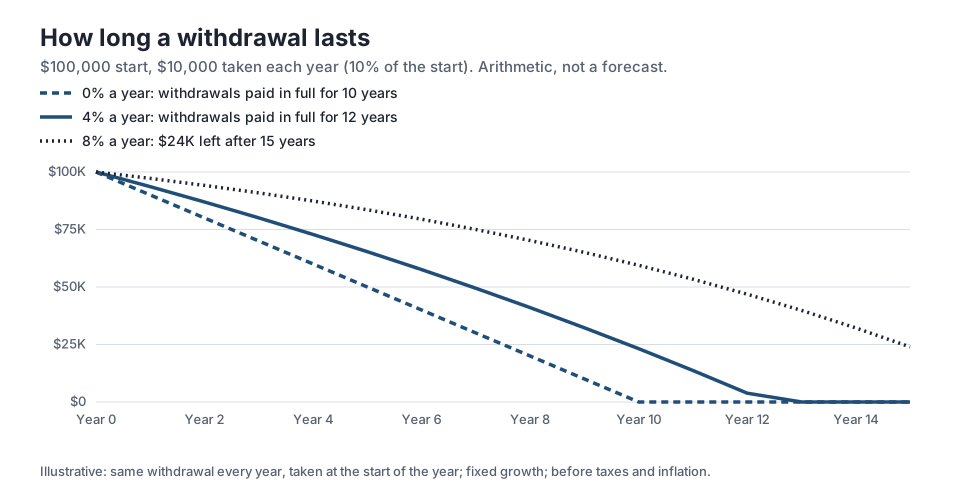
Once a $100,000 balance sits inside the donor-advised fund, investment performance over time influences how many $10,000 grants the account can support. Assuming a $100,000 starting balance and $10,000 annual withdrawals, equal to 10% of the initial balance, purely mathematical projections show distinct timelines depending on assumed annual growth. At an assumed 0% annual growth rate, the $10,000 withdrawal is distributed in full for 10 years before the account reaches zero.
Modest or stronger hypothetical returns extend that granting horizon, though market volatility makes real-world outcomes unpredictable. At an assumed 4% annual growth rate, the $10,000 annual withdrawal is distributed in full for 12 years before the balance is exhausted. At an assumed 8% annual growth rate, every $10,000 annual withdrawal is covered across 15 years and $23,974 remains after 15 years. These figures represent arithmetic illustrations rather than return forecasts, and negative market years could reduce the grantable balance.
The Double Benefit of Appreciated Stock
The tax arithmetic of bunching changes substantially when a donor contributes appreciated investments instead of writing a check. Under IRS rules in Topic 409, capital gains on assets held for more than one year are considered long-term capital gains. Those long-term capital gains are typically taxed at federal rates ranging from 0% up to 20%, depending on the taxpayer's taxable income, alongside potential state taxes or surtaxes for higher-income households.
According to IRS Publication 561, when donating long-term appreciated property such as publicly traded stocks or mutual funds directly to a public charity or donor-advised fund, the charitable deduction is generally based on the fair market value of the property at the time of the contribution. Because the 501(c)(3) sponsoring organization is tax-exempt, it can liquidate the donated shares inside the account without incurring capital gains tax on the embedded appreciation.
For Mark and Linda, transferring their $100,000 mutual fund, originally bought for $40,000, directly in kind unlocks a double tax benefit. They claim an itemized charitable deduction valued at the $100,000 fair market value, subject to IRS income limits, while completely avoiding the long-term capital gains tax on the growth above their $40,000 cost basis. That avoided capital gains tax represents savings beyond the value of the Schedule A deduction alone.
A costly mistake occurs when donors liquidate appreciated investments inside their personal brokerage account and then transfer the resulting cash to a donor-advised fund. Selling the shares triggers a taxable capital gain on the donor's return, reducing the after-tax proceeds available to give and forfeiting the avoidance of capital gains tax. Coordinating an in-kind share transfer through the brokerage firm preserves both components of the tax arithmetic, whereas selling assets with unrealized losses before donating cash allows taxpayers to recognize the tax loss separately.
IRS Contribution Limits and Carryforwards
While bunching seeks to concentrate deductions into one year, federal tax law caps how much charitable giving can offset income in any single return. Under IRS Publication 526, the deduction limit for cash contributions to public charities, including donor-advised funds, is generally 60% of a taxpayer's adjusted gross income. In contrast, the deduction limit for contributions of long-term appreciated capital gain property to public charities is generally 30% of adjusted gross income.
When a bunched contribution exceeds those annual percentage ceilings, the deduction is not permanently lost. IRS Publication 526 provides that if charitable contributions exceed the adjusted gross income limits, the excess can be carried forward for up to 5 years on subsequent returns. During those carryforward years, however, the taxpayer still has to itemize deductions on Schedule A to absorb the remaining charitable balance, which means carried-over deductions compete against the $29,200 standard deduction in future years.
Assuming an entire bunched gift can be deducted immediately without checking the 30% or 60% income ceilings can derail multi-year expectations. For Mark and Linda, whose $100,000 mutual fund gift falls under the 30% adjusted gross income limit, deducting the full fair market value in one year requires sufficient adjusted gross income in that tax year. If they execute the transfer after leaving full-time work when income is lower, excess deductions could spill into retirement years when itemizing no longer clears the standard deduction.
Weighing the Options
Households approaching retirement typically weigh three main structures for multi-year charitable giving: continuing annual cash gifts, bunching cash into a donor-advised fund, or bunching appreciated securities into a donor-advised fund. Each path carries distinct trade-offs among administrative complexity, liquidity, tax efficiency, and flexibility. Evaluating them side by side helps clarify which mechanics align with a couple's cash reserves, taxable investment holdings, and projected income trajectory.
Annual direct giving prioritizes simplicity and complete flexibility, leaving personal savings liquid until the moment a check is written, though it forfeits tax deductions whenever Schedule A totals stay under $29,200. Bunching cash clears the deduction hurdle and preserves the higher 60% adjusted gross income ceiling, yet it demands substantial upfront liquidity and introduces ongoing sponsor charges. Bunching appreciated shares adds capital gains avoidance to the deduction, though it introduces Form 8283 reporting, brokerage coordination, and the stricter 30% income cap.
| Annual cash gifts | Bunching cash | Bunching securities | |
|---|---|---|---|
| Tax efficiency | May forfeit deductions under $29,200 | Clears hurdle and preserves 60% limit | Clears hurdle and avoids capital gains tax |
| Upfront liquidity needed | Low | High | High |
| Administrative complexity | Low | Moderate | Highest |
A side-by-side look at the trade-offs between annual cash gifts and bunching strategies.
Returning to Mark and Linda's situation illustrates the trade-offs couples face when evaluating a large upfront gift. Transferring the $100,000 mutual fund locks those dollars permanently inside the charitable account and subjects the balance to the sponsor's annual administrative fees over the granting period. Before initiating a transfer, couples in their position weigh those ongoing costs against the tax reduction and the questions to ask an advisor.
- Annual Cash Giving: Donating cash directly to charities each year out of current income or savings. Pros: Simplest method with no setup required; avoids all administrative and investment fees; provides immediate, direct support to the receiving charities. Cons: May not exceed the standard deduction, yielding zero tax benefit; uses after-tax dollars rather than untaxed capital gains. People weigh it when donors give smaller amounts that would not justify donor-advised fund minimums or fees, or already have enough other deductions to itemize every year.
- Bunching Cash in a Donor-Advised Fund: Contributing several years of cash donations to a donor-advised fund in a single tax year to itemize, then granting it out over time. Pros: Clears the standard deduction threshold in the contribution year; allows for consistent, ongoing support to charities over multiple years; cash contributions qualify for the higher 60% AGI deduction limit. Cons: Requires a large upfront cash outlay in a single year; incurs ongoing administrative fees from the fund sponsor. People weigh it when donors have a high-income year or a cash windfall but do not hold highly appreciated taxable investments.
- Bunching Appreciated Stock in a Donor-Advised Fund: Transferring highly appreciated, long-term investments to a donor-advised fund in a single year to itemize, avoiding capital gains tax, and granting over time. Pros: Provides a tax deduction for the full fair market value of the assets; eliminates capital gains tax on the embedded appreciation; clears the standard deduction threshold in the contribution year. Cons: Subject to a lower 30% AGI deduction limit; requires coordination with a broker and filing IRS Form 8283; incurs ongoing administrative fees from the fund sponsor. People weigh it when donors hold concentrated stock positions or highly appreciated mutual funds in a taxable brokerage account and want to maximize tax efficiency.
Administrative Considerations and Reporting
Executing a bunched noncash gift brings tax-filing responsibilities that do not apply to ordinary cash checks. According to IRS instructions, to deduct a noncash charitable contribution over $500, a taxpayer is required to file Form 8283 with their annual return. For gifts of publicly traded stocks or mutual funds, Form 8283 documents the asset description, date acquired, original cost basis, and fair market value on the contribution date, alongside confirmation from the 501(c)(3) sponsoring organization.
Beyond paperwork, overlooking the administrative and investment fees of a donor-advised fund can quietly erode the ultimate charitable impact. Sponsoring organizations assess an annual administrative fee, often calculated as a percentage of the account balance, and underlying investment pools charge internal expense ratios. While direct gifts to a charity carry zero sponsor overhead, bunched funds held over ten or 15 years experience compounding fee drag that reduces the dollars eventually distributed.
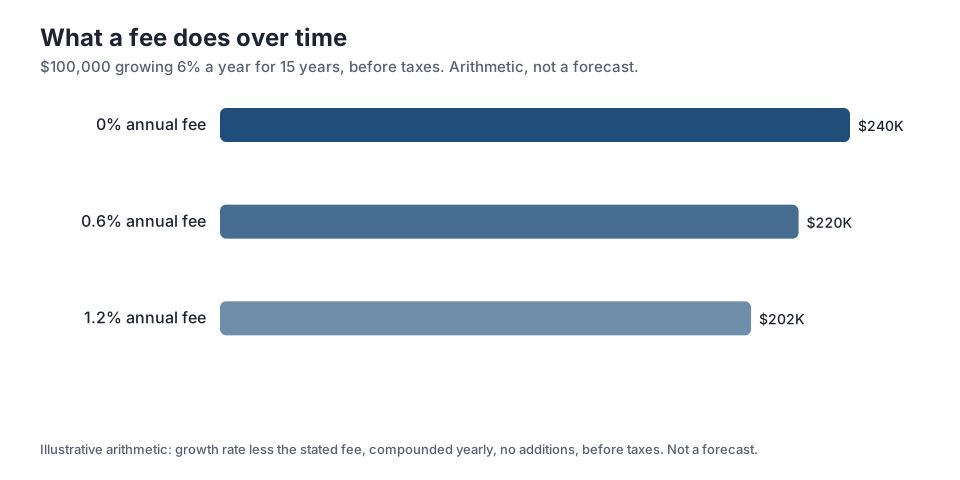
Purely arithmetic comparisons demonstrate how annual fee percentages alter a charitable pool over time. Assuming a $100,000 balance compounds at 6% annually for 15 years with zero withdrawals, the ending balance diverges noticeably across different annual fee levels. With a 0% annual fee, the balance after 15 years reaches $239,656. That baseline serves as an arithmetic reference point rather than a projection of investment performance.
Introducing realistic sponsor and fund charges reduces that hypothetical 15-year total. Under the same $100,000 and 6% annual growth assumptions, a 0.6% annual fee leaves a balance of $220,094 after 15 years, which is $19,561 less than the 0% fee case. A 1.2% annual fee leaves $202,032 after 15 years, or $37,624 less than the 0% fee case. Reviewing fee schedules carefully helps donors gauge whether tax savings outweigh multi-year administrative costs.
Key takeaways
- Separating the tax event from charitable grants allows steady nonprofit support while concentrating deductions into a single Schedule A filing.
- Donating long-term appreciated securities in kind avoids capital gains tax on embedded growth, though it reduces the annual deduction ceiling from 60% to 30% of adjusted gross income.
- Excess deductions above the 30% or 60% adjusted gross income limits carry forward for up to 5 years, making pre-retirement income levels a key factor in multi-year timing.
- Administrative and investment fees charged by a sponsoring organization compound over multi-year holding periods, shrinking the net balance available for future charitable grants.
- Every contribution to a 501(c)(3) donor-advised fund is irrevocable, and noncash gifts exceeding $500 require Form 8283 reporting on the donor's tax return.
- Giving through a donor-advised fund bars donors from receiving personal benefits, such as event tickets or auction items, in exchange for recommended grants.
Sources
- IRS provides tax inflation adjustments for tax year 2024 (https://www.irs.gov/newsroom/irs-provides-tax-inflation-adjustments-for-tax-year-2024)
- Donor-Advised Funds (https://www.irs.gov/charities-non-profits/charitable-organizations/donor-advised-funds)
- About Schedule A (Form 1040), Itemized Deductions (https://www.irs.gov/forms-pubs/about-schedule-a-form-1040)
- Publication 526, Charitable Contributions (https://www.irs.gov/publications/p526)
- Topic no. 409, Capital gains and losses (https://www.irs.gov/taxtopics/tc409)
- Publication 561, Determining the Value of Donated Property (https://www.irs.gov/publications/p561)
- About Form 8283, Noncash Charitable Contributions (https://www.irs.gov/forms-pubs/about-form-8283)
11Questions
Frequently asked questions
Can I use a donor-advised fund to fulfill a legally binding pledge I made to a charity?
Under IRS guidance, donor-advised fund grants generally cannot be used to satisfy a legally binding pledge made personally by the donor, because doing so would relieve a personal legal obligation and constitute an impermissible private benefit. Donors supporting a multi-year capital campaign through a donor-advised fund often submit a non-binding letter of intent instead, or confirm the sponsoring organization's written pledge policy beforehand.
Are there minimum contribution amounts required to open a donor-advised fund?
Minimum initial contribution thresholds and minimum grant sizes are set by each sponsoring organization rather than by the IRS. Some national sponsors require zero minimum to open an account, while community foundations and institutional sponsors may establish opening thresholds and minimum grant sizes. Comparing sponsor terms clarifies whether a planned bunched gift aligns with a given organization's rules.
Can I grant money from my donor-advised fund to an individual in need?
IRS regulations prohibit donor-advised funds from issuing grants to individuals, including direct assistance to a family facing hardship or personal educational support. Grants from a donor-advised fund are restricted to qualified public charities, typically organizations recognized under section 501(c)(3) that meet public support standards. Supporting a specific individual requires using personal, non-deductible cash outside the donor-advised account.
What happens to the money in my donor-advised fund after I pass away?
Because contributions to a donor-advised fund are irrevocable, remaining balances do not revert to a donor's estate. Most sponsoring organizations let account holders name successor advisors, such as a spouse or adult children, to recommend future grants, or designate specific charities to receive the balance upon death. If no succession instruction is on file, the sponsor's default charitable distribution policy governs the remaining funds.
Can I deduct the administrative fees charged by the donor-advised fund sponsor?
No separate deduction is available for administrative or investment fees assessed inside a donor-advised fund. The donor claims the charitable deduction based on the cash amount or fair market value of property at the time it enters the account, while ongoing sponsor fees are deducted directly from the fund's balance. Drawing fees internally reduces the pool available for grants rather than creating an extra itemized expense.
Does a donor-advised fund have a required minimum annual distribution like a private foundation?
Unlike private foundations, which face federal annual distribution mandates, donor-advised funds currently have no federal statutory requirement to distribute a set portion each year. Individual sponsoring organizations frequently enforce inactivity policies requiring a grant recommendation every few years to keep an account active, so reviewing a sponsor's inactivity terms clarifies how long assets can remain invested.
12Keep reading
Related guides
 Taxes
How Are HSA Investments Taxed in California?
Learn how California taxes HSA contributions, dividends, and capital gains, and weigh federal compounding against state tax drag and reporting. Taxes
Do I Have to Pay Taxes on a Gift Over the Annual Limit?
Learn how the 2026 $19,000 annual gift limit, IRS Form 709, and the $15,000,000 lifetime exemption apply when gifting a house down payment. Taxes
When Do I Owe the 23.8 Percent Capital Gains Tax Rate?
Learn how W-2 salary and RSU vestings push stock gains into the 20 percent bracket and 3.8 percent Net Investment Income Tax, plus trade-offs of timing sales.
13Next step
Take the next step
If you want to talk this through, an advisor at the firm can help.
14Next step
Talk it through with the firm
When you would like to talk something through, book a free call or send a message.

You will speak with Tayeb Ayat, the firm’s founder. (888) 336-8586 · info@fenul.com