Debt and cash · November 14, 2026
Should I Pay Off Credit Card Debt or Contribute to My 401(k)?
Compare paying down high-interest credit card debt against capturing an employer 401(k) match, emergency savings, and fee impacts using clear math.
11 min read · 10 sections

Young households balancing tight monthly budgets often face a difficult cash flow puzzle: whether to direct spare dollars toward high-interest credit card balances or contribute enough to a workplace retirement plan to receive an employer match. No single formula fits every household, because the decision involves competing financial forces. Capturing a match immediately increases retirement contributions, whereas lowering revolving card debt stops daily compounding interest charges from eroding future take-home cash flow.
Comparing these options requires looking at both sides of the household ledger. An employer match adds extra dollars directly into a retirement account on top of employee deferrals, creating an instant boost that is rarely replicated in ordinary savings accounts. Credit card debt works in reverse, compounding interest daily against the borrower. Meanwhile, carrying no liquid cash reserve leaves a family vulnerable to putting the next surprise bill straight back onto plastic.
Deciding how to split limited monthly cash flow depends on the employer matching rules, card annual percentage rates, existing savings, and personal comfort with carrying debt. Reviewing the math behind employer contributions, daily compounding interest, emergency reserves, and plan fees clarifies the trade-offs of each route so families can weigh their options calmly and prepare informed questions for a licensed advisor.
Should I Pay Off Credit Card Debt or Contribute to My 401(k)?
Employers often match employee contributions to a 401(k) plan up to a certain percentage of salary. Under a common dollar-for-dollar arrangement, every dollar deferred by the employee up to the employer cap brings an equal dollar from the company into the account. A frequent pitfall is leaving employer money unclaimed simply because a worker has not read the plan summary, misunderstands the matching cap, or assumes small contributions cannot move the needle over a multi-decade career.
Another common pitfall is assuming that clearing debt is always mathematically superior to investing, while overlooking the size of a 100% match. Even a steep credit card annual percentage rate of 24% represents a fraction of a 100% immediate employer match on the same contribution. Still, investment balances remain exposed to market fluctuations and plan fees, whereas each dollar applied to debt permanently eliminates future interest charges on that portion of principal.
Households with limited surplus cash flow generally weigh three distinct approaches when balancing debt reduction and workplace retirement savings. Each approach carries clear mathematical and practical consequences for total interest paid, long-term retirement accumulation, and monthly cash flexibility. Examining the advantages and drawbacks of all three paths side by side highlights what each choice depends on without treating one approach as universally superior.
- Contribute to a 401(k) up to the match, then address debt: The household defers just enough to receive the full employer match and directs remaining surplus cash toward credit card balances. Pros include capturing matching funds, avoiding forfeited employer dollars, and reducing debt steadily. Cons include taking slightly longer to eliminate debt than pausing retirement entirely and incurring slightly more total interest. People weigh this when cash flow is limited and the employer offers a generous match.
- Pause 401(k) contributions to clear debt aggressively: The household stops retirement deferrals temporarily and aims every spare dollar at high-interest balances. Pros include eliminating debt sooner, freeing monthly cash flow earlier, and lowering total interest charged by lenders. Cons include forfeiting employer matching dollars, missing potential compounding in the retirement account, and delaying retirement readiness. People weigh this when card interest rates are steep and no employer match exists, or when debt causes severe household strain.
- Split extra cash evenly between 401(k) and debt: The household divides available monthly surplus equally between retirement deferrals and extra debt payments. Pros include advancing both goals concurrently and building retirement savings while reducing balances. Cons include creating a mathematical drag whenever debt interest rates exceed potential investment returns, along with extending the time spent in debt. People weigh this when steady psychological progress on both fronts matters and debt rates are moderate.
The Mathematical Value of an Employer Match
Under rules administered by the Internal Revenue Service, the 2026 contribution limit for employees who participate in 401(k) plans is $24,500. Employer matching contributions sit outside that employee deferral ceiling, allowing total plan additions to grow faster than individual payroll deductions alone. When an employer matches 100% of deferrals up to 5% of salary, each matched dollar immediately doubles inside the plan before any market gains or losses occur, providing an immediate structural advantage.
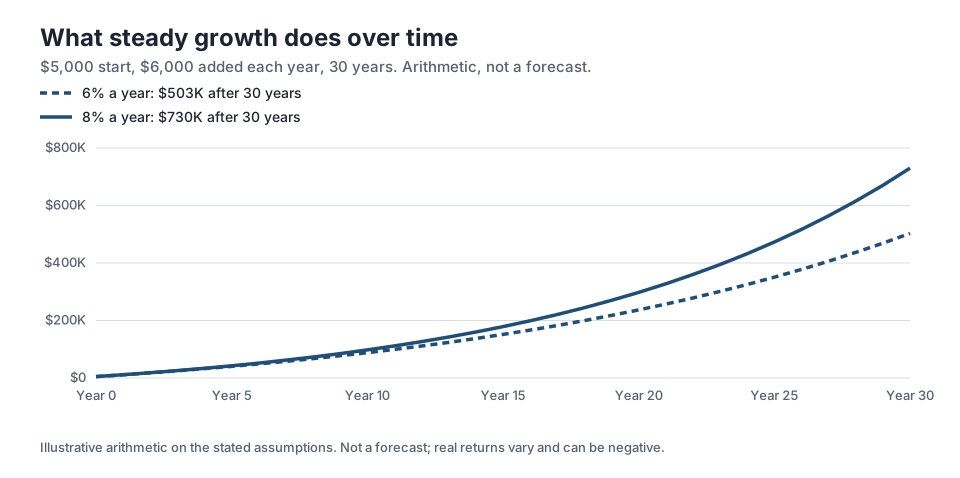
Over decades, matched contributions compound significantly in arithmetic illustrations. Consider a simplified example starting with $5,000 and adding $6,000 annually over 30 years—equivalent to $250 per month from an employee paired with $250 per month from an employer. Assuming a constant 6% annual growth rate before fees and taxes, the illustrative balance after 30 years reaches $503,067. Assuming an 8% annual growth rate under the same conditions, it reaches $730,013. These figures reflect pure arithmetic assumptions rather than market predictions.
Arithmetic illustrations leave out important real-world variables that affect actual outcomes. Market returns fluctuate year to year rather than progressing at a steady 6% or 8%, and investment losses can occur. In addition, employer matching contributions may follow a vesting schedule requiring several years of employment before the matched funds become fully owned by the worker. Still, missed employer match opportunities generally cannot be recovered retroactively once a calendar year closes.
How Credit Card Interest Compounds
According to the Consumer Financial Protection Bureau, credit card interest is often calculated using a daily periodic rate, which equals the annual percentage rate divided by 365. Each day a card carries an unpaid balance, the issuer multiplies that balance by the daily rate and adds the resulting interest charge. That daily compounding mechanism makes revolving credit card balances among the most expensive forms of household borrowing.
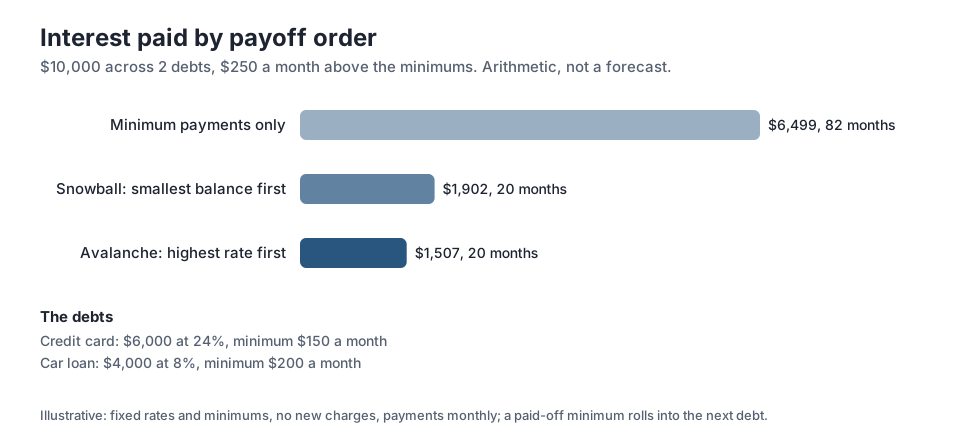
A frequent pitfall is looking only at the monthly minimum payment on credit card statements without recognizing how daily compounding inflates the total cost. Minimum formulas cover accrued interest plus a tiny sliver of principal, keeping debt active for years. In an arithmetic example of $10,000 in debt—comprising a $6,000 credit card at 24% annual interest with a $150 minimum and a $4,000 car loan at 8% annual interest with a $200 minimum—making only minimum payments generates $6,499 in interest over 82 months.
Adding $250 of extra monthly cash flow above those minimums sharply alters the math, assuming fixed rates and consistent payments. Directing the $250 extra toward the highest-rate debt trims total interest to $1,507 and eliminates all debt in 20 months, saving $4,992 in interest and 62 months compared with minimum payments. Directing the same $250 extra toward the smallest balance ahead of the larger one produces $1,902 in total interest over 20 months, saving $4,597 versus minimums.
Why a Starter Emergency Fund Precedes Extra Debt Payments
The Consumer Financial Protection Bureau defines an emergency fund as a cash reserve specifically set aside for unplanned expenses or financial emergencies. Common examples include sudden vehicle repairs, unexpected medical deductibles, urgent home maintenance, or a temporary interruption in household income. Keeping these dollars in an accessible, liquid bank account separates routine bill coverage from volatile investments and high-cost credit lines when surprise costs arrive.
Guidance from FINRA notes that a good rule of thumb is to save enough in an emergency fund to cover three to six months of living expenses. Reaching a full three to six months reserve can take a young family several years when monthly cash flow is also servicing debt and basic living costs, especially when childcare or housing consumes much of the budget.
A costly pitfall occurs when households skip building even a modest starter cash reserve and funnel every spare dollar toward debt balances. Without liquid savings on hand, the next unforeseen car repair or medical bill routinely lands straight back on a 24% credit card, erasing months of principal reduction and restarting daily interest charges. Holding a starter cash buffer before accelerating debt payments reduces the likelihood of cycling back into debt.
The Cost of Administrative and Investment Fees
While capturing an employer match expands contributions, internal expenses inside a retirement plan quietly affect long-term accumulation. According to the U.S. Department of Labor, 401(k) plan fees and expenses generally fall into three categories: plan administration fees, investment fees, and individual service fees. Administration charges cover recordkeeping and legal compliance, investment fees reflect mutual fund management expenses, and service fees apply to optional features like plan loans.
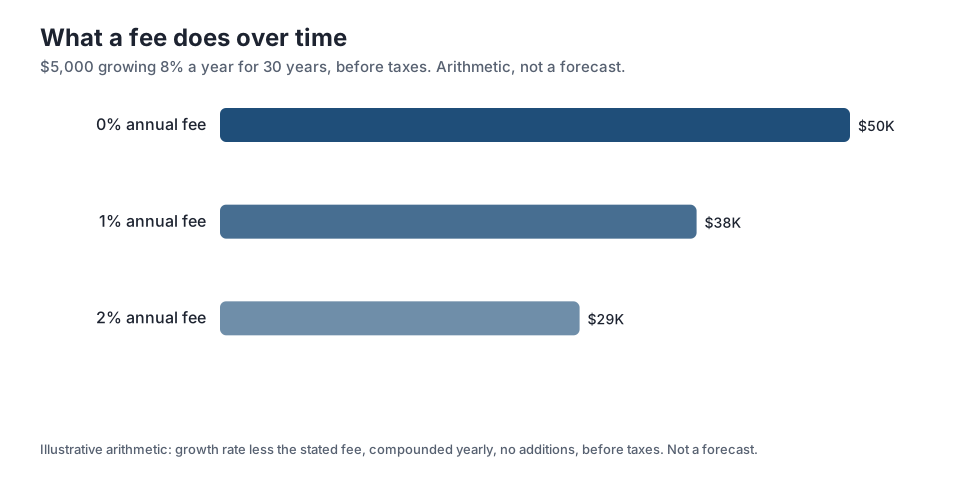
The U.S. Department of Labor illustrates how seemingly minor fee differences compound over an entire working career: a 1 percent difference in fees and expenses would reduce an account balance at retirement by 28 percent over 35 years. Unlike market returns, plan fees are deducted continuously from account assets in both rising and falling markets, permanently removing dollars that could otherwise remain invested and compound.
An arithmetic illustration of a single $5,000 balance growing at an assumed 8% annual rate over 30 years shows the fee drag clearly, before taxes and without predicting actual returns. With a 0% annual fee, the ending balance is $50,313. With a 1% annual fee, it falls to $38,061, or $12,252 less; with a 2% annual fee, it drops to $28,717, or $21,596 less. At Fenul Wealth Management, fees are set out in the firm's written agreement before you engage.
Balancing Debt Payoff and Retirement Savings: A Walk-Through
Consider Sarah and Mark, a young couple carrying a $6,000 credit card balance at 24% APR with a $150 minimum payment and a $4,000 car loan at 8% APR with a $200 minimum payment. After covering everyday household bills and those two minimum payments, they have $500 extra each month. Sarah earns $60,000, and her employer matches 100% of 401(k) contributions up to 5% of salary, equaling $250 per month.
If Sarah and Mark direct the entire $500 extra each month toward their $10,000 combined debt, they clear their balances faster and lower the total interest paid to lenders. However, pausing retirement deferrals completely means forfeiting $250 each month in employer matching contributions. Because matching room is tied to annual payroll deferrals, that missed employer contribution cannot be made up later once the year ends.
Alternatively, Sarah can contribute $250 per month—5% of her $60,000 salary—to capture the full $250 monthly employer match, leaving $250 extra per month for debt repayment. Using the arithmetic timeline from earlier, directing that $250 extra toward the 24% credit card before the 8% car loan clears all $10,000 of debt in 20 months with $1,507 in total interest.
Sarah and Mark face a clear set of trade-offs between capturing immediate matching funds for 30-year retirement compounding and extinguishing debt balances slightly earlier. Before finalizing their budget, they could ask a licensed financial advisor how pre-tax versus after-tax 401(k) contributions affect their current tax bracket, whether their emergency cash reserve is adequate before accelerating debt payments, and how vesting schedules apply to Sarah's employer match.
Strategies for Paying Down Credit Card Debt
Once a household decides how much monthly surplus to allocate toward debt reduction, two structured repayment methods organize the sequence. The avalanche method directs every extra dollar toward the debt carrying the highest interest rate while maintaining minimum payments on all other accounts. The snowball method directs extra dollars toward the account with the smallest dollar balance regardless of interest rate, aiming to close individual accounts sooner.
Applying both methods to the $10,000 example—a $6,000 card at 24% APR and a $4,000 car loan at 8% APR with $250 extra monthly—highlights the difference between arithmetic efficiency and early milestones. Both methods eliminate all debt in 20 months, yet the avalanche approach produces $1,507 in total interest while the snowball approach produces $1,902, saving $395 with avalanche. However, the snowball method clears its car loan in 10 months, whereas avalanche takes 19 months to clear its larger card balance.
Once high-interest revolving balances reach zero, ongoing discipline preserves those savings. As the Consumer Financial Protection Bureau explains, if a cardholder settles the credit card balance in full every month by the due date, interest is generally not charged on purchases. Keeping monthly spending within budget so statement balances clear completely restores that grace period and prevents daily periodic interest from returning to household finances.
When to Increase 401(k) Contributions Beyond the Match
Investor.gov defines a 401(k) plan as a defined contribution plan where an employee can make contributions from their paycheck either before or after taxes. Once a household eliminates high-interest credit card debt and establishes an emergency reserve covering three to six months of living expenses, monthly cash flow that previously serviced card principal and interest opens up for long-term wealth building.
Increasing deferrals beyond the employer match lets families move closer to federal contribution ceilings as earnings rise. For 2026, the Internal Revenue Service sets the standard employee 401(k) contribution limit at $24,500, and employees aged 50 and over have an additional catch-up contribution limit of $8,000 for 2026. Although a young family rarely reaches those limits immediately, knowing the ceilings clarifies how much tax-advantaged space remains available.
Deciding how to allocate newly freed cash flow beyond the match involves weighing several personal variables rather than following a rigid formula. Households compare lower-rate debts, such as an 8% auto loan, against the potential benefits of pre-tax or Roth workplace contributions, individual retirement accounts, or taxable savings for mid-term family goals. Checking plan investment fees, marginal tax brackets, and upcoming family expenses with a qualified professional keeps retirement savings aligned with overall stability.
- $24,500Standard employee 401(k) contribution limit
- $8,000Additional catch-up limit for age 50 and over
Key federal contribution ceilings for employees participating in a 401(k) plan. It shows the standard limit and the catch-up limit.
Key takeaways
- Employer plans vary in whether they calculate matching contributions strictly per paycheck or apply an annual true-up adjustment, meaning pausing or front-loading contributions mid-year can affect total matching dollars received when no true-up exists.
- A plan's Summary Plan Description details whether employer matching dollars vest immediately, on a cliff schedule after a set number of years, or gradually over time.
- Annual participant fee disclosures issued by plan administrators list exact investment expense ratios across the plan lineup alongside the terms of the employer match.
- Residual trailing interest can appear on the billing cycle immediately after reducing a credit card balance to zero, reflecting daily accrued charges from before the payment posting date.
- Payroll processing lags mean that changes to 401(k) deferral percentages submitted mid-cycle often take a couple of pay periods to reflect on pay stubs.
Sources
- 401(k) limit increases to $24,500 for 2026 (https://www.irs.gov/newsroom/401k-limit-increases-to-24500-for-2026-ira-limit-increases-to-7500)
- What is an emergency fund? (https://www.consumerfinance.gov/about-us/blog/what-is-an-emergency-fund/)
- How is interest calculated on my credit card? (https://www.consumerfinance.gov/ask-cfpb/how-is-interest-calculated-on-my-credit-card-en-43/)
- A Look at 401(k) Plan Fees (https://www.dol.gov/sites/dolgov/files/ebsa/about-ebsa/our-activities/resource-center/publications/a-look-at-401k-plan-fees.pdf)
- How to avoid paying interest on your credit card (https://www.consumerfinance.gov/ask-cfpb/how-can-i-avoid-paying-interest-on-my-credit-card-en-44/)
- Emergency Fund (https://www.finra.org/investors/insights/emergency-fund)
- 401(k) Plans (https://www.investor.gov/introduction-investing/investing-basics/glossary/401k-plans)
11Questions
Frequently asked questions
Should I stop my 401(k) contributions if I have a financial emergency?
Pausing 401(k) deferrals during an acute job loss or major medical expense frees up take-home cash flow immediately without taking on high-interest debt or tapping retirement principal early. The trade-offs include temporarily forfeiting employer matching dollars and increasing current taxable wages if prior deferrals were pre-tax. Households often evaluate how quickly contributions can resume once cash reserves recover.
Can I withdraw from my 401(k) to pay off credit card debt?
Taking an early distribution from a 401(k) before standard retirement age generally triggers ordinary federal and state income taxes plus an additional federal early-withdrawal tax penalty unless a specific statutory exception applies. Because those withdrawals permanently remove capital from tax-deferred compounding and reduce the net cash left after taxes, households typically compare withdrawal costs against structured repayment plans or debt counseling.
Does a 401(k) loan make sense for consolidating high-interest debt?
A workplace plan loan allows borrowing from existing account balances up to Internal Revenue Service limits and repaying principal plus interest back into the account through payroll deductions. Key drawbacks include missing potential market growth while funds sit outside the portfolio, repaying loan interest with after-tax dollars that get taxed again upon retirement distribution, and facing accelerated repayment deadlines if employment ends before the loan is cleared.
What happens to my employer match if I leave my job before I am fully vested?
An employee's own payroll contributions are always 100% owned by the worker immediately, whereas employer matching funds depend on the plan's vesting rules. Under cliff vesting, leaving prior to completing the required service period forfeits the entire employer match; under graded vesting, the worker retains a rising share for each completed year of service and forfeits only the unvested portion.
How do balance transfer credit cards affect my debt payoff strategy?
Moving revolving debt onto a promotional balance transfer card temporarily lowers the annual percentage rate on the transferred sum, allowing more of each monthly payment to reduce principal. However, issuers typically charge an upfront transfer fee based on a percentage of the moved balance, and any remaining debt reverts to a standard variable rate once the promotional window expires. Comparing the transfer fee against interest saved determines whether the switch lowers total cost.
Should I prioritize a Roth IRA over my employer's 401(k) match?
A Roth individual retirement account offers broad investment selection, flexible withdrawal rules on original contributions, and qualified retirement distributions free of federal income tax, yet it includes no employer match. Workplace 401(k) plans may have narrower fund menus or higher administrative fees, yet employer matching adds extra dollars onto each eligible contribution. Households weigh that matching boost against outside account fee savings and tax diversification.
12Keep reading
Related guides
 Retirement
Should I Roll My Old 401(k) to an IRA When I Change Jobs?
Compare keeping an old 401(k), rolling to a new employer plan, or moving to an IRA, including backdoor Roth pro-rata rules and institutional fee differences. Taxes
How do I use a donor-advised fund to bunch charitable contributions?
Learn how charitable bunching with a donor-advised fund compares to annual giving, including standard deduction math, appreciated assets, and IRS rules. Social Security
How Does My Social Security Claiming Age Affect My Spouse?
Learn how a primary earner's Social Security claiming age shapes joint retirement income and sets the surviving spouse's permanent monthly benefit.
13Next step
Take the next step
If you want to talk this through, an advisor at the firm can help.
14Next step
Talk it through with the firm
When you would like to talk something through, book a free call or send a message.

You will speak with Tayeb Ayat, the firm’s founder. (888) 336-8586 · info@fenul.com