Retirement · November 24, 2026
Should I Participate in My Company's Deferred Compensation Plan?
An educational guide explaining NQDC tax-deferred growth, company creditor risk, Section 409A payout rules, and taxable brokerage trade-offs.
11 min read · 9 sections

Deciding whether to participate in a nonqualified deferred compensation plan depends on weighing tax-deferred investment growth against company creditor risk and rigid distribution rules. Unlike a standard workplace retirement account, an NQDC plan leaves deferred money inside the employer's general assets, creating a structural trade-off between upfront tax deferral and ongoing financial exposure to the company's long-term solvency.
For high-earning executives who already max out qualified workplace accounts, an annual enrollment invitation presents a complex balance-sheet choice rather than a simple savings step. Deferring salary or bonus reduces current-year taxable income and lets the full pre-tax principal compound, yet that balance represents an unsecured corporate promise rather than segregated personal property.
Evaluating an enrollment offer involves looking closely at three distinct factors: how tax deferral compares with investing after-tax cash in a standard brokerage account, how vulnerable the employer is to insolvency or bankruptcy, and how strictly federal tax law locks in future payout dates. Because elections remain largely irrevocable once submitted, executives weigh these variables together before committing earned income.
Should You Participate in Your Company's NQDC Plan?
A nonqualified deferred compensation plan is a contractual arrangement between an employer and select employees—typically senior executives or highly compensated staff—to postpone a portion of earned salary, commissions, or bonuses until a future date. By postponing receipt of that compensation, the participant also postpones federal and often state ordinary income taxes on the deferred amount until the company distributes the cash.
Although income taxes are postponed, the IRS still tracks annual deferrals for wage reporting. Your employer reports the total amount of deferrals for the year under a nonqualified deferred compensation plan in box 12 of Form W-2. Rather than placing cash into an individual trust account, the company records a bookkeeping liability on its balance sheet, tracking notional investment choices that mirror market indexes, mutual funds, or a fixed crediting rate defined by the plan.
Choosing whether to enroll during an open enrollment window hinges on whether postponing current taxes outweighs two substantial drawbacks. A participant accepts the risk that the company may be unable to honor its obligation during severe financial distress, and accepts inflexible payout schedules that cannot adapt easily if personal cash requirements shift years later.
NQDC vs. 401(k): Understanding the Differences
Although employers frequently present deferred compensation alongside standard workplace benefits, an NQDC plan operates under entirely different statutes than a 401(k). A 401(k) is a qualified plan governed by the Employee Retirement Income Security Act, known as ERISA, which enforces strict participation, nondiscrimination, and fiduciary funding rules. An NQDC plan is nonqualified specifically because it bypasses ERISA nondiscrimination testing so employers can offer it exclusively to top management.
Because a 401(k) enjoys federal trust protections and broad tax advantages, the IRS caps annual employee contributions. For 2025, the total annual amount you can contribute to a 401(k) plan is $23,500. Under IRS rules, if you are age 50 or older, the total annual amount you can contribute to a 401(k) plan is $31,000 for 2025, and if you are age 60 through 63 at the end of 2025, the total annual limit rises to $34,750.
- $23,500Base contribution limit
- $31,000Limit if age 50 or older
- $34,750Limit if age 60 through 63
The maximum amounts employees can contribute to a 401(k) plan based on age.
In contrast, the IRS sets no statutory dollar ceiling on how much compensation an executive can defer into an NQDC plan. Many employers permit participants to defer a large share of base salary and up to the entire annual bonus, bounded only by the written plan document. That absence of an annual cap makes NQDC plans a common overflow vehicle once qualified limits are filled, even though the account lacks qualified portability and creditor shields.
- Qualified 401(k) assets reside in an independent trust managed by fiduciaries, whereas NQDC balances remain on the employer's corporate books.
- A 401(k) allows tax-deferred rollovers into an Individual Retirement Account upon departure, while NQDC distributions are taxed as wage income when received.
- Employers can restrict NQDC eligibility to a select group of management or highly compensated staff, whereas 401(k) plans cover broad employee groups.
The Creditor Risk: Are Your Funds Safe?
A common pitfall among newly eligible executives is assuming an NQDC plan carries the same ERISA protections as a 401(k). Under federal law, 401(k) contributions sit in a segregated trust that belongs strictly to the employee, placing those funds beyond the reach of the employer or its lenders. Because an NQDC plan avoids ERISA funding mandates to preserve tax deferral, the IRS treats deferred compensation as an unfunded, unsecured promise to distribute money later.
If the sponsoring company files for bankruptcy or becomes insolvent, NQDC assets remain part of the company's general corporate assets. Plan participants stand in line as general unsecured creditors, meaning secured banks and bondholders hold senior claims, and deferred balances can be reduced or lost completely. Some firms establish a rabbi trust to hold assets earmarked for the plan, preventing management from repurposing funds during normal operations, yet even a rabbi trust remains legally exposed to general creditors during bankruptcy.
Credit exposure intensifies when an executive already holds substantial employer risk through unvested stock units, stock options, and ongoing salary. Over-concentrating net worth in a single employer creates correlated vulnerability: the same corporate downturn that threatens employment and depresses company share prices could simultaneously jeopardize the entire NQDC balance. Evaluating an employer's debt load, industry stability, and cash flow durability becomes central before locking away compensation over multi-year horizons.
The Math of Tax Deferral
Deferring income taxes lets the entire pre-tax dollar remain invested rather than losing an upfront slice to withholding. Inside an NQDC account, annual notional returns compound without yearly tax drag from dividends, interest, or portfolio rebalancing. On year-end tax paperwork, the IRS requires clear tracking of these ongoing contributions: the total amount of deferrals for the year under a nonqualified deferred compensation plan is shown using code Y on Form W-2.
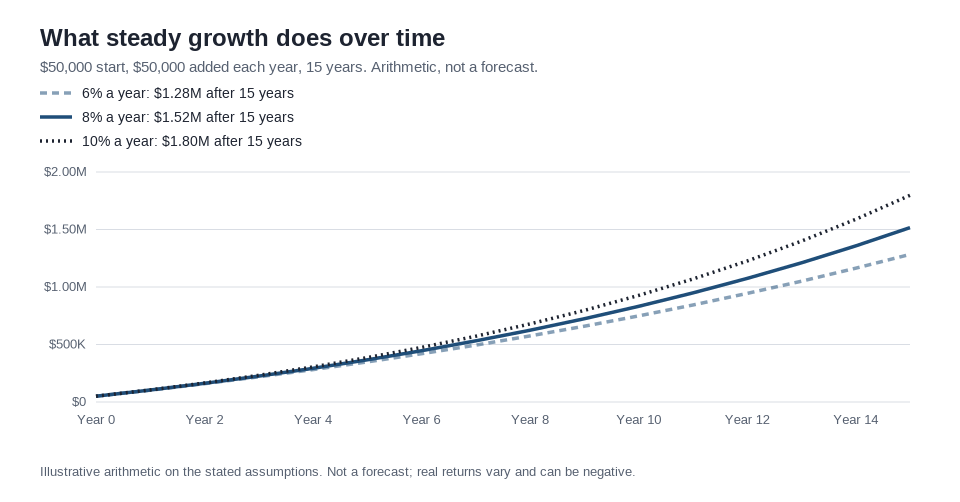
To examine how unencumbered compounding builds over a career, an illustrative calculation assumes an initial $50,000 deferral followed by $50,000 deferred annually for 15 years, with no annual taxes deducted. At an assumed annual growth rate of 6%, the balance after 15 years is $1,283,626 ($1.28M). At an assumed 8% annual rate, the balance reaches $1,516,214 ($1.52M), and at an assumed 10% annual rate, it reaches $1,797,486 ($1.80M). These figures show arithmetic compounding only, not a market forecast.
A standard taxable brokerage account follows a contrasting tax path. An executive receives full compensation as taxable wages, settles ordinary income taxes upfront, and invests the smaller after-tax principal. Each year, dividends and realized capital gains face ongoing tax drag, slowing long-term compounding. However, investments held in a brokerage account can qualify for lower long-term capital gains rates, whereas a common pitfall is forgetting that NQDC distributions—both principal and investment growth—are taxed entirely as ordinary income.
Weighing NQDC participation against a taxable brokerage account involves balancing pre-tax compounding against liquidity, tax character, and credit exposure. Neither approach fits every balance sheet, and each carries distinct trade-offs depending on an executive's tax bracket trajectory and tolerance for corporate credit risk.
- Participate in the NQDC Plan: You elect to defer salary or bonus before the year starts on an unsecured corporate promise. Pros include unlimited tax-deferred growth potential, lower current-year taxable income, and timing flexibility for lower retirement brackets; cons include exposure to company creditors in bankruptcy, rigid Section 409A payout rules, and no IRA rollover option. Executives often weigh this when they have maxed out a 401(k), occupy a high tax bracket, and trust the employer's financial durability.
- Invest in a Standard Taxable Brokerage Account: You receive full compensation, settle income taxes immediately, and invest the net cash independently. Pros include complete control and liquidity, full insulation from employer creditors, and potential eligibility for lower capital gains rates; cons include no upfront tax reduction, annual tax drag on dividends and realized gains, and a smaller starting investment principal. Executives often weigh this when liquidity, avoiding company credit exposure, or pre-retirement access matters most.
Section 409A and Rigid Distribution Rules
Following major corporate accounting scandals two decades ago, Congress and the IRS enacted Internal Revenue Code Section 409A to restrict flexible timing maneuvers in executive compensation. Under Section 409A, elections to defer base salary generally happen in the calendar year before the compensation is earned, while elections for qualifying performance-based bonuses follow strict mid-year deadlines. Crucially, the participant selects both the future distribution trigger and the payout schedule when submitting the initial deferral election.
A frequent pitfall is believing you can easily alter a payout schedule if your personal financial situation shifts. Under Section 409A, accelerating an NQDC distribution is nearly impossible outside narrow events like death, disability, or a corporate change in control. Delaying a scheduled payout is allowed only under strict subsequent-deferral rules: the request to postpone a distribution is submitted well before the original date—at least a full year in advance—and pushes the new payout date back by five additional years.
- If you submit an initial deferral electionyou must select the future distribution trigger and payout schedule.
- If you want to accelerate a distributionit is nearly impossible outside narrow events like death or disability.
- If you want to delay a scheduled payoutit is allowed only under strict subsequent-deferral rules.
How Section 409A restricts changes to nonqualified deferred compensation payout schedules.
The IRS enforces Section 409A rules with severe tax consequences rather than mild administrative penalties. If a nonqualified deferred compensation plan fails to meet requirements, all amounts deferred under the plan are included in your income for the current year, even when no cash is distributed. Those failed plan amounts are included in wages shown in box 1 of Form W-2, and failed plan amounts are also shown in box 12 of Form W-2 using code Z, triggering steep additional taxes and interest.
- Permissible distribution triggers under IRS Section 409A are limited to separation from service, disability, death, a specified fixed calendar date, a corporate change in control, or an unforeseeable emergency.
- Specified employees at publicly traded companies face a mandatory waiting period of several months after separating from service before any NQDC payout can begin.
- Plan administrators cannot allow participants to borrow against NQDC balances or pledge deferred amounts as collateral for a personal loan.
Payout Options: Lump Sum vs. Installments
Most NQDC plans offer two main payout choices at enrollment: a single lump sum or a series of annual installments over multiple years. A lump sum delivers the entire balance upon the trigger event, eliminating ongoing employer creditor risk as soon as funds clear, yet concentrating the full payout into one tax year can push income into top brackets. Installments spread distributions across a fixed schedule to smooth taxable income, though unpaid balances stay exposed to company credit risk until settled.
| Lump Sum | Installments | |
|---|---|---|
| Creditor risk | Eliminated once funds clear | Exposed until fully settled |
| Tax impact | Concentrated in one year | Spread across multiple years |
A comparison of the two main payout choices for nonqualified deferred compensation.
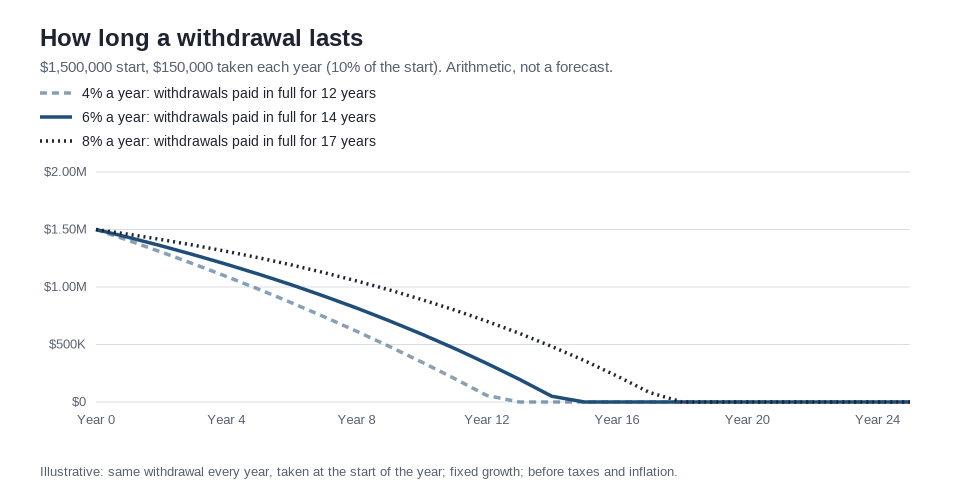
Evaluating installment schedules also requires testing how long a balance sustains planned withdrawals under varying return assumptions. An illustrative model starts with $1,500,000 ($1.50M) and withdraws $150,000 each year, equal to 10% of the initial balance. Assuming 4% annual growth, the $150,000 withdrawal is distributed in full for 12 years before the money runs out. At an assumed 6% annual return, the $150,000 payout lasts for 14 years, and at an assumed 8% annual return, it lasts for 17 years. These arithmetic figures show that a 10% withdrawal rate depletes the account before a 25 years horizon.
Another common pitfall is failing to account for how NQDC distributions affect your retirement tax bracket. Because payouts count as ordinary wage income, annual installments stack directly onto Social Security benefits, required minimum distributions from 401(k) accounts, pension income, and portfolio interest. Higher combined ordinary income can push marginal rates upward, increase the taxable share of Social Security, and trigger elevated Medicare premium surcharges, eroding the expected benefit of deferring income during peak earning years.
Walkthrough: An Executive's NQDC Decision
Sarah is a 50-year-old executive reviewing her annual open enrollment packet. She is deciding whether to defer $50,000 annually into her company's NQDC plan, starting with an initial $50,000 deferral. Sarah plans to retire in 15 years and evaluates illustrative annual return assumptions of 6%, 8%, or 10% over that working period to gauge how tax-deferred compounding might build her retirement resources.
Under those arithmetic assumptions, 15 years of $50,000 annual deferrals grow to $1,283,626 at 6%, $1,516,214 at 8%, or $1,797,486 at 10%. Using roughly $1,500,000 as a retirement baseline, Sarah tests whether withdrawing $150,000 annually—10% of that starting balance—can cover a 25 years retirement. Under illustrative retirement return assumptions of 4%, 6%, or 8%, a $1,500,000 balance supports $150,000 annual payouts for 12 years, 14 years, or 17 years respectively before running out, showing a funding gap relative to a 25 years retirement span.
While tax-deferred growth over 15 years looks compelling next to investing after-tax cash in a taxable brokerage account, Sarah weighs that compounding against major constraints. Her projected $1,500,000 balance would remain an unsecured corporate obligation vulnerable to employer bankruptcy, and strict IRS deferred compensation rules would lock in her distribution schedule years ahead of retirement. Holding both company equity compensation and a substantial NQDC account also concentrates her household net worth inside the same enterprise.
Rather than treating the enrollment deadline as an automatic savings step, Sarah evaluates how an unsecured NQDC promise balances against her qualified workplace retirement account and liquid personal investments. Before locking in an election, executives weighing similar trade-offs often bring targeted questions to a licensed financial advisor or tax professional.
- How do the employer's credit rating, debt obligations, and cash reserves affect the risk of holding $1,500,000 as an unsecured balance over 15 years?
- What share of total household net worth is already tied to the employer through salary, bonuses, and equity awards?
- How does today's marginal tax bracket compare with projected retirement brackets when $150,000 NQDC payouts stack onto qualified retirement withdrawals and Social Security?
- Could a shorter installment window lower corporate credit exposure enough to justify potentially higher annual income taxes?
- How would a voluntary departure, termination, or corporate acquisition affect NQDC payout timing under the written plan document?
Key takeaways
- Federal law restricts states from taxing certain retirement distributions of former residents when installments stretch across at least a decade, making payout duration relevant for executives planning to relocate in retirement.
- Reviewing an employer's public debt ratings, bond covenants, and free cash flow provides concrete context on default risk before locking money into an unsecured plan.
- Naming and updating NQDC beneficiaries separately from a 401(k) matters because qualified plan spousal consent rules do not automatically govern nonqualified accounts.
- Checking how an employer defines a corporate change in control inside the written plan document reveals whether a merger or acquisition accelerates balances into an unexpected taxable lump sum.
- Coordinating annual deferral elections with bonus announcement schedules helps prevent missed Section 409A deadlines during busy year-end enrollment windows.
Sources
- Publication 525 (2025), Taxable and Nontaxable Income (https://www.irs.gov/publications/p525)
10Questions
Frequently asked questions
Can I roll my NQDC plan balance into an IRA when I retire?
No. Under IRS rules, tax-deferred rollovers apply only to qualified retirement plans, such as a 401(k), and Individual Retirement Accounts. Because an NQDC plan is an unfunded corporate obligation rather than a qualified trust, distributions are treated as ordinary compensation and cannot move into an IRA or Roth IRA. Plan administrators withhold federal and applicable state income taxes directly from each distribution as wages.
What happens to my deferred compensation if I leave the company before retirement?
The outcome depends on the written plan document and the reason for leaving. Employee salary deferrals are typically vested immediately, whereas employer matching or discretionary credits often follow a multi-year vesting schedule and may be forfeited upon early departure. Under Section 409A, leaving a company frequently triggers a separation-from-service payout according to the original election, though some plans enforce non-compete forfeiture clauses for executives who join direct competitors.
Are NQDC plan contributions subject to Social Security and Medicare taxes?
Yes. Under IRS payroll tax rules, deferred compensation is generally subject to Social Security and Medicare taxes when the services are performed or when the balance vests, whichever occurs later, rather than when cash is distributed in retirement. High-earning executives whose base wages already exceed the annual Social Security wage limit often owe only Medicare taxes on additional deferrals, and future investment growth inside the plan generally avoids extra payroll taxes once taxed upfront.
Can I change my distribution election if I have an unforeseeable financial emergency?
Only under narrow IRS criteria. Section 409A restricts emergency withdrawals to severe financial hardships caused by an illness, accident, or uninsured property loss beyond the participant's control, excluding routine needs like home purchases or college tuition. Even when an administrator approves a hardship request, the early distribution cannot exceed the exact amount required to satisfy the emergency after using insurance proceeds or liquidating other accessible personal assets.
Does my company get a tax deduction when I defer my compensation?
No. IRS tax accounting rules enforce a matching principle between executive income and corporate deductions. An employer cannot claim a business tax deduction in the year an executive defers salary or bonuses into an NQDC plan. Instead, the company takes its tax deduction only in the future tax year when the funds are actually distributed to the executive and reported as taxable ordinary income.
Are NQDC plans protected by the Pension Benefit Guaranty Corporation (PBGC)?
No. The Pension Benefit Guaranty Corporation is a federal agency that insures certain private-sector defined benefit pension plans covered by ERISA. Because nonqualified deferred compensation plans are exempt from ERISA funding, vesting, and insurance mandates, the PBGC provides zero coverage if an employer defaults or enters bankruptcy. Plan participants rely solely on the sponsoring company's ongoing solvency and future ability to honor its promises.
11Keep reading
Related guides
 Retirement
Should I Take My Airline Pilot Pension as a Lump Sum or Annuity?
This article compares an airline pilot pension lump sum rollover to a monthly annuity at age 65, covering breakeven math, taxes, inflation, and spousal rules. Retirement
In What Order Should I Withdraw From My Retirement Accounts?
Learn how blending withdrawals across taxable, tax-deferred, and Roth accounts can manage annual taxes, RMDs, and Social Security timing in retirement. Retirement
Should I Roll My Old 401(k) to an IRA When I Change Jobs?
Compare keeping an old 401(k), rolling to a new employer plan, or moving to an IRA, including backdoor Roth pro-rata rules and institutional fee differences.
12Next step
Take the next step
If you want to talk this through, an advisor at the firm can help.
13Next step
Talk it through with the firm
When you would like to talk something through, book a free call or send a message.

You will speak with Tayeb Ayat, the firm’s founder. (888) 336-8586 · info@fenul.com