Insurance · November 14, 2026
How Do Hybrid Long-Term Care Insurance Policies Work?
Compare hybrid life-LTC policies, traditional long-term care insurance, and self-funding through opportunity cost, portfolio withdrawals, and tax rules.
11 min read · 9 sections

A hybrid long-term care policy is an asset-based insurance contract that links long-term care benefits with a life insurance or annuity reserve inside one agreement. Rather than sending ongoing premiums into a standalone health-style contract that forfeits everything if no claim occurs, a policyholder commits a lump sum or scheduled installments to establish a dual-purpose pool. If qualifying care needs arise, the contract disburses monthly benefits from that pool; if the insured person stays healthy through life, beneficiaries receive a death benefit when the insured dies.
Evaluating a hybrid contract requires setting it beside two neighboring strategies: traditional long-term care insurance and self-funding from personal savings. Traditional policies typically deliver the largest care pool per premium dollar, yet premiums can rise over time and disappear entirely without a claim. Self-funding preserves total control over investments and avoids insurance underwriting, while leaving household assets exposed to prolonged out-of-pocket care bills. Every path shifts risk differently between an insurance carrier and a retiree's balance sheet.
Looking closely at the underlying numbers clarifies what each arrangement truly costs. The price of a hybrid contract extends well beyond the check written at issue because tying up capital forfeits years of potential market compounding. Meanwhile, keeping assets invested for self-funding raises the question of whether a retirement portfolio can absorb steep annual care withdrawals without jeopardizing a surviving spouse. Examining public care benchmarks alongside plain arithmetic assumptions shows how those trade-offs behave over two decades.
The True Cost of Long-Term Care
Many households approaching retirement assume federal health coverage will absorb extended assistance in later life, yet HealthCare.gov notes that Medicare and most standard health insurance plans do not cover long-term care. Routine help with daily living—known as custodial care—falls outside regular medical benefits regardless of whether assistance occurs in a private residence or an institutional setting. Relying on standard health insurance for prolonged frailty leaves a retirement plan exposed to substantial out-of-pocket expenses.
Confusion often stems from short-term rehabilitation coverage under Medicare Part A. According to Medicare.gov rules, Medicare Part A caps skilled nursing facility benefits at 100 days during each benefit period, and only after a qualifying inpatient hospital stay. During the initial 20 days of skilled care, Medicare covers the bill in full. For the remaining days up to the 100-day limit, patients owe a daily coinsurance of $217. Once day 100 passes, or when care shifts from medical rehabilitation to custodial support, Medicare coverage stops completely.
Private care rates measured by the federal Long Term Care Insurance Program illustrate the scale of those uncovered bills. Nationally, a semi-private room in a nursing home averages $112,420 per year, while an assisted living facility averages $5,511 per month. Hiring part-time in-home aides over a standard workweek averages $51,000 annually. Because cognitive decline or mobility loss can persist across multiple years, even moderate care needs can quickly rival ordinary retirement living expenses.
- Personal hygiene assistance, including bathing, grooming, and dressing when mobility or balance declines.
- Meal preparation, feeding support, and routine household upkeep that enable someone to remain at home.
- Supervision for wandering or memory impairment in dedicated memory care residences.
- Daily medication reminders and non-skilled monitoring not tied to an acute hospital recovery.
- $112,420Annual cost for a semi-private nursing home room
- $51,000Annual cost for home care
- $5,511Monthly cost for an assisted living facility
A snapshot of the average expenses for different types of long-term care, highlighting the high cost of nursing home facilities.
Traditional Long-Term Care Insurance: Leverage vs. Risk
Traditional long-term care insurance functions much like homeowners or auto coverage: policyholders remit ongoing monthly or annual premiums in exchange for a specified daily or monthly care allowance. When a claim occurs, the policy provides substantial leverage relative to total premiums remitted, often creating the largest pool of care dollars for a given budget. Because premiums depend on age and health at application, qualifying policyholders who buy earlier in retirement lock in lower baseline rates.
That leverage comes with two notable trade-offs. Under a traditional use-it-or-lose-it design, if an insured person passes away without needing qualifying care, none of the premiums return to heirs. Furthermore, overlooking the risk of future premium increases is a common pitfall. Unlike level-term life policies, traditional carriers can petition state regulators for rate increases across an entire class of policyholders when claims experience or low interest rates strain reserves, forcing retirees either to absorb steep hikes or accept reduced benefits.
- If you buy a policy earlier in retirementYou lock in lower baseline premium rates based on your age and health.
- If you pass away without needing qualifying careNone of the premiums return to your heirs under a traditional design.
- If the carrier faces higher overall claimsThey can petition state regulators for premium rate increases.
A decision flow outlining the potential outcomes and risks associated with traditional long-term care insurance.
People weigh traditional coverage when they prioritize maximum care capacity per premium dollar and accept the possibility of funding unused coverage. To collect benefits under a tax-qualified policy, guidelines summarized by the federal Long Term Care Insurance Program require a licensed healthcare practitioner to certify that the insured cannot perform at least two of the six activities of daily living for at least 90 days, or requires substantial supervision due to severe cognitive impairment.
- Bathing safely in a tub or shower without hands-on assistance.
- Dressing in appropriate clothing, including managing fasteners and footwear.
- Eating prepared food or using adaptive utensils independently.
- Transferring in and out of a bed or chair without physical support.
- Toileting and maintaining personal hygiene before and after restroom use.
- Maintaining continence or managing related medical supplies unassisted.
How Hybrid Long-Term Care Policies Work
Inside a hybrid life-LTC contract, benefits typically operate in two sequential layers built atop a permanent life insurance base. Initially, qualifying care claims accelerate the policy's death benefit, drawing down the survivor benefit dollar-for-dollar to cover care invoices. Once that base death benefit is exhausted, an extension-of-benefits rider activates to provide additional years of care funding, multiplying the total pool available beyond the original life insurance face amount.
Hybrid contracts also differ in how they fund premiums and distribute claims. Most carriers accept either a single upfront lump sum or fixed annual installments over a set period, locking in rates contractually so future premium hikes cannot occur. Some contracts include a return-of-premium option allowing policyholders to surrender the contract and recover most or all of their deposit after a waiting period. Depending on the carrier, claims either reimburse actual receipts up to a monthly cap or disburse a flat cash indemnity once eligibility triggers are met.
People weigh hybrid coverage when they hold idle cash or conservative bond reserves, prefer locked-in premiums, and want a death benefit if care is never needed. The primary trade-offs are a heavy upfront capital outlay and lower care leverage than a traditional policy. A critical pitfall is buying a contract without verifying that it satisfies Internal Revenue Service rules for a tax-qualified long-term care contract; non-qualified riders can expose monthly care benefits to ordinary income taxes and impose narrower benefit triggers.
The Hidden Price Tag: Opportunity Cost
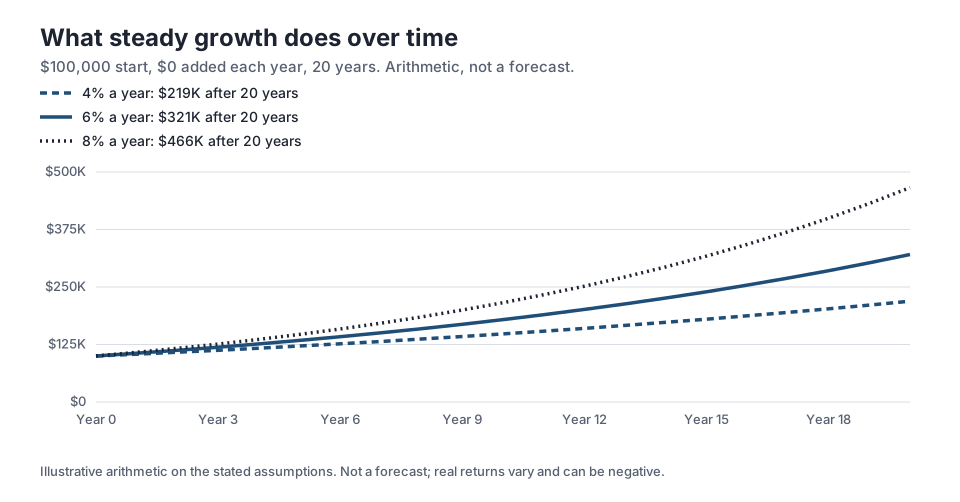
Focusing solely on the avoided risk of forfeited premiums leads many buyers to overlook opportunity cost—the investment growth given up when a lump sum leaves a portfolio. Consider John and Mary, both age 60, who hold a $1,500,000 portfolio and are evaluating a $100,000 upfront premium for a hybrid policy. Shifting $100,000 into an insurance contract removes that capital from stocks and bonds, permanently trading market compounding for contractual policy values.
Simple arithmetic illustrates what that $100,000 could accumulate if left invested for 20 years with $0 in additional contributions, assuming steady annual compounding rather than a market forecast. At an assumed 4% annual return, the $100,000 grows to $219,112 after 20 years. At an assumed 6% annual return, the balance reaches $320,714 over the same 20 years. At an assumed 8% annual return, compounding carries the account to $466,096.
Plain compounding math omits real-world frictions that shape net household wealth. Investment returns fluctuate year to year rather than arriving in smooth percentages, and interest, dividends, or realized gains inside taxable brokerage accounts create annual tax drag unless assets sit inside tax-deferred retirement accounts. Fund expenses and advisory fees also trim net results. Even accounting for those drags, however, an invested balance remains fully liquid for emergencies, home modifications, or family gifts, whereas capital inside a hybrid contract sits behind surrender rules.
Self-Funding: Is Your Portfolio Big Enough?
Self-funding relies on personal savings, investment portfolios, and retirement income streams rather than third-party insurance contracts. Households keep complete authority over asset allocation, keep all investment gains if they stay healthy, and avoid policy underwriting or insurance charges. The vulnerability is concentration risk: a prolonged stay in memory care or skilled nursing can drain assets rapidly, potentially leaving a healthy spouse with diminished income. People generally weigh self-funding when net worth comfortably exceeds core retirement spending needs.
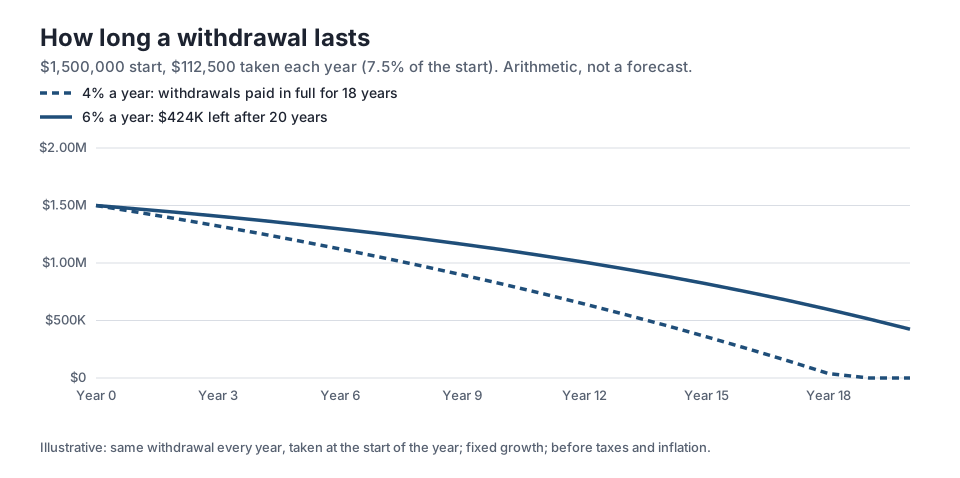
Arithmetic demonstrates how John and Mary's $1,500,000 portfolio responds to a sustained $112,500 annual care withdrawal, representing 7.5% of their starting balance each year. These figures reflect constant-return arithmetic only, not a market forecast. Assuming 4% annual growth, the portfolio covers the full $112,500 withdrawal for 18 years before reaching zero. Assuming 6% annual growth, the portfolio sustains every $112,500 annual withdrawal across 20 years and finishes with $424,021 remaining.
Constant-return arithmetic conceals sequence-of-returns risk, which poses the sharpest hazard for self-funders. If a steep market downturn strikes during the opening years of a $112,500 annual withdrawal schedule, selling depressed shares accelerates depletion far faster than an average 4% or 6% model suggests. Moreover, care inflation, household taxes on retirement account distributions, and ongoing living expenses for a healthy spouse at home can push total portfolio withdrawals well above the care bill alone.
Another common pitfall is underestimating the cost of in-home care relative to a residential facility. While part-time home assistance averages $51,000 annually, around-the-clock care requires multiple shifts of aides every day of the week. When continuous home staffing is combined with ongoing mortgage or property tax obligations, utilities, home maintenance, and groceries, staying at home with full-time support can match or surpass the $112,420 national nursing home average.
Walking Through the Decision
Putting the numbers side by side clarifies the specific trade-off John and Mary face at age 60. By allocating $100,000 to a hybrid contract, they secure a contractual $300,000 long-term care benefit pool alongside a $120,000 death benefit for heirs if care is never required. That structure immediately protects against an early care event in their sixties, when an invested $100,000 has had little time to compound.
Keeping that $100,000 invested inside their $1,500,000 portfolio yields a different risk profile. At an illustrative 6% annual growth rate with $0 added, the $100,000 balance reaches $320,714 after 20 years, slightly exceeding the $300,000 insurance pool while remaining available for any financial need. However, if either spouse needs $112,500 a year in care, the uninsured portfolio absorbs the full cost directly, testing whether $1,500,000 can support both care bills and a surviving spouse's lifestyle.
| Hybrid Contract | Invested Portfolio | |
|---|---|---|
| Initial allocation | $100,000 | $100,000 |
| Long-term care pool | $300,000 | Account balance |
| Death benefit | $120,000 | Account balance |
| Market growth potential | No | Yes |
A side-by-side comparison of allocating $100,000 to a hybrid insurance contract versus keeping it invested.
Neither route removes uncertainty altogether; each shifts which risk the household carries. The hybrid contract trades away upside compounding and liquidity for a defined care pool and survivor benefit, whereas self-funding trades away contractual protection for full flexibility and investment upside.
- How does our $1,500,000 portfolio hold up in stress tests if a $112,500 care event begins during a market downturn while one spouse remains at home?
- After accounting for taxes on withdrawals from retirement accounts, what net return is needed to match a $300,000 care pool?
- Do the contract's terms and tax-qualification language match our local care costs?
- Would splitting the risk—covering part of the potential bill with a smaller policy and self-funding the remainder—align better with our liquidity preferences?
Tax Implications and Business Owners
Tax treatment can meaningfully narrow the net cost gap between covering bills out of pocket and owning coverage. Under Internal Revenue Service guidelines, individuals who itemize deductions can deduct qualified medical and dental expenses—including premiums for tax-qualified long-term care insurance—to the extent those combined expenses exceed 7.5% of adjusted gross income. Because many retirees carry modest adjusted gross income alongside rising healthcare outlays, crossing that 7.5% threshold becomes more common later in retirement.
Hybrid contracts receive narrower medical-expense tax treatment than traditional standalone policies. Because part of a hybrid premium funds life insurance and only a portion funds the long-term care rider, the IRS permits medical deductions solely on the explicitly allocated qualified care portion, subject to age-based annual caps.
Business owners face distinct rules when structuring coverage through an enterprise. According to Internal Revenue Service rules on employee compensation, contributions made by an employer to provide coverage for long-term care services generally are not included in an employee's taxable income. Depending on whether a firm operates as a C-corporation, partnership, or sole proprietorship, owner-employees may deduct employer-funded qualified premiums as a business expense while keeping benefits excluded from personal income, making business structure an important variable to review with a tax professional.
Key takeaways
- Elimination periods act like a time deductible: contracts typically require a waiting window—often 90 days or shorter—of out-of-pocket care before benefits start, meaning policyholders still keep liquid reserves for initial bills.
- Inflation riders materially reshape hybrid math: choosing a flat benefit preserves a larger initial pool, while compounding inflation riders reduce starting benefits or increase the required deposit.
- Joint hybrid policies allow spouses to share one care pool from a single deposit, though prolonged care for one partner can deplete coverage available to the surviving spouse.
- Underwriting reviews prescription histories, cognitive screenings, and specialist notes before issuing a policy, so health changes later in retirement can restrict insurance choices regardless of asset size.
- Long-term care partnership programs in participating states shelter an amount of personal assets equal to benefits received if Medicaid is eventually needed, a feature traditional policies carry more often than hybrids.
Sources
- HealthCare.gov Glossary (https://www.healthcare.gov/glossary/long-term-care/)
- LTCFEDS Cost of Care (https://www.ltcfeds.gov/)
- Medicare.gov Skilled Nursing Facility Care (https://www.medicare.gov/coverage/skilled-nursing-facility-snf-care)
- LTCFEDS Tax Advantages (https://www.ltcfeds.gov/)
- IRS Publication 502 (https://www.irs.gov/publications/p502)
- IRS Publication 525 (https://www.irs.gov/publications/p525)
10Questions
Frequently asked questions
Does Medicare cover assisted living or memory care?
Medicare does not cover room, board, or personal custodial care at assisted living residences or memory care centers. However, a resident enrolled in Medicare can still receive coverage for eligible outpatient doctor visits, durable medical equipment, diagnostic tests, and prescription medications delivered while living inside those communities.
What happens if my long-term care insurance company goes bankrupt?
Each state operates a life and health insurance protection association funded by licensed insurers operating in that state. If a carrier becomes insolvent, state regulators typically step in to transfer policies to a solvent insurer or cover eligible claims through the state association up to statutory state limits, though benefits above those caps can be reduced.
Can I use a Health Savings Account (HSA) to cover long-term care premiums?
Yes. HSA owners can take tax-advantaged distributions to cover premiums for tax-qualified long-term care contracts up to annual age-based caps published by the Internal Revenue Service. For hybrid contracts, only the separately billed portion attributed to the qualified long-term care rider is eligible for HSA reimbursement, while HSA balances can also cover direct care bills.
How does Medicaid factor into long-term care planning?
Medicaid is a means-tested federal and state assistance program that covers custodial nursing care only after an applicant's countable assets and monthly income fall below strict state limits. When evaluating eligibility, state agencies apply a multi-year look-back review to recent gifts or below-market asset transfers, imposing penalty waiting periods if assets were shifted prematurely.
Are hybrid policy death benefits taxable to my heirs?
Under Internal Revenue Code rules, life insurance death proceeds distributed to named beneficiaries upon the insured's death are generally excluded from federal taxable income. Any benefits previously accelerated during the policyholder's life for long-term care reduce the remaining death benefit dollar-for-dollar, and very large estates can still face federal or state estate taxes depending on total net worth.
Can I buy a hybrid policy if I already have pre-existing health conditions?
Standard hybrid life-LTC contracts require medical underwriting and can decline applicants with serious neurological, cardiac, or mobility histories. Applicants declined for standard coverage sometimes explore simplified-issue hybrid policies with narrower health questionnaires or annuity-based long-term care contracts, which accept broader medical histories while typically offering lower care leverage per dollar committed.
11Keep reading
Related guides
 Taxes
How do I use a donor-advised fund to bunch charitable contributions?
Learn how charitable bunching with a donor-advised fund compares to annual giving, including standard deduction math, appreciated assets, and IRS rules. Social Security
Should I Claim Social Security at 65 or Wait Until 70?
Airline pilots face mandatory retirement at 65, but claiming Social Security is a separate choice. Compare claiming at 65 against bridging to 67 or 70. Retirement
In What Order Should I Withdraw From My Retirement Accounts?
Learn how blending withdrawals across taxable, tax-deferred, and Roth accounts can manage annual taxes, RMDs, and Social Security timing in retirement.
12Next step
Take the next step
If you want to talk this through, an advisor at the firm can help.
13Next step
Talk it through with the firm
When you would like to talk something through, book a free call or send a message.

You will speak with Tayeb Ayat, the firm’s founder. (888) 336-8586 · info@fenul.com